


News
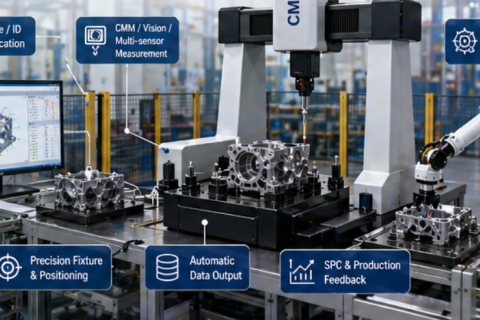
Building an automated dimensional inspection system for manufacturing lines requires a complete evaluation of inspection requirements, measurement technology, fixtures, loading method, software workflow, data output, environment, safety, and validation process. A successful system should not only measure parts accurately, but also provide fast feedback to production, reduce operator variation, improve process control, and support traceable quality data. By preparing drawings, tolerance requirements, production rhythm, line layout, and data integration needs before quotation, buyers can build a more practical and reliable automated inspection solution.
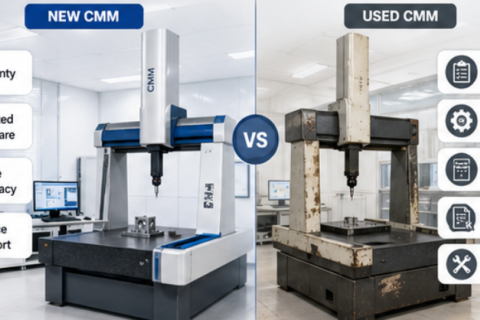
Both new CMM and used CMM options can be reasonable depending on the buyer’s budget, application, accuracy requirement, and risk tolerance. A new CMM usually offers better warranty, updated software, easier configuration, and stronger long-term support. A used CMM may reduce initial investment, but buyers must carefully check calibration, mechanical condition, controller compatibility, software license, probe system, spare parts, and total ownership cost. The best choice is the machine that can provide reliable, repeatable, and supported measurement results for your real inspection tasks.
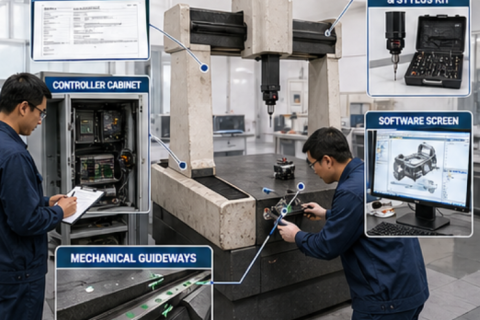
Choosing a CMM fixture for repeatable part measurement requires careful evaluation of datum location, clamping force, part support, fixture rigidity, probe clearance, material stability, loading speed, and compatibility with the CMM program. A suitable fixture should hold the part in a consistent position without deformation and allow all critical features to be measured safely. For batch production and precision inspection, the fixture should be designed together with the probe system, measurement software, and inspection workflow. A well-designed fixture can improve repeatability, reduce operator variation, shorten inspection time, and support more reliable dimensional quality control.
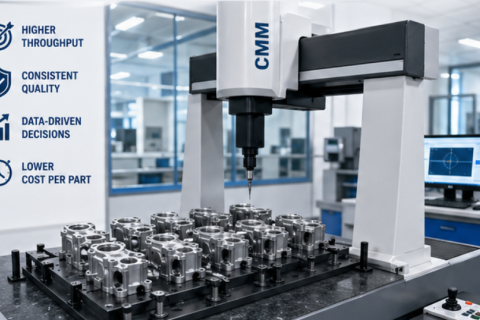
Improving CMM inspection efficiency in batch production requires a complete workflow approach. Manufacturers should reduce setup time with repeatable fixtures, optimize probe and stylus configurations, standardize CNC measurement programs, automate report generation, prepare parts before inspection, train operators, and use data output for production feedback. When volume is high, semi-automation or full automation may further improve productivity. A well-designed CMM inspection process can reduce bottlenecks, improve repeatability, support faster quality decisions, and strengthen production quality control.
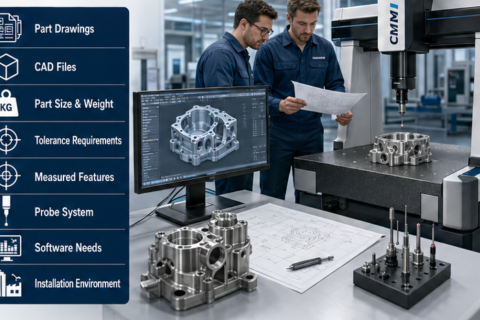
A coordinate measuring machine quotation should be based on real inspection needs, not only a general machine model. Buyers should prepare part drawings, CAD files, size, weight, tolerance requirements, measured features, software needs, probe requirements, fixture information, production volume, installation conditions, and future upgrade plans. Complete information allows the supplier to recommend a CMM system that fits the application, controls cost, improves inspection reliability, and supports long-term quality management.
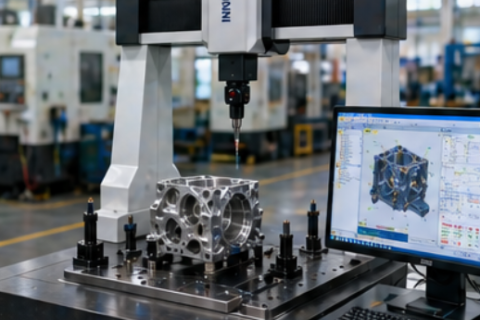
Choosing a shop-floor CMM for production quality control requires a balance between measurement accuracy, environmental resistance, workflow efficiency, software reporting, and production integration. Buyers should evaluate the installation site, part tolerances, measuring range, probe system, fixture design, software functions, operator process, and future automation needs. A well-selected shop-floor CMM can shorten inspection feedback time, reduce production risk, improve process control, and support more stable quality management near the production line.
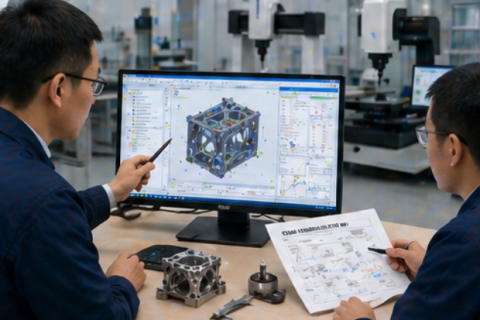
CMM and vision measuring machines are both valuable inspection tools, but they serve different purposes. A CMM is better for 3D geometry, precision machined parts, datums, GD&T, deep features, and complex industrial inspection. A vision measuring machine is better for fast non-contact inspection of small, thin, flat, delicate, or high-volume parts with visible features. The right choice depends on part geometry, tolerance, material, measurement speed, software requirements, and production workflow. By preparing real drawings, sample parts, and inspection requirements before quotation, buyers can choose a more suitable and cost-effective measurement solution.
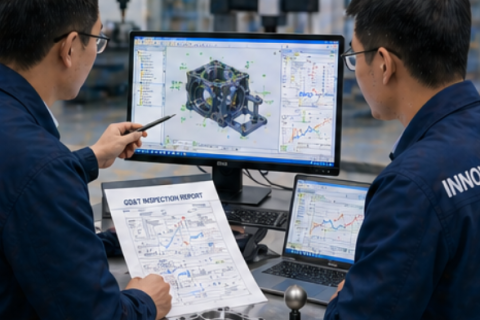
Selecting CMM measurement software for GD&T inspection requires more than checking whether the software can generate a basic report. Buyers should evaluate CAD import, datum alignment, GD&T calculation, probe compatibility, programming efficiency, reporting flexibility, traceability, data output, and operator usability. The right software should help quality teams measure complex parts accurately, reduce manual errors, standardize inspection methods, and generate clear reports for production control and customer approval. By testing the software with real drawings and inspection requirements before purchase, buyers can reduce risk and build a more reliable CMM inspection process.
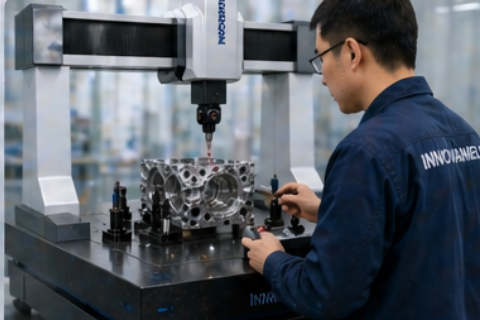
CMM calibration and acceptance testing are critical steps in a successful coordinate measuring machine purchase. Calibration verifies measurement accuracy, while acceptance testing confirms that the complete system meets the buyer’s technical and practical requirements. Before final approval, buyers should check machine configuration, accuracy results, probe qualification, software functions, environmental conditions, training, documents, and practical inspection performance. A clear acceptance process helps reduce measurement risk, improve audit readiness, and build long-term confidence in the CMM inspection system.
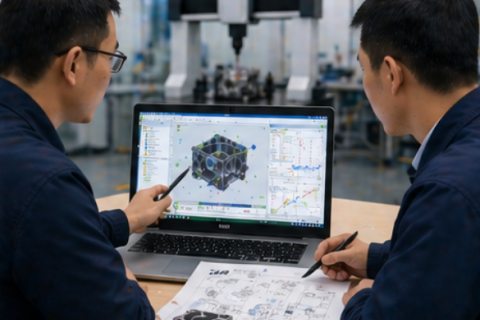
Choosing a bridge CMM for precision machined parts requires a complete evaluation of part size, tolerance, measuring range, accuracy, repeatability, probe access, fixture design, software capability, and installation environment. A suitable bridge CMM should not only meet catalog specifications, but also support real inspection tasks with stable, repeatable, and useful measurement results. By preparing drawings, CAD files, tolerance data, and workflow requirements before quotation, buyers can reduce configuration risk and select a more reliable CMM solution for precision machining quality control.