


What Information Is Needed Before Quoting A Coordinate Measuring Machine
2026-05-16 23:08What Information Is Needed Before Quoting A Coordinate Measuring Machine?
Requesting a quote for a coordinate measuring machine is not the same as asking for a standard product price. A CMM must match the buyer’s part size, tolerance level, inspection task, measuring range, probe system, software requirements, fixture method, installation environment, and future quality control plan. If the information provided is incomplete, the quotation may be inaccurate or the recommended machine may not fit the real application. This guide explains what information buyers should prepare before requesting a CMM quotation.
Quick Answer
Before quoting a coordinate measuring machine, buyers should provide part drawings, CAD files, maximum part size and weight, tolerance requirements, inspection features, material type, production volume, required accuracy, probe needs, software and reporting requirements, installation environment, and future automation plans. Complete information helps the supplier recommend a suitable CMM configuration instead of only giving a rough machine price.
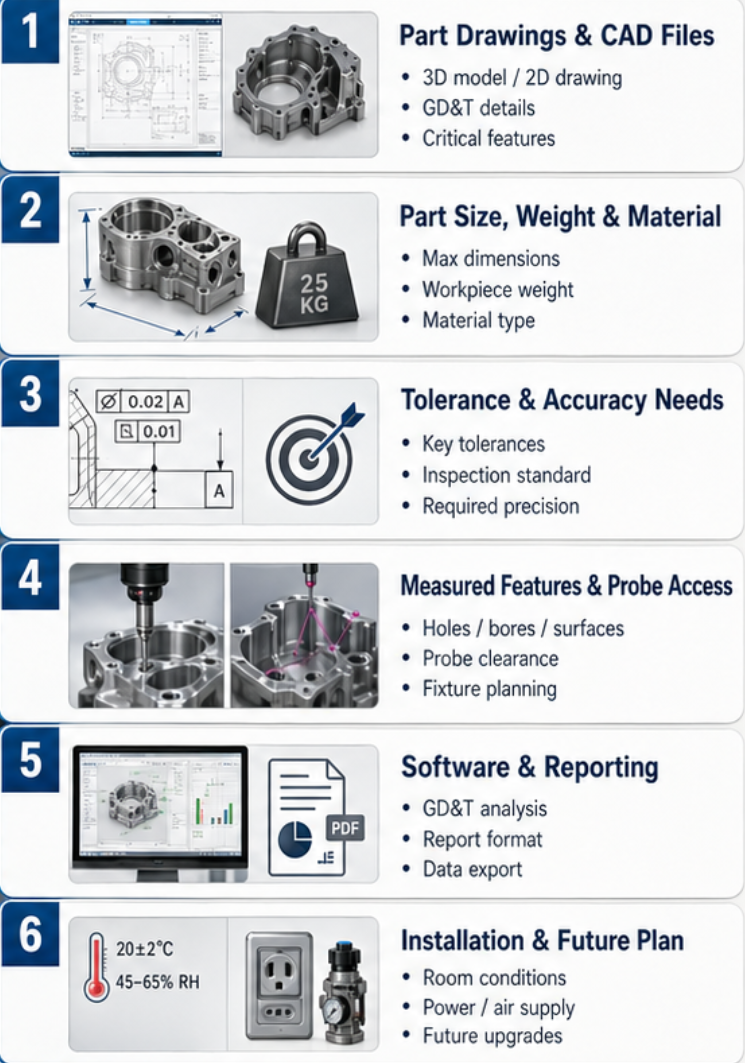
1. Part Drawings And CAD Files
The most important information for a CMM quotation is the part drawing or CAD file. Drawings show the dimensions, tolerances, datum references, critical features, and GD&T requirements. CAD files help the technical team understand the part geometry, measurement path, probe access, and software programming needs.
Without drawings or CAD files, the supplier can only provide a general recommendation. This may lead to a machine that is too small, too expensive, under-specified, or not suitable for the inspection task. For complex parts such as automotive housings, aerospace brackets, mold inserts, turbine blades, and precision machined components, CAD data is especially useful.
If full drawings cannot be shared at the beginning, buyers can provide simplified dimensions, sample photos, key tolerance information, and the main features to be inspected. This still helps improve quotation accuracy.
2. Maximum Part Size, Weight And Measuring Range
A CMM quotation must be based on the largest part that needs to be measured. Buyers should provide the maximum part length, width, height, and weight. The supplier also needs to know whether the part will be placed directly on the granite table or held by a fixture.
Measuring range should include more than the part envelope. It should also allow enough space for fixtures, clamps, probe movement, stylus clearance, and safe loading. A machine that barely fits the part may become difficult to use in real inspection.
| Information Needed | What To Provide | Why It Matters |
|---|---|---|
| Part Size | Maximum length, width, and height | Determines the basic CMM measuring range |
| Part Weight | Maximum workpiece weight | Affects table capacity and loading method |
| Fixture Space | Fixture height, base plate, clamps, locating pins | Prevents insufficient working volume |
| Probe Clearance | Probe head, stylus length, movement path | Ensures all features can be reached safely |
| Future Parts | Possible new part sizes or product families | Improves long-term machine usability |

3. Tolerance Requirements And Accuracy Expectations
The required CMM accuracy depends on the part tolerance. Buyers should provide the smallest tolerance that must be verified, the critical dimensions, and any GD&T items that are important for quality control. This helps determine whether a standard machine is enough or whether higher accuracy, better repeatability, or special probing strategies are needed.
Buyers should avoid simply asking for the “most accurate” CMM. Over-specification may increase cost without improving production value. Under-specification may create unreliable measurement results. A good quotation should match the actual tolerance requirement and inspection confidence needed by the buyer.
Accuracy Information To Provide
Smallest tolerance to be verified
Critical dimensions and functional features
Required GD&T items such as position, flatness, profile, or runout
Need for batch repeatability or first article inspection
Customer acceptance or audit requirements
Required calibration and accuracy documentation
4. Measured Features And Inspection Purpose
Different inspection tasks require different CMM configurations. Buyers should explain what features need to be measured: holes, bores, planes, slots, curves, profiles, deep features, thin walls, datum surfaces, or assembly interfaces. The supplier also needs to know whether the CMM is used for incoming inspection, first article inspection, process control, final inspection, or reverse engineering.
If the part has difficult-to-reach features, the quotation may need special styli, angled probes, star styli, scanning probes, or a customized fixture. If the part requires profile or surface inspection, software capability and probe selection become more important.
| Inspection Need | Quotation Impact |
|---|---|
| Hole position and bore measurement | Probe access, stylus length, GD&T software |
| Flatness, perpendicularity, and datum surfaces | Datum strategy, fixture support, software calculation |
| Profile and complex surface inspection | Scanning probe, CAD comparison, advanced software |
| Batch production inspection | CNC programs, repeatable fixtures, automatic reports |
| First article inspection | Complete GD&T report, traceability, software capability |
5. Probe System, Fixture And Software Requirements
A useful CMM quotation should include more than the machine body. The probe system, stylus configuration, fixture plan, and measurement software can strongly affect the final cost and inspection capability. Buyers should tell the supplier whether they need touch trigger probing, scanning measurement, automatic probe changing, special styli, dedicated fixtures, or advanced GD&T software.
Reporting requirements are also important. Some buyers only need basic dimensional reports. Others need CAD-based reports, GD&T analysis, SPC data output, customer-specific templates, or traceability records. These requirements should be confirmed before quotation so the software package is not under-specified.
System Configuration Information
Touch trigger probe or scanning probe requirement
Special stylus, angled stylus, star stylus, or extensions
Dedicated fixture or universal fixture requirement
CAD import, offline programming, and GD&T software needs
Inspection report format and customer documentation needs
SPC, MES, ERP, or data export requirements
6. Installation Environment And Site Conditions
The installation environment affects CMM performance and may also influence the quotation. Buyers should explain whether the machine will be installed in a controlled metrology room, quality lab, shop-floor area, or near production equipment. Temperature fluctuation, vibration, dust, humidity, oil mist, and compressed air quality should be considered.
If the environment is challenging, the supplier may recommend environmental control, vibration isolation, temperature compensation, protective measures, or a different machine configuration. Providing site information early helps avoid installation problems later.
| Site Information | What To Confirm |
|---|---|
| Installation Area | Metrology room, quality lab, shop-floor, or near production line |
| Temperature | Room stability, daily fluctuation, heat sources, part temperature |
| Vibration | Nearby CNC machines, presses, compressors, forklifts, floor condition |
| Utilities | Power supply, grounding, compressed air, air quality |
| Layout | Machine footprint, loading route, crane access, operator space |
7. Production Volume, Automation And Future Upgrade Plan
The quotation should also reflect how often the CMM will be used. A machine for occasional sample inspection may require a different configuration from a machine used for daily batch production. If the buyer needs repeated programs, fast loading, automatic reports, barcode identification, or data connection with production systems, this should be discussed before quotation.
Buyers should also mention future plans. If automation, additional probes, larger parts, more operators, or software upgrades may be needed later, the supplier can recommend a platform that supports expansion instead of a limited configuration.
8. Final CMM Quotation Checklist
Part drawings and CAD files
Maximum part size, weight, and material
Critical dimensions and tolerance requirements
GD&T symbols, datum references, and inspection standards
Main features to be measured
Inspection purpose and production volume
Required measuring range and fixture space
Probe system, stylus, scanning, and fixture needs
Software functions, report format, and data output requirements
Installation environment and site layout
Calibration, acceptance testing, training, and after-sales requirements
Future automation or expansion plans
Preparing this information before requesting a quote helps the supplier recommend the right CMM solution faster and reduces the risk of configuration mismatch.
Conclusion
A coordinate measuring machine quotation should be based on real inspection needs, not only a general machine model. Buyers should prepare part drawings, CAD files, size, weight, tolerance requirements, measured features, software needs, probe requirements, fixture information, production volume, installation conditions, and future upgrade plans. Complete information allows the supplier to recommend a CMM system that fits the application, controls cost, improves inspection reliability, and supports long-term quality management.
Need A Coordinate Measuring Machine Quotation?
Contact us with your part drawings, tolerance requirements, measuring range, software needs, probe configuration, and installation conditions. We can help you evaluate a suitable CMM solution for your inspection task.