


How To Build An Automated Dimensional Inspection System For Manufacturing Lines
2026-05-20 23:25How To Build An Automated Dimensional Inspection System For Manufacturing Lines
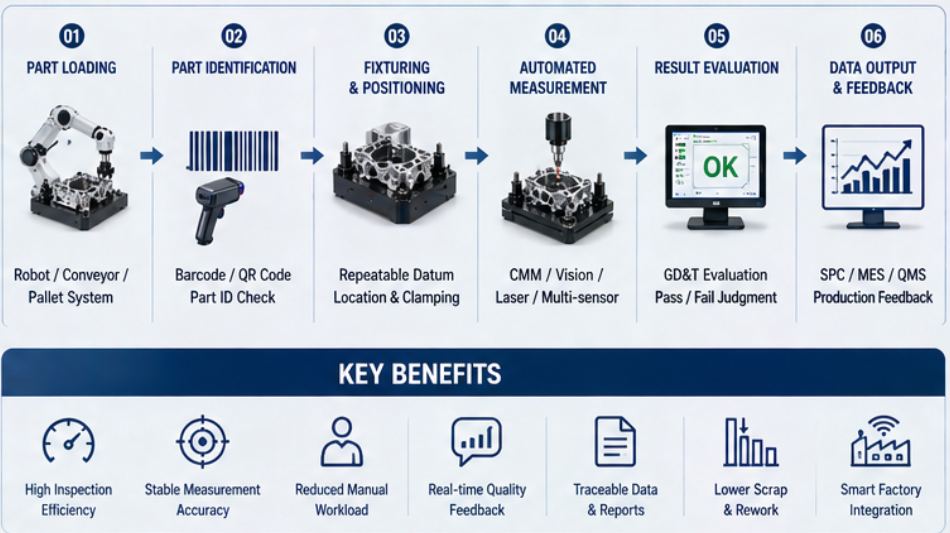
Automated dimensional inspection is becoming increasingly important for manufacturing lines that require stable quality control, faster feedback, reduced manual inspection workload, and traceable production data. Instead of relying only on offline measurement or manual checking, an automated inspection system can combine CMM technology, vision measurement, probes, fixtures, robots, conveyors, barcode identification, software reporting, and production data integration. For automotive parts, precision machined components, electronics, medical devices, molds, castings, and high-volume manufacturing, a well-designed automated dimensional inspection system can improve consistency, reduce scrap, and support data-driven process control.
Quick Answer
To build an automated dimensional inspection system for manufacturing lines, buyers should define inspection requirements, choose suitable measurement technology, design repeatable fixtures, plan part loading and unloading, integrate measurement software, connect data output with production systems, control the inspection environment, and verify system repeatability before full production use. The system should be designed around real parts, real tolerances, real cycle time, and real quality control goals.
1. Start With The Real Inspection Requirement
An automated dimensional inspection system should not start from equipment selection. It should start from the actual inspection task. Buyers should first define what parts need to be measured, which features are critical, how tight the tolerances are, how often the parts need inspection, and how quickly the results must return to production.
Some manufacturing lines only need key feature inspection for process control. Others require full dimensional reports, GD&T evaluation, profile measurement, first article inspection, or automatic pass/fail decisions. The inspection depth affects equipment type, sensor selection, fixture design, software functions, cycle time, and automation cost.
A clear inspection requirement helps avoid over-automation and under-configuration. The best automated inspection system should solve real production quality problems, not simply add complex equipment to the line.
2. Choose The Right Measurement Technology
Different manufacturing lines require different measurement technologies. A CMM-based system is suitable for 3D geometry, datum-based measurement, deep features, holes, bores, planes, and GD&T inspection. A vision measuring system is suitable for fast non-contact inspection of small, thin, flat, delicate, or visible features. Laser scanning or multi-sensor systems may be useful when complex surfaces, profiles, or mixed inspection needs are involved.
| Inspection Task | Suitable Technology | Typical Application |
|---|---|---|
| 3D dimensional inspection | CMM or automated CMM system | Machined parts, housings, brackets, automotive components |
| Fast 2D feature inspection | Vision measuring machine or optical inspection system | Electronics, connectors, stamped parts, gaskets, films |
| Complex surface and profile inspection | Scanning probe, laser scanner, or multi-sensor system | Molds, turbine blades, castings, freeform parts |
| High-volume pass/fail inspection | Automated fixture, vision, CMM, or hybrid system | Production lines requiring fast quality feedback |
| Traceable GD&T reporting | CMM with advanced measurement software | Automotive, aerospace, medical, precision machining |
The measurement technology should be selected according to part geometry, tolerance, surface condition, required speed, and reporting needs. In many manufacturing lines, a hybrid system may be more practical than using only one sensor.
3. Design Repeatable Fixtures And Part Positioning
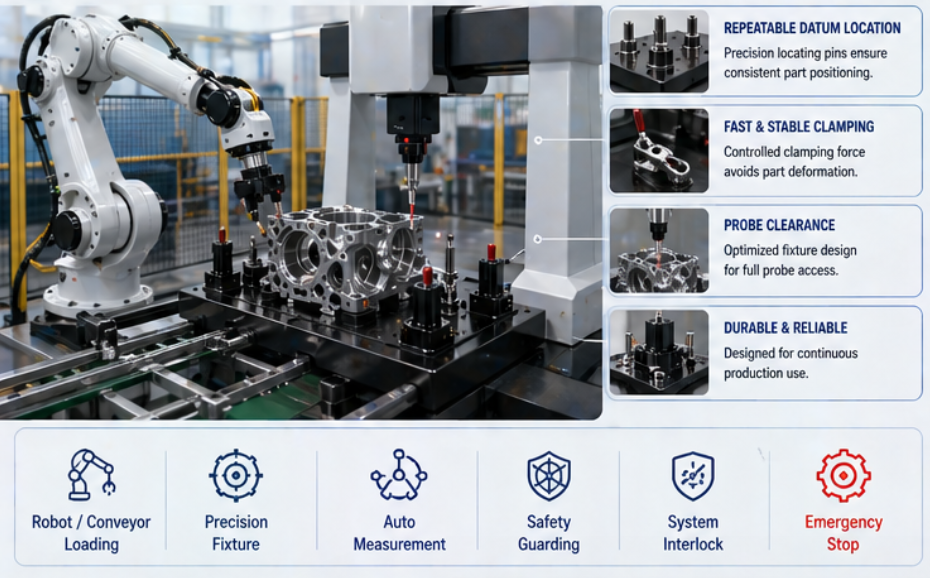
Fixture repeatability is one of the most important factors in automated dimensional inspection. If the part is not positioned consistently, the measurement system may produce unstable data even when the machine itself is accurate. The fixture should locate the part according to the correct datum structure, support the workpiece without deformation, and allow sensors or probes to reach all required features.
In automated lines, fixtures must also support fast loading, safe clamping, sensor clearance, and repeatable release. If robots or conveyors are used, the fixture should be designed together with the loading method. For multi-part inspection, the fixture must maintain stable positioning for every part location.
Fixture Design Checklist
Does the fixture locate the part according to functional datums?
Can the part be loaded in the same position every cycle?
Is clamping force controlled to avoid deformation?
Is there enough clearance for probes, cameras, or scanners?
Can the fixture support robot loading or conveyor transfer?
Is the fixture durable enough for repeated production use?
4. Plan Part Loading, Unloading And Line Integration
Automated inspection should be planned together with the manufacturing line layout. Parts may be loaded manually, by robot, conveyor, pallet system, rotary table, or automatic transfer unit. The right method depends on part weight, cycle time, production volume, safety requirements, and line space.
For high-volume production, automatic loading can reduce operator workload and improve consistency. For medium-volume or mixed-part production, semi-automatic loading may provide a better balance between flexibility and cost. The inspection system should not slow down the manufacturing line unless the quality value justifies the cycle time.
| Loading Method | Best For | Main Benefit |
|---|---|---|
| Manual loading | Low to medium volume, flexible inspection | Lower automation cost and easier part changeover |
| Robot loading | High-volume repeated parts | Reduces manual handling and improves consistency |
| Conveyor transfer | Inline inspection and continuous production | Connects measurement directly with production flow |
| Pallet or fixture system | Batch inspection and part family production | Improves repeatable positioning and changeover control |
| Rotary table | Multi-station inspection workflow | Allows loading and measuring in parallel |
5. Build Measurement Software And Data Workflow
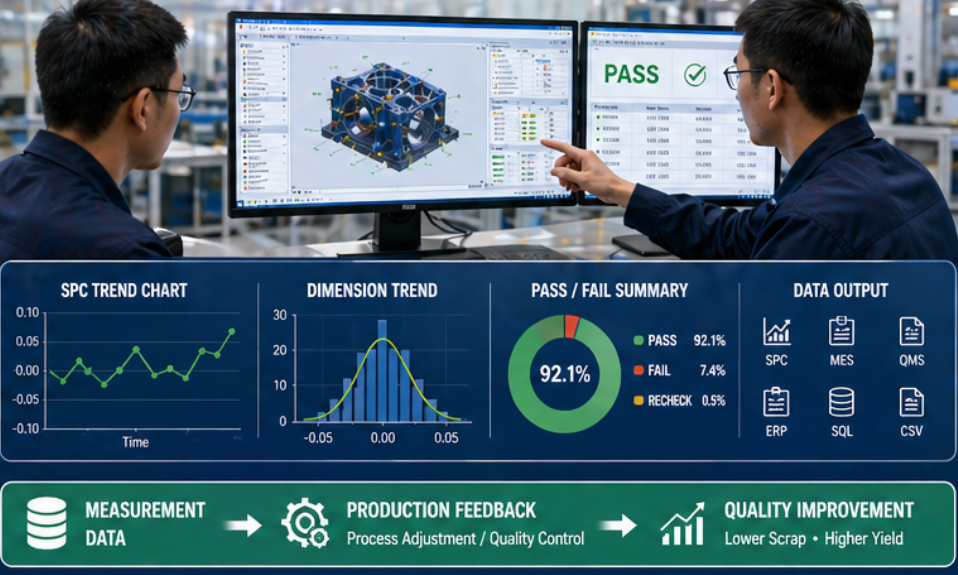
Software is the center of an automated dimensional inspection system. It controls measurement programs, sensor operation, part identification, report generation, data output, and quality decisions. Buyers should check whether the software supports CAD import, GD&T evaluation, automatic program selection, barcode or QR code input, SPC output, pass/fail judgment, and integration with production systems.
For manufacturing lines, inspection data should not stay only inside the measurement machine. It should support production feedback. If a dimension trends toward the tolerance limit, the system should help engineers identify process drift early. This can reduce scrap, rework, and customer quality issues.
Software And Data Checklist
Automatic measurement program execution
Barcode, QR code, or part ID recognition
CAD import and GD&T inspection capability
Automatic report generation and pass/fail judgment
SPC data output and trend analysis
Data export for MES, ERP, QMS, or internal quality systems
Alarm or feedback when dimensions approach control limits
Program version control and traceability records
6. Control Environment, Safety And System Reliability
Automated inspection systems used near manufacturing lines may face temperature fluctuation, vibration, dust, oil mist, operator traffic, robot movement, and changing production conditions. These factors can affect measurement stability and system reliability. Before installation, buyers should evaluate the site environment and decide whether environmental control, vibration isolation, air filtration, enclosure protection, or temperature compensation is needed.
Safety is also important. If the system includes robots, conveyors, automatic doors, moving probes, or loading stations, the layout should include safety barriers, interlocks, emergency stops, collision prevention, and clear operator procedures. Reliability depends not only on machine accuracy but also on safe and stable daily operation.
| System Factor | What To Check | Why It Matters |
|---|---|---|
| Temperature | Part temperature, room fluctuation, heat sources | Reduces measurement drift |
| Vibration | Nearby machines, robot movement, floor condition | Improves repeatability and measurement stability |
| Cleanliness | Dust, oil mist, coolant, chips, air quality | Protects sensors, probes, fixtures, and workpieces |
| Safety | Robot area, guarding, emergency stop, interlock | Protects operators and equipment |
| Maintenance | Sensor cleaning, fixture wear, probe calibration, system backup | Keeps system stable over long-term production |
7. Validate The System Before Full Production
Before an automated dimensional inspection system is used in full production, it should be validated with real parts, real fixtures, real programs, and real production conditions. The validation process should check repeatability, cycle time, measurement accuracy, loading stability, report output, data connection, and abnormal result handling.
Buyers should not only test whether the machine can measure one good part. They should test how the system performs across repeated cycles, different operators, different batches, and possible production variation. This helps prevent hidden problems after the system is installed on the line.
System Validation Checklist
Repeatability test with multiple measurement cycles
Accuracy verification using reference parts or calibrated artifacts
Cycle time test compared with production takt time
Fixture loading and unloading stability check
Probe, camera, or sensor calibration verification
Report output and data export test
Pass/fail decision verification with known good and bad samples
Abnormal handling test for missing part, wrong part, or failed measurement
8. What Information Should Buyers Prepare Before Quotation?
Automated dimensional inspection projects require more information than a standard machine quote. The supplier needs to understand the part, process, line layout, inspection speed, automation method, software requirements, and quality data goals before recommending a system.
Recommended Information Checklist
Part drawings, CAD files, and tolerance requirements
Critical dimensions, GD&T items, and inspection standards
Part size, weight, material, surface condition, and production volume
Required cycle time and production takt time
Current line layout, loading method, and available installation space
Manual, robot, conveyor, pallet, or rotary table loading preference
Required measurement technology: CMM, vision, laser, scanning, or multi-sensor
Software reporting, SPC, MES, ERP, QMS, or data output requirements
Environmental conditions such as temperature, vibration, dust, and oil mist
Safety, maintenance, training, and after-sales support expectations
9. Common Mistakes To Avoid
Starting with automation hardware before defining inspection requirements.
Choosing measurement technology without checking real part features and tolerances.
Ignoring fixture repeatability and part positioning stability.
Designing robot loading without considering probe or sensor clearance.
Building data output without a clear production feedback process.
Underestimating temperature, vibration, dust, and shop-floor environment risks.
Failing to validate repeatability and cycle time under real production conditions.
Over-automating a process that still needs flexible manual handling.
Not planning maintenance, calibration, operator training, and long-term support.
Avoiding these mistakes helps manufacturers build an automated inspection system that is reliable, practical, and useful for real production quality control.
Conclusion
Building an automated dimensional inspection system for manufacturing lines requires a complete evaluation of inspection requirements, measurement technology, fixtures, loading method, software workflow, data output, environment, safety, and validation process. A successful system should not only measure parts accurately, but also provide fast feedback to production, reduce operator variation, improve process control, and support traceable quality data. By preparing drawings, tolerance requirements, production rhythm, line layout, and data integration needs before quotation, buyers can build a more practical and reliable automated inspection solution.
Need An Automated Dimensional Inspection System?
Contact us to discuss your manufacturing line, part drawings, tolerance requirements, cycle time, fixture needs, measurement technology, software reporting, and data integration plan. We can help you evaluate a suitable automated inspection solution for stable production quality control.