



How To Choose A Shop-Floor CMM For Production Quality Control
2026-05-15 23:05How To Choose A Shop-Floor CMM For Production Quality Control
A shop-floor coordinate measuring machine can help manufacturers move inspection closer to production, shorten feedback time, reduce rework, and improve process control. Unlike a traditional CMM installed in a controlled metrology room, a shop-floor CMM must handle more challenging conditions such as temperature variation, vibration, dust, oil mist, operator traffic, and fast production rhythm. Choosing the right shop-floor CMM is not only about accuracy. Buyers should evaluate machine structure, environmental stability, probe system, fixture design, software workflow, automation potential, and daily quality control requirements.
Quick Answer
To choose a shop-floor CMM for production quality control, buyers should check environmental resistance, temperature compensation, vibration control, measuring range, repeatability, probe protection, fixture loading speed, software reporting, operator usability, and data connection with production systems. A good shop-floor CMM should provide reliable measurement results while supporting faster inspection feedback near the production line.
1. Understand Why Shop-Floor CMM Is Different From Lab CMM
A traditional CMM is usually installed in a metrology room where temperature, humidity, cleanliness, and vibration are easier to control. A shop-floor CMM works closer to machining centers, assembly lines, operators, forklifts, and production equipment. This gives faster measurement feedback, but it also creates more environmental challenges.
The main value of a shop-floor CMM is speed of quality response. When parts are measured near production, engineers can identify process deviation earlier and adjust machining, tooling, fixture, or assembly conditions before more defective parts are produced. This is useful for automotive parts, precision machined components, castings, molds, fixtures, aerospace parts, and batch production quality control.
However, buyers should not simply move a standard lab CMM to the shop floor. The machine, installation environment, protection level, workflow, and operator process must be suitable for production-side use.
2. Check Environmental Stability First
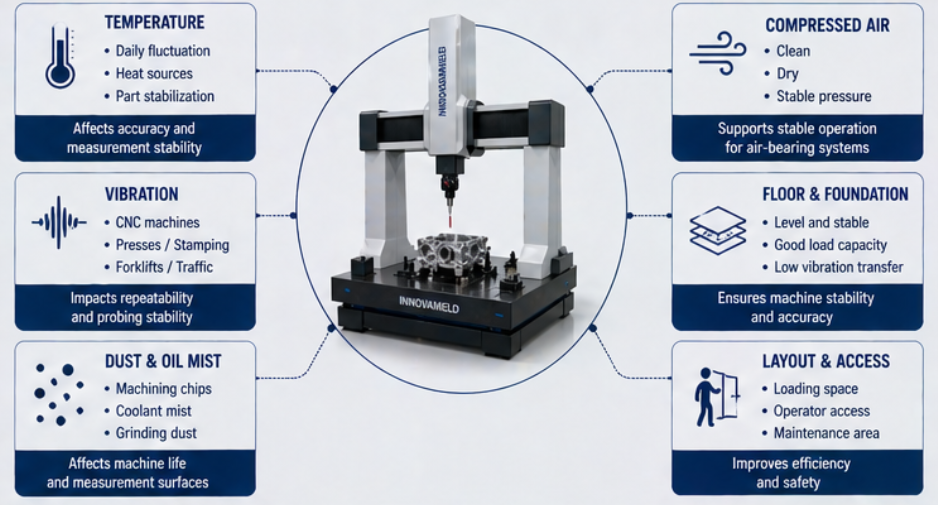
The biggest challenge for shop-floor CMM inspection is the working environment. Temperature changes, vibration, dust, oil mist, air flow, and unstable floor conditions can all affect measurement repeatability. Before selecting a machine, buyers should evaluate the actual installation site and identify possible risks.
If the production area has strong vibration from CNC machines, stamping equipment, compressors, or forklifts, the CMM may require vibration isolation or a better installation location. If temperature changes significantly during the day, temperature compensation and part stabilization procedures may be necessary.
| Shop-Floor Factor | What Buyers Should Check | Why It Matters |
|---|---|---|
| Temperature | Daily fluctuation, nearby heat sources, part temperature | Reduces thermal drift and measurement variation |
| Vibration | Nearby machines, forklifts, compressors, floor stability | Improves repeatability and probing stability |
| Dust And Oil Mist | Machining area, grinding dust, coolant mist, chips | Protects machine reliability and measurement surfaces |
| Air Supply | Clean, dry, stable compressed air if required | Supports stable machine operation |
| Layout | Loading path, operator access, safety distance, maintenance space | Improves daily inspection efficiency and safety |
3. Match Machine Accuracy With Real Production Tolerances
Shop-floor CMM selection should be based on actual production tolerances. Buyers should not focus only on the highest catalog accuracy. A machine with excellent laboratory accuracy may not deliver the same performance if used in an unstable production environment. The better question is whether the CMM can provide reliable results for the required tolerances under real shop-floor conditions.
Repeatability is especially important for production quality control. If the same feature is measured several times and results vary too much, operators may not trust the data. This can create unnecessary rechecking, production delays, or quality disputes. A suitable shop-floor CMM should provide stable repeatability for the parts and inspection tasks used every day.
Buyers should compare machine accuracy, part tolerance, fixture repeatability, probe strategy, and environmental influence together. Shop-floor inspection is a system decision, not only a machine specification decision.
4. Choose Measuring Range Based On Parts, Fixtures And Loading
Measuring range should be selected according to the largest production part, fixture height, clamping method, probe movement, stylus clearance, and future product changes. In shop-floor inspection, loading efficiency is also important. Operators may need to load parts quickly, use lifting equipment, or change fixtures frequently.
If the working volume is too small, the probe may not reach all required features after the fixture is installed. If the machine layout is not practical, operators may waste time loading parts or adjusting workpieces. For production quality control, measuring range and workflow must be evaluated together.
Measuring Range Checklist
Maximum part length, width, height, and weight
Fixture base height and clamping space
Probe head, stylus length, and movement path
Loading direction and operator access
Future part size changes or new production programs
Safe distance from nearby machines or production traffic
5. Evaluate Probe System, Fixture Design And Operator Workflow
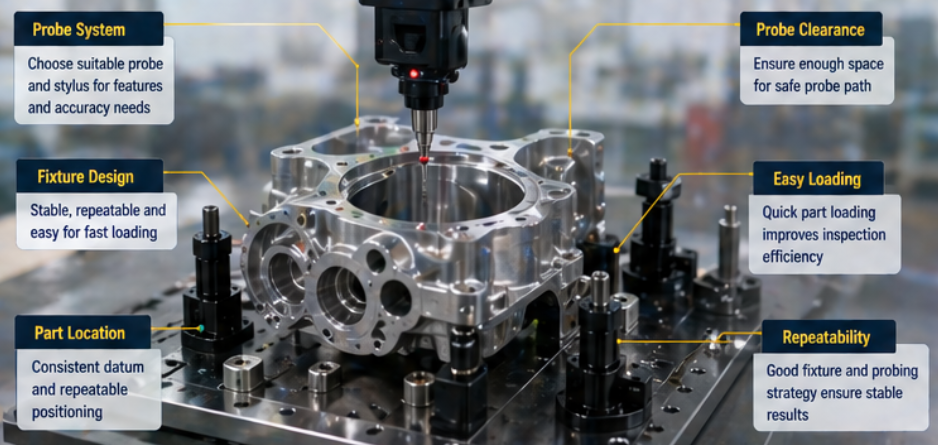
A shop-floor CMM must support fast and repeatable inspection. The probe system should match the measured features and daily workload. Touch trigger probes are commonly used for holes, planes, slots, edges, and standard dimensional checks. Scanning probes may be useful for profiles, complex surfaces, or parts that require more data points.
Fixture design is equally important. Production inspection usually requires repeated loading and unloading of similar parts. A good fixture should locate the part quickly, support the correct datum references, avoid deformation, and allow safe probe access. Poor fixture repeatability can make even a good CMM produce unstable results.
Operator workflow should be simple and standardized. If shop-floor operators need too many manual steps, inspection speed may decline and measurement variation may increase. The best system should make correct measurement easy to repeat.
6. Software Must Support Fast Production Feedback
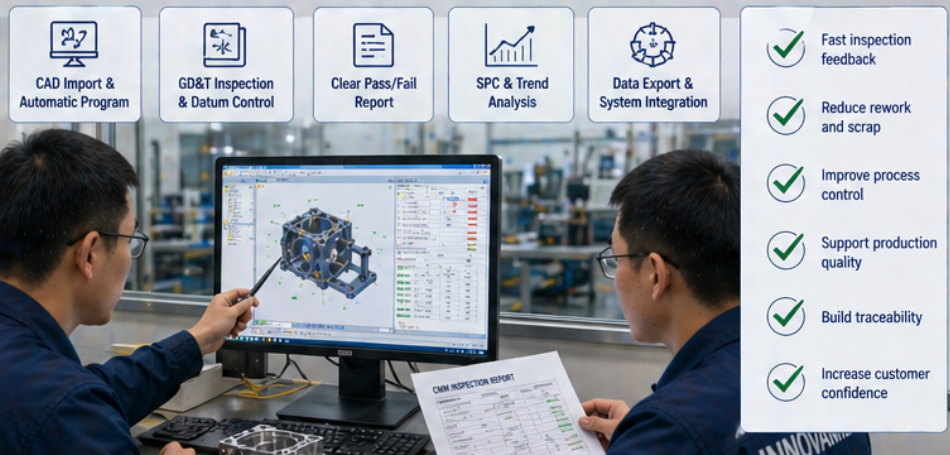
Shop-floor CMM software should not only calculate measurement results. It should help production teams make faster decisions. Buyers should check whether the software supports automatic programs, CAD import, GD&T inspection, clear pass/fail reports, SPC output, barcode identification, data export, and simple operator interfaces.
In production quality control, reports must be easy to understand. Operators, quality engineers, and production supervisors should be able to identify whether the part is acceptable, which dimensions are out of tolerance, and whether the process is trending in the wrong direction.
| Software Function | Production Value |
|---|---|
| Automatic Measurement Program | Reduces operator variation and improves repeatability |
| Clear Pass/Fail Report | Helps production teams make faster quality decisions |
| SPC Data Output | Supports process trend analysis and defect prevention |
| Barcode Or Part ID Input | Improves traceability and reduces program selection errors |
| Data Export | Connects inspection results with quality or production systems |
7. Consider Automation And Data Integration
Not every shop-floor CMM needs full automation. However, buyers should consider whether future production may require automatic loading, automatic program selection, barcode scanning, automatic report output, or connection with SPC, MES, or other quality systems. Planning for future data integration can reduce upgrade difficulty later.
For high-volume production, an automated or semi-automated workflow can reduce manual handling, improve inspection consistency, and provide faster feedback to production. For lower-volume production, a standard CNC shop-floor CMM with good fixture design and clear software reporting may be enough.
The automation level should match real production volume, part stability, operator skill, and return on investment.
8. What Information Should Buyers Prepare Before Quotation?
To recommend a suitable shop-floor CMM, the supplier needs to understand the parts, production rhythm, quality requirements, and installation environment. Buyers should prepare more than part drawings. They should also provide information about inspection frequency, site condition, production layout, and reporting needs.
Recommended Information Checklist
Part drawings, CAD files, and tolerance requirements
Maximum part size, weight, and material
Inspection frequency and production batch volume
Required features, datums, and GD&T items
Current inspection problems or quality risks
Installation site temperature, vibration, dust, and layout conditions
Need for fixtures, probes, software reports, SPC, or data output
Future plans for automation or production data integration
9. Common Mistakes To Avoid
Moving a standard lab CMM to the shop floor without checking environmental suitability.
Choosing a machine only by catalog accuracy without considering real production conditions.
Ignoring temperature fluctuation, vibration, dust, and oil mist around the installation site.
Selecting measuring range without considering fixture space and loading workflow.
Using unstable fixtures that reduce repeatability in batch inspection.
Buying software that cannot provide fast pass/fail reports or production data output.
Ignoring operator training and standard inspection procedures.
Not planning for future automation or quality data integration.
Avoiding these mistakes helps manufacturers build a shop-floor measurement process that is both practical and reliable.
Conclusion
Choosing a shop-floor CMM for production quality control requires a balance between measurement accuracy, environmental resistance, workflow efficiency, software reporting, and production integration. Buyers should evaluate the installation site, part tolerances, measuring range, probe system, fixture design, software functions, operator process, and future automation needs. A well-selected shop-floor CMM can shorten inspection feedback time, reduce production risk, improve process control, and support more stable quality management near the production line.
Need A Shop-Floor CMM For Production Quality Control?
Contact us to discuss your production parts, tolerance requirements, inspection frequency, shop-floor environment, software needs, and automation plan. We can help you evaluate a suitable CMM solution for reliable production quality control.