


CMM vs Vision Measuring Machine: Which One Is Better For Your Inspection Task
2026-05-14 23:01CMM vs Vision Measuring Machine: Which One Is Better For Your Inspection Task?
Coordinate measuring machines and vision measuring machines are both important tools for dimensional inspection, but they are designed for different measurement tasks. A CMM is often used for 3D dimensional inspection, complex geometry, GD&T evaluation, datum-based measurement, and parts requiring probe contact or scanning. A vision measuring machine is often used for fast non-contact inspection of small, thin, flat, delicate, or high-volume parts. Choosing between these two systems depends on part size, material, geometry, tolerance, inspection speed, feature accessibility, and reporting requirements. This guide helps buyers understand the difference and choose the right inspection equipment for their application.
Quick Answer
A CMM is better for 3D parts, complex geometries, datums, deep features, GD&T inspection, and precision machined components. A vision measuring machine is better for fast non-contact measurement of small, thin, flat, delicate, transparent, or high-volume parts. If your inspection requires both 3D contact measurement and optical feature measurement, a multi-sensor solution may be worth considering.
1. What Is A Coordinate Measuring Machine?
A coordinate measuring machine, or CMM, measures the three-dimensional coordinates of a workpiece. It usually uses a touch trigger probe, scanning probe, or other sensor to collect measurement data from physical features. CMM systems are widely used for precision machined parts, automotive components, aerospace parts, molds, tooling, fixtures, and industrial quality control.
The main strength of a CMM is its ability to measure 3D geometry and datum relationships. It can inspect holes, bores, planes, slots, angles, profiles, curved surfaces, and complex GD&T requirements. For parts with strict dimensional tolerances and functional assembly relationships, a CMM is often the more reliable choice.
However, a CMM may not always be the fastest or most suitable option for very small, thin, flexible, or delicate parts where contact measurement could deform the workpiece or where many 2D features must be checked quickly.
2. What Is A Vision Measuring Machine?
A vision measuring machine uses optical imaging, camera systems, lenses, lighting, and software to measure part features without physical contact. It is commonly used for 2D and 2.5D inspection of small components, thin parts, electronic parts, plastic parts, stamped parts, rubber parts, gaskets, films, PCB components, connectors, and precision parts with visible edges.
The main advantage of a vision measuring machine is fast non-contact measurement. It can measure edges, contours, holes, slots, distances, angles, radii, and surface features quickly when the features are clearly visible under proper lighting. This makes it useful for parts that are too small, soft, thin, or delicate for contact probing.
The limitation is that a standard vision measuring machine may not be suitable for deep internal features, hidden surfaces, complex 3D geometry, or datum-based GD&T inspection that requires physical probing or full 3D measurement.
3. CMM vs Vision Measuring Machine: Key Differences
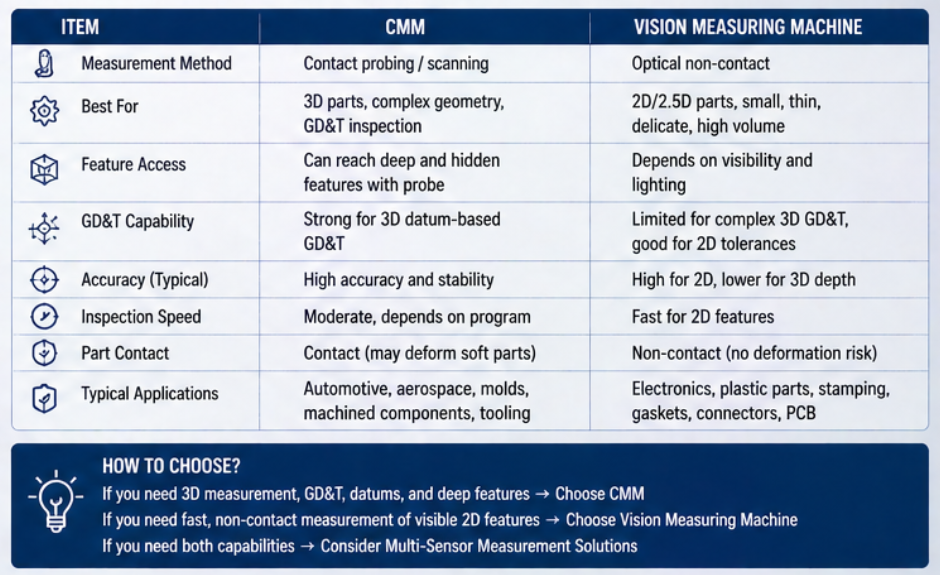
Buyers should not choose inspection equipment only by price or appearance. The right choice depends on what features must be measured and how the measurement result will be used. The table below summarizes the major differences between CMM and vision measuring machine systems.
| Comparison Item | CMM | Vision Measuring Machine |
|---|---|---|
| Measurement Method | Contact probing, scanning, or multi-sensor measurement | Optical non-contact measurement using camera and lighting |
| Best For | 3D parts, machined components, complex geometry, GD&T | Small, thin, flat, delicate, and high-volume 2D parts |
| Feature Access | Can reach many physical features with proper stylus setup | Depends on optical visibility and lighting condition |
| GD&T Capability | Strong for datum-based 3D GD&T inspection | Good for some 2D feature tolerances, limited for complex 3D GD&T |
| Inspection Speed | Stable but may be slower for many small 2D features | Fast for visible edges, contours, and repeated small features |
| Part Contact | Usually contact-based unless multi-sensor options are used | Non-contact, suitable for fragile or flexible parts |
| Typical Applications | Automotive, aerospace, precision machining, molds, tooling | Electronics, plastics, stamping, connectors, gaskets, thin parts |
4. When Should You Choose A CMM?
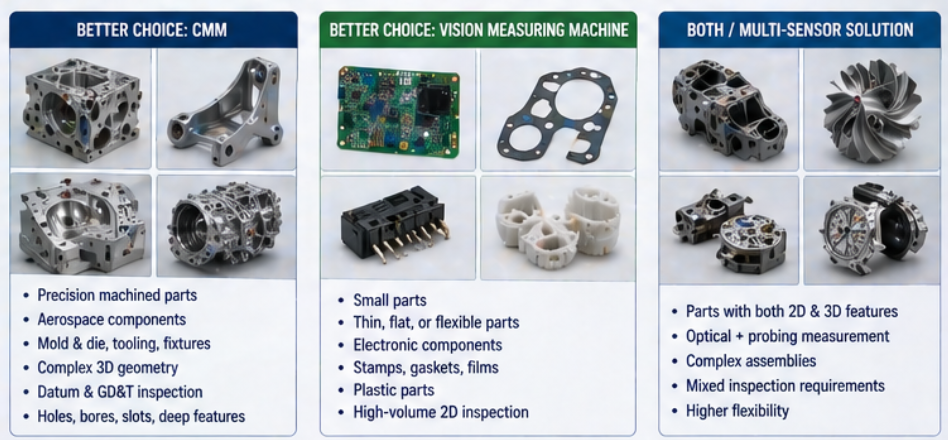
A CMM is usually the better choice when the part has true 3D geometry, deep features, multiple datum references, strict GD&T requirements, or assembly-related dimensional relationships. It is especially useful for precision machined parts where hole position, bore alignment, flatness, perpendicularity, profile, coaxiality, and datum relationships must be inspected accurately.
Choose A CMM If You Need:
3D dimensional inspection of machined parts
Datum-based GD&T measurement
Inspection of holes, bores, planes, slots, and deep features
High repeatability for batch quality control
Professional reports for automotive, aerospace, or precision manufacturing
Touch trigger or scanning probe measurement
For parts where functional geometry and assembly relationships matter, a CMM often provides stronger measurement confidence than a purely optical system.
5. When Should You Choose A Vision Measuring Machine?
A vision measuring machine is usually better when the measured features are visible, small, delicate, thin, or easily deformed by contact. It is also useful when inspection requires fast measurement of many 2D features, such as hole diameter, edge distance, slot width, contour, angle, radius, and profile outline.
Choose A Vision Measuring Machine If You Need:
Non-contact measurement of fragile or flexible parts
Fast 2D inspection of visible edges and contours
Measurement of thin sheets, films, gaskets, connectors, or electronic parts
Inspection of small parts that are difficult to touch with a probe
High-volume visual dimensional checks
Optical measurement where lighting and edge detection are reliable
If the part can be measured clearly through optical imaging and the main inspection features are 2D or 2.5D, a vision measuring machine can offer high efficiency and reduced risk of part deformation.
6. Which Machine Is Better For Different Parts?
The best machine depends on the actual part and inspection task. Some parts are clearly better suited to CMM inspection, while others are more suitable for optical measurement. In some cases, both technologies may be used together.
| Part / Application | Better Choice | Reason |
|---|---|---|
| Precision machined housing | CMM | Requires 3D datums, bores, planes, and GD&T inspection |
| Aerospace bracket | CMM | Needs datum relationship, hole position, and traceable reports |
| Thin gasket or film | Vision Measuring Machine | Non-contact optical measurement avoids deformation |
| Electronic connector | Vision Measuring Machine | Fast inspection of small visible features and pin geometry |
| Mold component with 3D profiles | CMM or Multi-Sensor System | May require both contact probing and surface/profile evaluation |
| Plastic part with visible edges and flexible areas | Vision or Multi-Sensor System | Optical measurement can reduce contact influence |
7. Do You Need A Multi-Sensor Measurement Solution?
Some inspection tasks cannot be solved efficiently by only one technology. A part may require contact probing for deep holes and datum features, while also requiring optical measurement for small edges, delicate surfaces, or visible contours. In this case, a multi-sensor measurement solution may provide better flexibility.
Multi-sensor systems can combine touch probes, optical sensors, scanning options, and software reporting. This can be useful for complex plastic parts, precision electronics, medical components, molds, and hybrid components with both 3D and optical inspection needs.
Buyers should not automatically choose multi-sensor equipment if the application does not require it. The right solution should be based on real parts, real features, tolerance requirements, and inspection volume.
8. What Information Should Buyers Prepare Before Choosing?
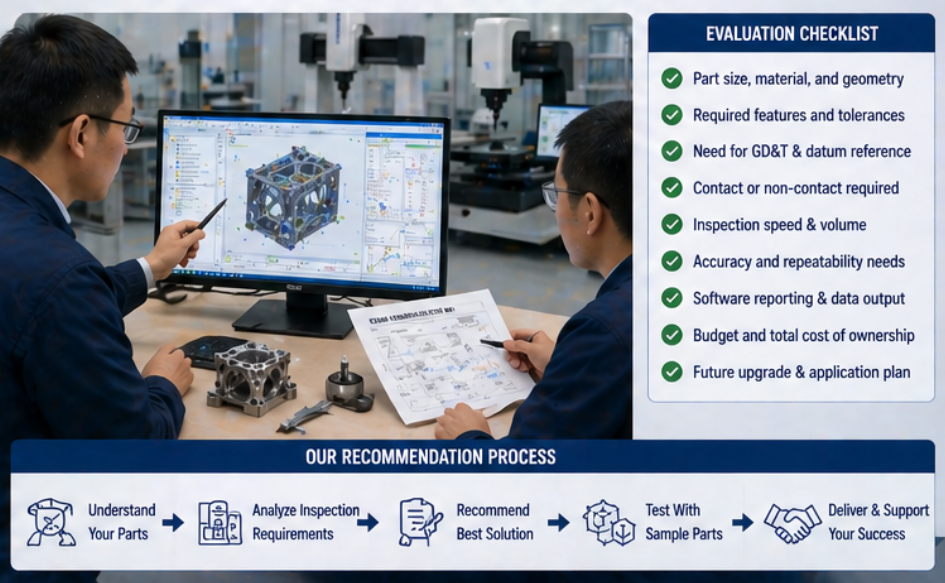
To choose between a CMM and a vision measuring machine, buyers should prepare complete inspection information. A supplier cannot recommend the right equipment accurately without understanding the actual parts and measurement goals.
Recommended Information Checklist
Part drawings and CAD files
Part size, thickness, weight, and material
Critical dimensions and tolerance requirements
Features to be measured: holes, edges, surfaces, profiles, datums
Whether the part can tolerate contact probing
Required inspection speed and production volume
GD&T, reporting, and traceability requirements
Whether 2D, 2.5D, 3D, or multi-sensor measurement is needed
9. Common Selection Mistakes To Avoid
Choosing a vision measuring machine for parts that require true 3D datum-based inspection.
Choosing a CMM for fragile thin parts when non-contact optical measurement would be safer.
Ignoring feature accessibility, probe clearance, or optical visibility.
Comparing only machine price instead of inspection efficiency and measurement reliability.
Not checking software capability for GD&T, CAD comparison, and report output.
Underestimating lighting, surface reflection, or edge detection issues in optical measurement.
Ignoring fixture design and part positioning repeatability.
Not testing the equipment with real sample parts before final selection.
Avoiding these mistakes helps buyers choose equipment that fits the real inspection task instead of creating limitations after installation.
Conclusion
CMM and vision measuring machines are both valuable inspection tools, but they serve different purposes. A CMM is better for 3D geometry, precision machined parts, datums, GD&T, deep features, and complex industrial inspection. A vision measuring machine is better for fast non-contact inspection of small, thin, flat, delicate, or high-volume parts with visible features. The right choice depends on part geometry, tolerance, material, measurement speed, software requirements, and production workflow. By preparing real drawings, sample parts, and inspection requirements before quotation, buyers can choose a more suitable and cost-effective measurement solution.
Need Help Choosing Between CMM And Vision Measurement?
Related product and article resources
For procurement comparison and technical evaluation, readers can continue with these related product pages and supporting articles.
- Products
- Product catalog
- Contact the sales team
- Contact us
- 100% Inline Automatic Inspection for Automotive Body-in-White: Technology Breakdown
- 5-Axis Machining Centers: Capabilities for Complex Geometry Manufacturing
- 5 Key Features of High-End CMMs
- A Look Inside a Fully Automated Chassis Arc Welding Production Line
Contact us to discuss your part drawings, tolerance requirements, material, inspection speed, GD&T needs, and production workflow. We can help you evaluate a suitable measurement solution for your inspection task.