


What Buyers Should Know About CMM Calibration And Acceptance Testing
2026-05-12 22:54What Buyers Should Know About CMM Calibration And Acceptance Testing
Buying a coordinate measuring machine is not complete when the machine is delivered. Calibration and acceptance testing are essential steps to confirm whether the CMM can meet the required accuracy, repeatability, and inspection performance after installation. For buyers in precision machining, automotive, aerospace, mold manufacturing, electronics, and industrial quality control, calibration documents and acceptance procedures can directly affect measurement confidence, audit readiness, and long-term equipment reliability. This guide explains what buyers should know before accepting a CMM machine.
Quick Answer
CMM calibration verifies machine accuracy and measurement performance against defined standards, while acceptance testing confirms that the delivered machine, probe system, software, environment, and inspection workflow meet the agreed requirements. Buyers should check calibration certificates, accuracy test results, probe qualification, software operation, repeatability, environmental conditions, training, and final acceptance documents before approving the machine.
1. Why CMM Calibration Matters
A CMM is used to make dimensional quality decisions. If the machine is not properly calibrated, inspection results may become unreliable even when the machine looks normal during operation. Calibration helps confirm whether the CMM can measure within its stated accuracy range and whether the system is suitable for the buyer’s required tolerance level.
Calibration is especially important for industries that require traceable measurement records, such as automotive components, aerospace parts, medical devices, precision machining, and mold manufacturing. When customers or auditors ask for measurement reliability, calibration documents provide important evidence that the inspection equipment has been verified.
Buyers should not treat calibration as a simple document attached to the machine. It should be understood as part of the complete measurement control process, together with machine accuracy, probe setup, environmental control, operator training, and inspection software.
2. Calibration vs Acceptance Testing: What Is The Difference?
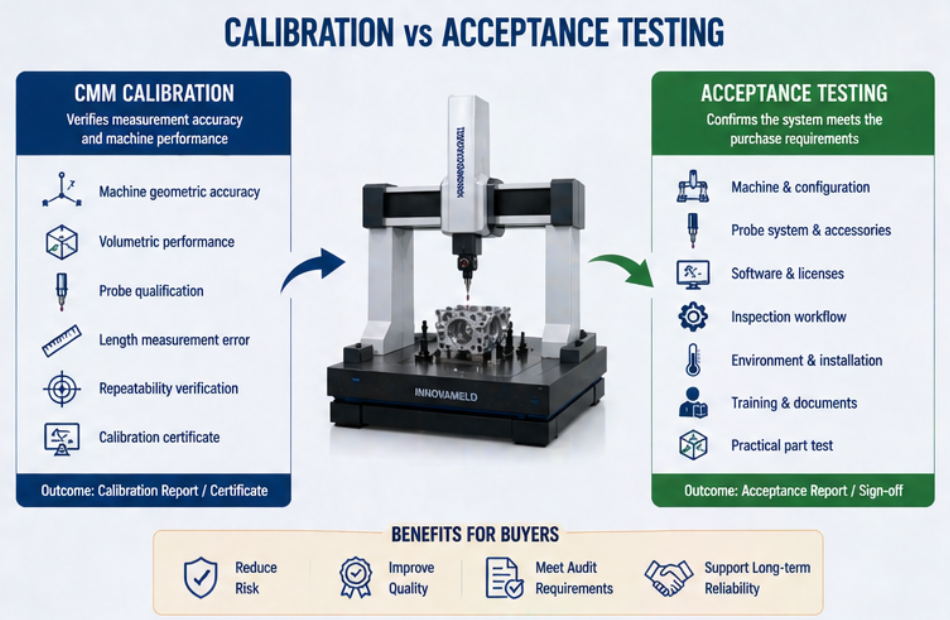
Calibration and acceptance testing are related, but they are not the same. Calibration focuses on verifying measurement accuracy and machine performance. Acceptance testing is broader. It confirms whether the delivered system matches the order agreement, technical specification, site condition, software requirements, and practical inspection workflow.
| Item | CMM Calibration | Acceptance Testing |
|---|---|---|
| Main Purpose | Verify machine measurement accuracy | Confirm the complete system meets purchase requirements |
| Focus Area | Accuracy, repeatability, machine geometry, probe performance | Machine, software, accessories, training, environment, workflow |
| Document Output | Calibration report or certificate | Acceptance report, checklist, and sign-off record |
| Timing | Before delivery, after installation, or periodically | Before final handover or payment approval |
| Buyer Concern | Can the machine measure accurately? | Can the full system work as required in real use? |
A professional CMM purchase should include both. Calibration verifies measurement capability, while acceptance testing protects the buyer from incomplete delivery, configuration mismatch, or installation problems.
3. What Should Be Checked During CMM Calibration?
CMM calibration usually involves checking the machine’s measurement performance under defined conditions. The exact procedure may vary depending on machine type, standard, supplier process, and buyer requirements. However, buyers should understand the main items that affect measurement reliability.
Common CMM Calibration Items
Machine geometric accuracy and axis movement condition
Volumetric measurement performance across the working range
Probe qualification and probing repeatability
Length measurement error verification
Repeatability testing on selected features or reference artifacts
Software compensation and machine error correction status
Environmental condition during calibration
Calibration report, date, result, and traceability information
Buyers should ask whether the calibration is performed before shipment, after installation, or both. For high-precision applications, installation-site calibration or verification may be especially important because the actual operating environment can affect measurement performance.
The calibration document should be kept as part of the buyer’s quality system. It may be needed for audits, customer approval, internal inspection control, or future maintenance records.
4. What Should Be Included In CMM Acceptance Testing?
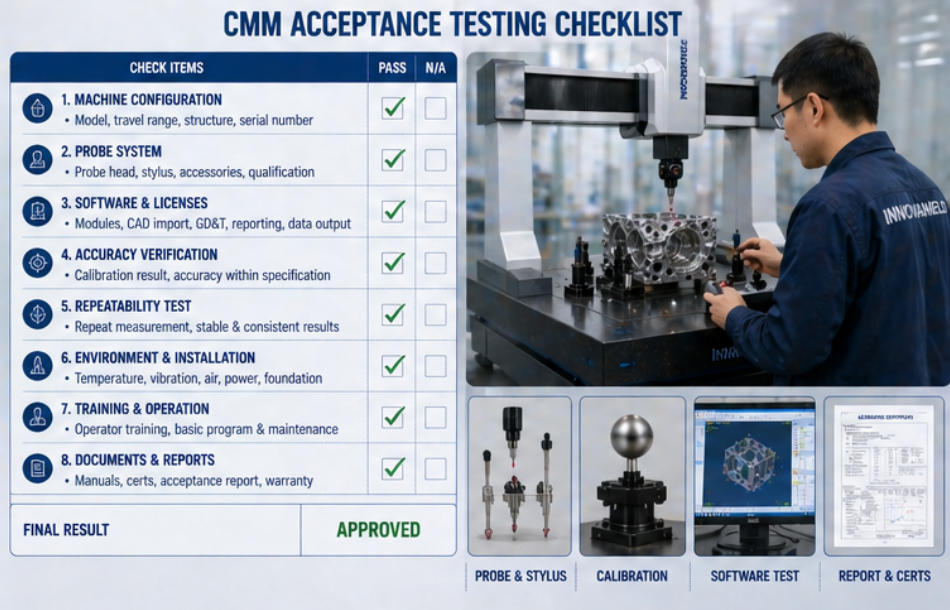
Acceptance testing should confirm that the delivered CMM system matches what the buyer ordered. This includes not only the machine frame, but also the controller, probe system, software, computer, joystick or control box, fixture accessories, training, documents, and optional functions.
A complete acceptance test should also verify whether the machine can perform typical inspection tasks. If the buyer provides sample parts, drawings, or CAD files, the test can include a practical measurement demonstration. This helps confirm that the CMM is not only installed correctly, but also usable for real production inspection.
| Acceptance Item | What Buyers Should Confirm | Risk If Ignored |
|---|---|---|
| Machine Model | Measuring range, structure, table size, serial number | Wrong model or configuration mismatch |
| Probe System | Probe head, stylus, accessories, qualification result | Incomplete measurement capability |
| Software | License, CAD import, GD&T, reporting, data export | Limited inspection workflow after delivery |
| Accuracy Test | Calibration result and acceptance tolerance | Unverified measurement reliability |
| Training | Operator training, basic program operation, maintenance guidance | Low machine utilization and operation errors |
| Documents | Manuals, calibration report, acceptance report, warranty terms | Difficult audit, maintenance, or after-sales communication |
5. Factory Acceptance Test vs Site Acceptance Test
Buyers may hear two common terms: Factory Acceptance Test and Site Acceptance Test. A factory acceptance test is usually performed before shipment at the supplier’s facility. It confirms that the CMM is assembled, configured, and tested before delivery. A site acceptance test is performed after installation at the buyer’s facility. It confirms whether the machine works properly in the real installation environment.
| Testing Type | When It Happens | Main Purpose |
|---|---|---|
| Factory Acceptance Test | Before shipment | Confirm machine build, configuration, and basic performance |
| Site Acceptance Test | After installation at buyer’s site | Confirm installed performance and working condition |
| Practical Part Test | During acceptance or training | Verify real inspection workflow with buyer’s part |
For buyers with strict quality requirements, site acceptance testing is highly valuable because temperature, vibration, foundation, compressed air, and installation layout can affect actual measurement results.
6. Environmental Conditions During Acceptance Testing
A CMM cannot be evaluated properly if the environment is unstable. Temperature fluctuation, vibration, dust, humidity, poor compressed air, and unstable floor conditions may influence the acceptance result. Before site acceptance testing, buyers should prepare the installation area according to the required machine conditions.
The room should provide stable temperature, sufficient space, clean air, correct power supply, suitable foundation, and safe loading access. If the buyer wants to verify high-accuracy performance, environmental control becomes even more important.
Site Preparation Checklist
Stable room temperature during testing
Low vibration and stable foundation
Clean and dry compressed air if required
Proper power supply and grounding
Enough space for machine movement and operator access
Clean environment away from dust, oil mist, and strong airflow
Workpieces stabilized before measurement
Required drawings, CAD files, and sample parts prepared
7. Documents Buyers Should Request
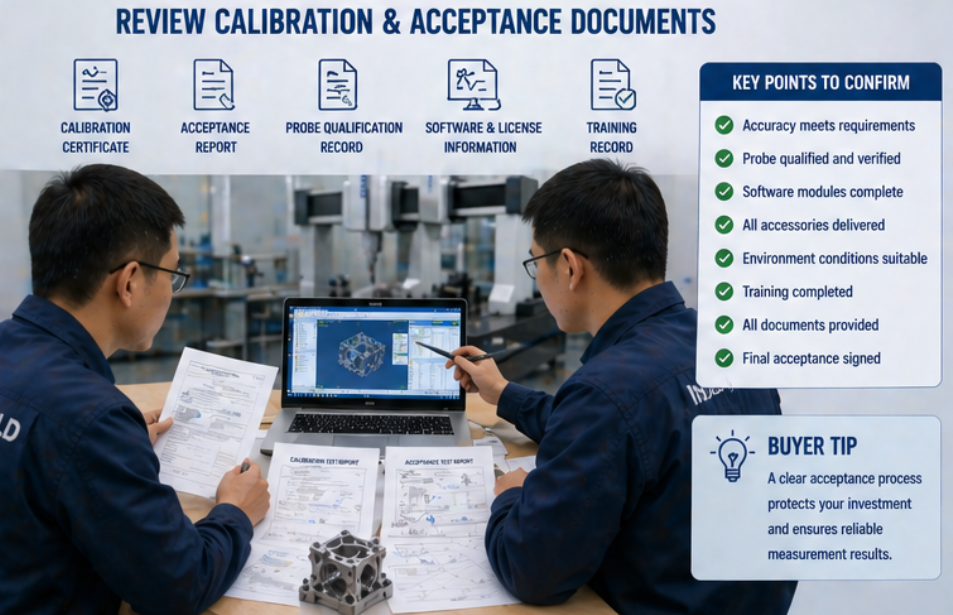
Documentation is an important part of CMM acceptance. Without clear documents, buyers may face problems during customer audits, equipment maintenance, software support, or future calibration. The required documents should be confirmed before the order is placed.
Machine configuration list and serial number information
Calibration certificate or calibration report
Acceptance testing report and signed checklist
Probe qualification record and accessory list
Software license and module information
Operation manual and maintenance guide
Training record and basic operation notes
Warranty terms and after-sales support contact information
For buyers who serve automotive, aerospace, medical, or export customers, these documents help build a more traceable and professional inspection system.
8. Common Mistakes Buyers Should Avoid
Accepting the machine without checking the calibration report.
Only testing machine movement but not verifying measurement performance.
Ignoring probe qualification and stylus configuration during acceptance.
Failing to check whether software modules and licenses match the order.
Not preparing the installation environment before site acceptance testing.
Skipping practical part measurement when the application is complex.
Not requesting complete manuals, reports, certificates, and training records.
Signing acceptance before unresolved technical issues are documented.
Avoiding these mistakes helps buyers reduce procurement risk and ensures the CMM can support reliable inspection after installation.
Conclusion
CMM calibration and acceptance testing are critical steps in a successful coordinate measuring machine purchase. Calibration verifies measurement accuracy, while acceptance testing confirms that the complete system meets the buyer’s technical and practical requirements. Before final approval, buyers should check machine configuration, accuracy results, probe qualification, software functions, environmental conditions, training, documents, and practical inspection performance. A clear acceptance process helps reduce measurement risk, improve audit readiness, and build long-term confidence in the CMM inspection system.
Need Help With CMM Calibration And Acceptance Requirements?
Contact us to discuss your CMM application, accuracy requirements, acceptance checklist, calibration documents, software needs, and installation conditions. We can help you evaluate a suitable CMM solution for reliable industrial inspection.