


How To Choose A Bridge CMM For Precision Machined Parts
2026-05-11 22:47How To Choose A Bridge CMM For Precision Machined Parts
Precision machined parts often require reliable dimensional inspection, stable repeatability, and clear quality documentation. A bridge coordinate measuring machine is one of the most common choices for inspecting CNC machined parts, aluminum housings, steel components, molds, fixtures, aerospace parts, automotive components, and high-precision mechanical assemblies. However, choosing the right bridge CMM is not only about machine size or catalog accuracy. Buyers should evaluate part tolerance, measuring range, probe configuration, fixture design, software capability, environmental control, and long-term inspection workflow before making a purchase decision.
Quick Answer
To choose a bridge CMM for precision machined parts, buyers should check part size, tolerance level, measuring range, machine accuracy, repeatability, probe access, fixture space, GD&T software, reporting needs, and installation environment. A suitable bridge CMM should provide stable accuracy, enough measuring margin, reliable fixture compatibility, and practical software support for daily quality control.
1. Why Bridge CMM Is Commonly Used For Precision Machined Parts
A bridge CMM has a stable bridge-type structure that moves over a granite table. This design offers good rigidity, repeatability, and measurement stability, making it suitable for many precision machining applications. Compared with flexible manual tools, a bridge CMM can inspect complex dimensions, positions, datums, profiles, and GD&T requirements with higher consistency.
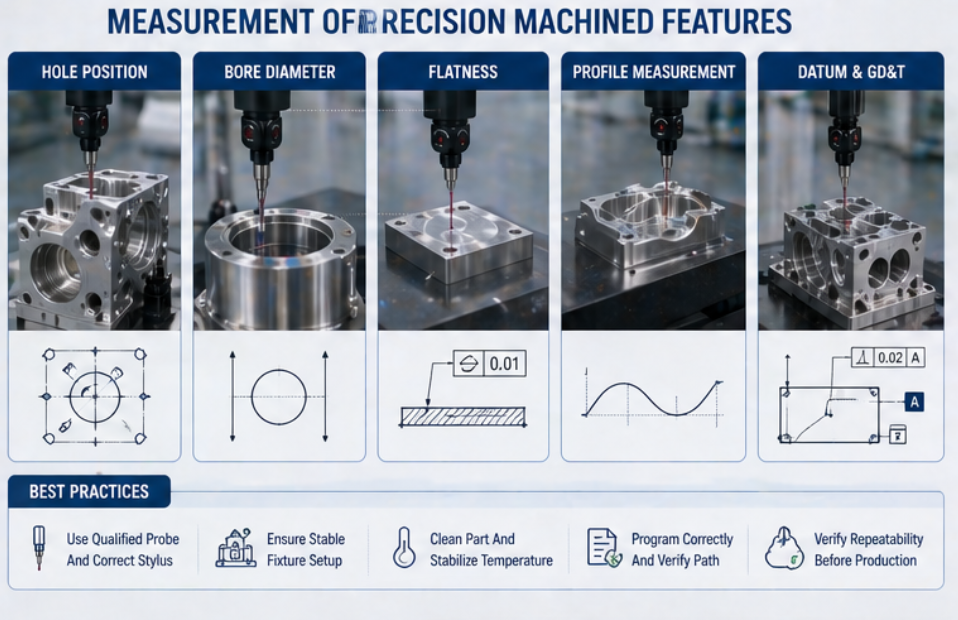
Precision machined parts often include holes, planes, slots, bores, curved surfaces, threaded features, reference datums, and assembly interfaces. These features must be measured accurately to verify whether the part meets drawing requirements. A bridge CMM can support repeatable inspection programs, professional measurement reports, and long-term dimensional quality control.
For CNC machining suppliers, mold manufacturers, automotive parts factories, aerospace component manufacturers, and precision hardware producers, a bridge CMM is often a practical and reliable inspection platform.
2. Start With Part Size, Tolerance And Inspection Purpose
Before choosing a bridge CMM, buyers should first define what parts will be measured. The maximum part size, weight, material, tolerance level, drawing requirements, and inspection frequency should be reviewed carefully. A CMM selected only by catalog model may not match the real inspection task.
For example, a small aluminum machined part may require high repeatability and short stylus stability. A large housing may require bigger measuring range and better volumetric accuracy. A mold insert may need surface profile evaluation, while an aerospace bracket may require strict GD&T reporting and traceability.
| Part Type | Common Inspection Focus | Bridge CMM Selection Priority |
|---|---|---|
| CNC Machined Housings | Hole position, bore size, flatness, datum relationship | Measuring range, probe access, GD&T software |
| Precision Shafts And Sleeves | Roundness, coaxiality, diameter, length | Repeatability, fixture stability, probing strategy |
| Mold Inserts | Profiles, surfaces, cavity position, precision edges | Scanning capability, CAD comparison, surface analysis |
| Aerospace Brackets | Hole patterns, datum structure, angles, GD&T | Accuracy, traceability, fixture repeatability |
| Automotive Machined Parts | Batch consistency, position tolerance, assembly dimensions | CNC programs, reporting efficiency, repeatability |
3. Choose Enough Measuring Range And Working Space
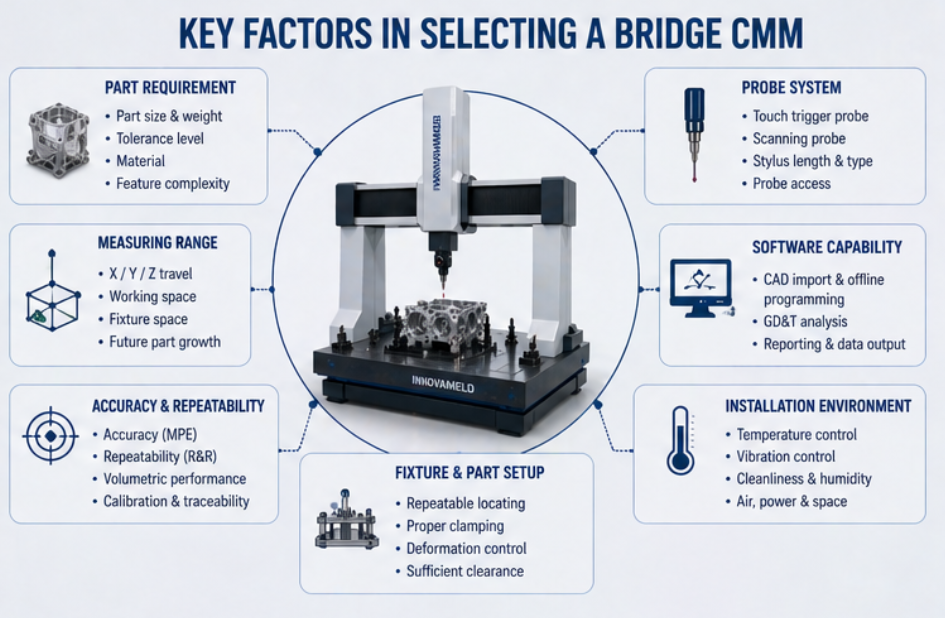
Measuring range is one of the most important points when selecting a bridge CMM. Buyers should not only check whether the part fits inside the CMM travel range. They should also consider fixture height, clamping space, stylus movement, probe clearance, part loading direction, and future part size changes.
If the CMM is too small, the machine may not be able to reach all required features after the fixture is installed. If the Z-axis height is too limited, tall parts or long styli may create access problems. If the X/Y working space is too tight, operators may face difficulty loading parts safely and efficiently.
A practical selection should leave enough margin for real measurement operation. Buyers should share maximum part size, fixture plan, part weight, and loading method before confirming the machine model.
4. Check Accuracy, Repeatability And Volumetric Performance
Accuracy matters, but buyers should avoid judging a bridge CMM only by one accuracy number. The machine must be accurate enough for the real tolerance of the machined parts. It should also provide stable repeatability when the same part or feature is measured many times.
Volumetric performance is important when features are distributed across the full part. A machine may perform well in a small local area, but precision machined parts often require measurement across multiple surfaces, bores, datums, and assembly locations. Stable performance throughout the measuring volume helps improve inspection confidence.
Accuracy Checklist
Does the CMM accuracy match the smallest tolerance you need to verify?
Is repeatability stable enough for batch inspection?
Is volumetric accuracy suitable for the full part size?
Are calibration and acceptance documents available?
Will the installation environment support the required accuracy level?
Does the probe and fixture setup support stable measurement results?
5. Select The Right Probe, Stylus And Fixture Configuration
The bridge CMM machine body is only one part of the inspection system. The probe, stylus, and fixture determine whether the machine can actually measure the required features. Precision machined parts often include deep bores, narrow slots, angled surfaces, internal features, and complex datum relationships. These features may require different probe and stylus configurations.
Touch trigger probes are suitable for many standard dimensional checks, hole locations, planes, and edge features. Scanning probes may be useful for profiles, curves, and surface evaluation. Long styli, angled styli, or star styli may help access difficult features, but they should be selected carefully to avoid unstable measurement.
Fixture design is equally important. A good fixture should locate the part repeatably, support the correct datums, avoid deformation, and provide enough clearance for the probe path. For batch inspection, fixture repeatability can strongly affect measurement consistency.
6. Evaluate Measurement Software And Reporting Functions
Good measurement software can make a bridge CMM much more useful in daily quality control. Buyers should check whether the software supports CAD import, offline programming, GD&T evaluation, profile analysis, automatic report generation, data export, and clear pass/fail judgment.
For precision machined parts, GD&T capability is often important. The software should be able to evaluate position, flatness, parallelism, perpendicularity, concentricity, profile, and other drawing requirements. Report clarity also matters because inspection data may be used for internal quality control, customer approval, and audit documentation.
Buyers should ask for software demonstrations, sample reports, and workflow examples based on similar parts before confirming the bridge CMM configuration.
7. Consider Environment, Installation And Long-Term Use
A bridge CMM requires a suitable working environment to maintain stable accuracy. Temperature fluctuation, vibration, dust, humidity, and poor floor stability can all affect measurement results. If the machine will be used for tight-tolerance inspection, a controlled metrology room is usually preferred.
Buyers should check room temperature, vibration sources, compressed air quality, machine foundation, power supply, loading access, and maintenance space before installation. If the site is not prepared properly, the machine may not perform as expected after delivery.
| Installation Factor | What To Check | Why It Matters |
|---|---|---|
| Temperature | Room stability and part thermal balance | Reduces measurement drift |
| Vibration | Nearby CNC machines, presses, forklifts, compressors | Improves repeatability and probing stability |
| Cleanliness | Dust, oil mist, chips, humidity | Protects machine reliability and measurement surfaces |
| Layout | Operator access, loading route, computer station, maintenance space | Improves daily operation efficiency |
8. What Information Should Buyers Prepare Before Requesting A Quote?
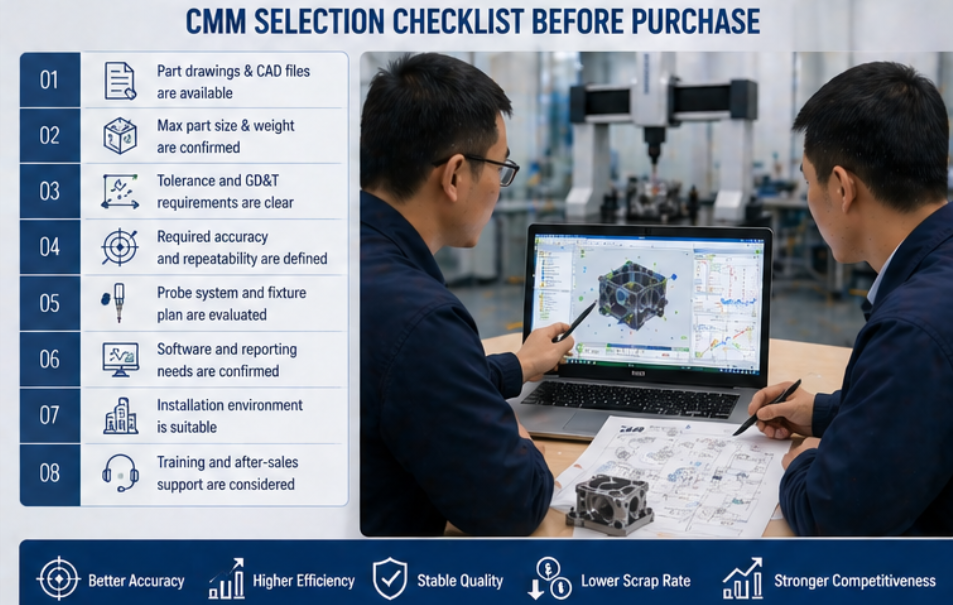
To receive a useful bridge CMM recommendation, buyers should provide clear application information. A simple request such as “we need a bridge CMM” is usually not enough to select the correct configuration. The supplier needs to understand the parts, tolerance requirements, workflow, and installation conditions.
Recommended Quotation Information
Part drawings and CAD files
Maximum part size and weight
Material type and surface condition
Critical dimensions and tolerance requirements
GD&T requirements and datum structure
Inspection frequency and batch volume
Required report format and data output
Installation site conditions and available space
9. Common Mistakes To Avoid
Choosing a bridge CMM only by price without checking real part tolerance.
Selecting measuring range without considering fixture space and probe clearance.
Ignoring repeatability for batch inspection of precision machined parts.
Using unsuitable probe or stylus configurations for deep holes and complex features.
Buying software without checking GD&T and reporting requirements.
Installing the CMM near vibration sources or unstable temperature conditions.
Requesting a quote without drawings, CAD files, or inspection workflow details.
Avoiding these mistakes helps buyers choose a bridge CMM that performs reliably after installation and supports long-term quality control.
Conclusion
Choosing a bridge CMM for precision machined parts requires a complete evaluation of part size, tolerance, measuring range, accuracy, repeatability, probe access, fixture design, software capability, and installation environment. A suitable bridge CMM should not only meet catalog specifications, but also support real inspection tasks with stable, repeatable, and useful measurement results. By preparing drawings, CAD files, tolerance data, and workflow requirements before quotation, buyers can reduce configuration risk and select a more reliable CMM solution for precision machining quality control.
Need A Bridge CMM For Precision Machined Parts?
Contact us to discuss your part drawings, tolerance requirements, measuring range, probe configuration, fixture needs, and inspection environment. We can help you evaluate a suitable bridge CMM solution for precision machining quality control.