


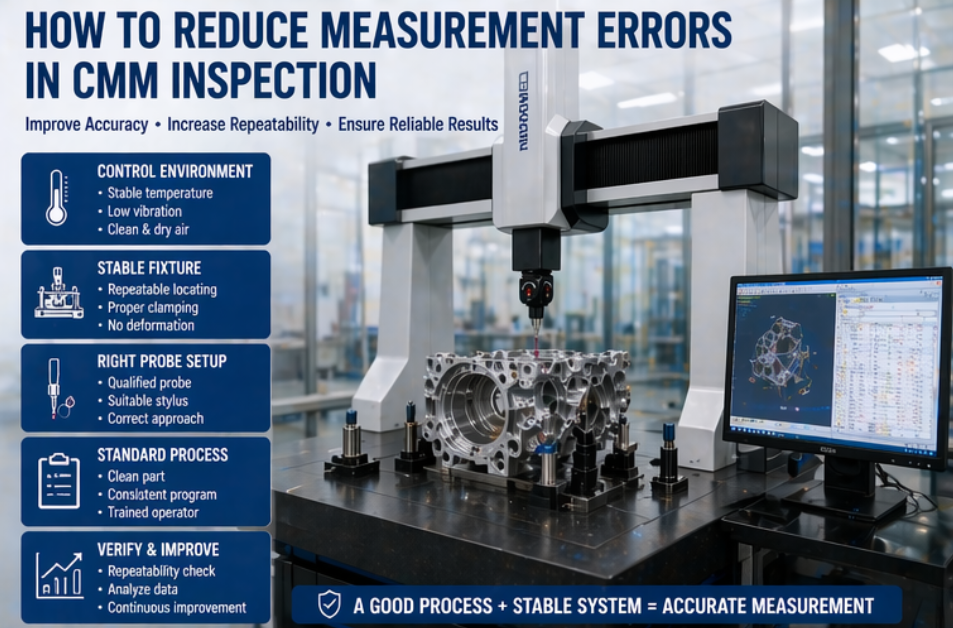
How To Reduce Measurement Errors In CMM Inspection
2026-05-10 15:39How To Reduce Measurement Errors In CMM Inspection
Coordinate measuring machine inspection is widely used for dimensional verification, quality control, first article inspection, and production process monitoring. However, even a high-accuracy CMM can produce unreliable results if the measurement process is not properly controlled. Measurement errors may come from machine accuracy, probe setup, fixture instability, temperature changes, vibration, operator method, software programming, part cleanliness, or poor inspection strategy. This guide explains how manufacturers can reduce CMM measurement errors and build a more stable inspection process.
Quick Answer
To reduce measurement errors in CMM inspection, manufacturers should control the measurement environment, use stable fixtures, select the right probe and stylus, clean and stabilize workpieces, calibrate the probe correctly, standardize measurement programs, train operators, and verify results with repeatability checks. CMM accuracy depends on the whole inspection system, not only the machine itself.
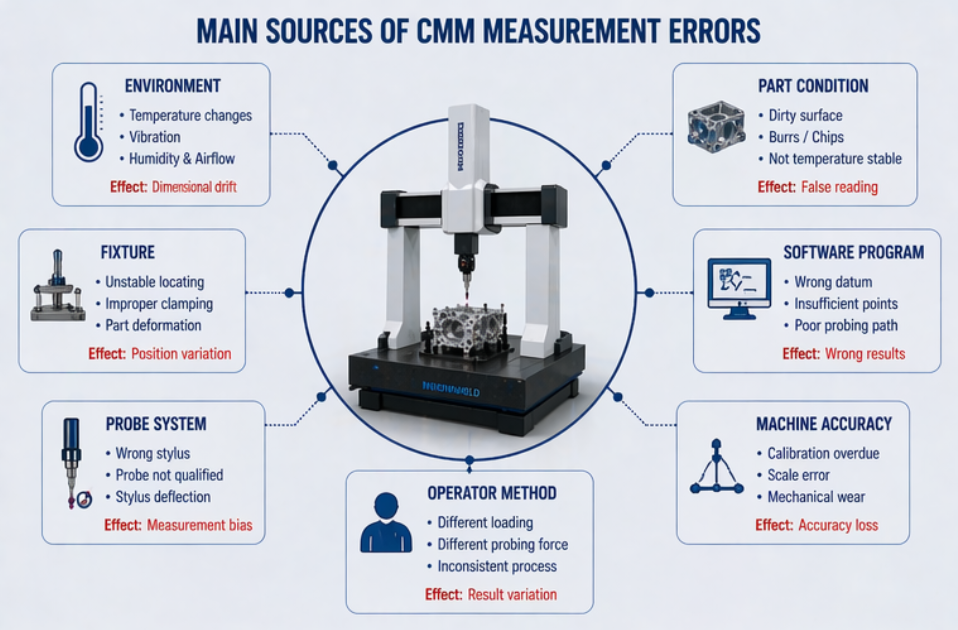
1. Understand Where CMM Measurement Errors Come From
Before reducing measurement errors, buyers and quality teams must understand that CMM error is rarely caused by one single factor. A measurement result is influenced by the machine structure, scale system, probe, stylus, fixture, software algorithm, part condition, environment, and operator procedure. If any part of this chain is unstable, the final inspection data may become unreliable.
For example, a precision CMM may still produce inconsistent results if the part is not fixed correctly. A well-designed fixture may still fail if the probe is not qualified properly. A correct measurement program may still generate poor data if the workpiece temperature has not stabilized. This is why CMM inspection should be managed as a complete process.
| Error Source | Typical Problem | How To Reduce Risk |
|---|---|---|
| Environment | Temperature drift, vibration, humidity, dust | Use a stable metrology environment and site control |
| Fixture | Unstable part positioning or deformation | Use repeatable locating points and controlled clamping |
| Probe System | Wrong stylus, poor qualification, probe access limits | Select suitable probe and perform proper calibration |
| Part Condition | Burrs, dust, oil, heat, unstable material condition | Clean and thermally stabilize parts before inspection |
| Software Program | Poor point strategy or wrong datum setup | Standardize programs and verify measurement methods |
| Operator Method | Different loading, cleaning, or measurement habits | Use SOPs, training, and repeatability checks |
2. Control Temperature, Vibration And Room Conditions
Environmental control is one of the most important ways to reduce CMM measurement error. Temperature changes can cause the machine, fixture, and workpiece to expand or contract. Vibration from nearby CNC machines, presses, forklifts, compressors, or unstable floors can reduce repeatability. Dust, oil mist, and humidity may also affect machine reliability and measurement stability.
If the CMM is used for high-precision inspection, it should be installed in a controlled metrology room whenever possible. If the CMM must be used near production, buyers should evaluate vibration isolation, temperature compensation, clean air, floor stability, and machine protection. The environment must match the required inspection accuracy.
Environment Control Checklist
Keep room temperature stable during measurement.
Allow workpieces to reach thermal stability before inspection.
Keep the CMM away from vibration sources.
Maintain clean and dry air supply if the system requires compressed air.
Avoid direct sunlight, heaters, strong airflow, and large door openings.
Check floor stability and machine leveling regularly.
3. Use Stable Fixtures And Repeatable Part Positioning
Fixture instability is a common but often underestimated source of CMM measurement error. If a part is positioned differently each time, the measurement program may still run correctly, but the results may not be comparable. In batch inspection, this can create unstable reports and wrong quality decisions.
A good fixture should locate the part using proper datum references, support the workpiece without deformation, provide enough probe access, and allow operators to load parts consistently. For thin-walled parts, plastic components, aluminum castings, aerospace parts, and complex machined components, clamping force must be carefully controlled.
For repeated production inspection, fixture design should be treated as part of the measurement system. A stable fixture can reduce operator influence, shorten setup time, and improve repeatability across different batches.
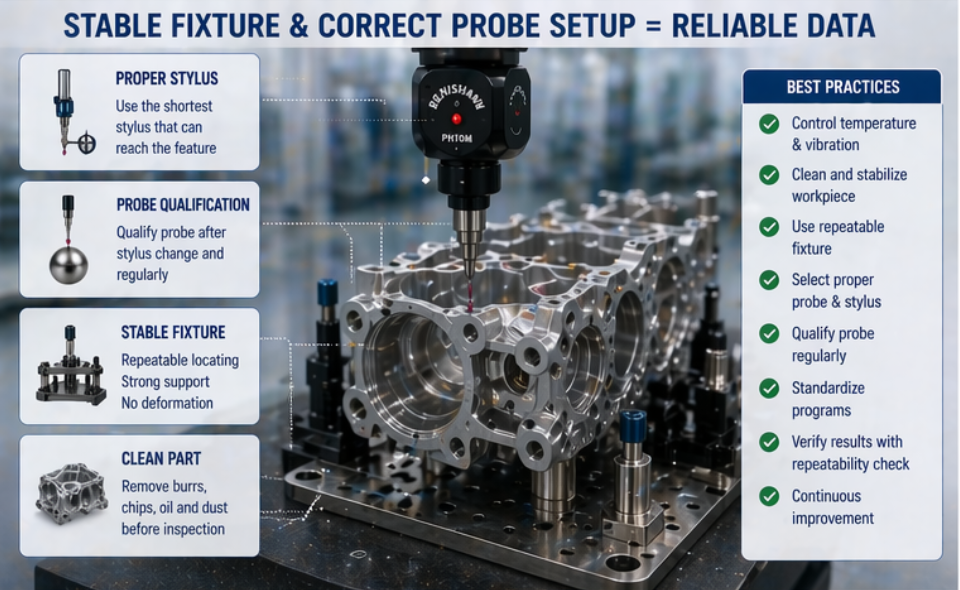
4. Select And Calibrate The Probe System Correctly
The probe system directly affects measurement data collection. A touch trigger probe is suitable for many standard dimensional checks, hole positions, planes, and edges. A scanning probe may be required for profiles, curved surfaces, freeform geometry, molds, turbine blades, and applications requiring dense data points. Selecting the wrong probe can lead to incomplete measurement coverage or unstable results.
Stylus selection is also important. Long styli, angled styli, star styli, and extensions can improve access to difficult features, but they may reduce stability if not used correctly. Probe qualification should be performed according to the actual stylus configuration and measurement direction.
| Probe-Related Check | Potential Error | Best Practice |
|---|---|---|
| Stylus length | Deflection or unstable contact | Use the shortest stable stylus that can reach the feature |
| Probe qualification | Incorrect probe radius compensation | Qualify probes before inspection and after stylus changes |
| Approach direction | Inconsistent contact points | Use consistent probing direction and safe approach paths |
| Probe access | Collision risk or missed features | Check access with CAD model, fixture, and program simulation |
5. Clean And Stabilize The Workpiece Before Measurement
Workpiece condition has a direct effect on measurement accuracy. Burrs, chips, dust, oil, coolant residue, fingerprints, and surface contamination can change contact points and create false measurement results. Before inspection, parts should be cleaned and visually checked, especially around datum surfaces, holes, edges, and critical measuring features.
Thermal stability is also important. A part taken directly from machining, heat treatment, or an uncontrolled workshop may still be expanding or contracting. Measuring it immediately can produce results that do not represent its stable dimensional condition. For tight tolerance parts, a waiting time or thermal stabilization process may be necessary.
Standard part preparation procedures can greatly reduce measurement variation and make inspection results more trustworthy.
6. Standardize Measurement Programs And Datum Strategy
Software programming is another important factor in CMM error reduction. A poor measurement program may use insufficient points, incorrect datum alignment, unsafe probe paths, wrong feature definitions, or inconsistent measurement methods. Even if the machine is accurate, the results may be misleading if the program is not designed properly.
The datum strategy should match the drawing requirement and actual part function. Operators should avoid changing alignment methods without approval. For production inspection, measurement programs should be controlled, documented, and version-managed so that different operators and shifts use the same inspection method.
Program Control Checklist
Use the correct datum alignment based on the drawing.
Apply enough measurement points for reliable feature evaluation.
Use consistent probing speed and approach direction.
Check probe path safety to avoid collision.
Standardize report templates and pass/fail criteria.
Control program versions for repeated production inspection.
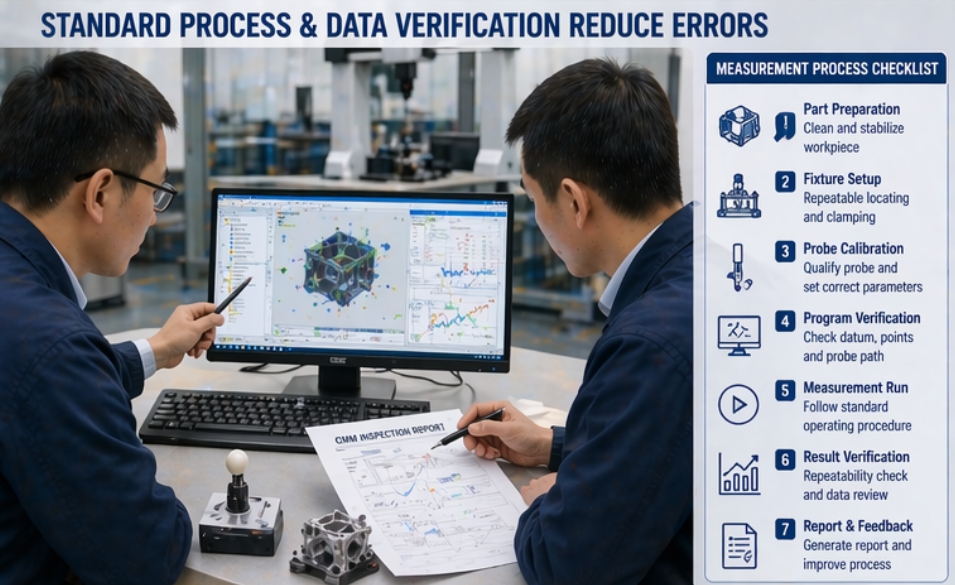
7. Train Operators And Use Repeatability Checks
Operator training is essential for reducing CMM inspection errors. Operators must understand part loading, fixture use, probe calibration, part cleaning, program selection, report interpretation, and basic troubleshooting. Without standard training, different operators may use different habits, creating inconsistent measurement results.
Repeatability checks are also useful. Measuring the same part or feature multiple times can reveal fixture instability, environmental drift, probe problems, or operator variation. For important production parts, repeatability verification should be part of the inspection control process.
A stable CMM process should not depend on one experienced operator only. It should be supported by clear procedures, controlled programs, proper training, and regular verification.
8. Common Mistakes That Increase CMM Measurement Errors
Measuring parts before they reach thermal stability.
Ignoring dust, oil, burrs, or chips on datum surfaces.
Using unstable fixtures or inconsistent clamping methods.
Changing stylus configuration without requalification.
Using long styli when shorter and more stable options are possible.
Installing the CMM near vibration sources without evaluation.
Using different datum strategies for the same part.
Allowing operators to modify inspection programs without control.
Skipping repeatability checks for important production measurements.
Reducing these mistakes can significantly improve measurement reliability and help the quality team make more confident decisions.
Conclusion
Reducing measurement errors in CMM inspection requires a complete process approach. Manufacturers should control the environment, stabilize workpieces, use repeatable fixtures, select and calibrate probes correctly, standardize software programs, train operators, and verify measurement repeatability. A CMM is only as reliable as the full inspection system around it. By improving each part of the measurement process, manufacturers can reduce inspection uncertainty, avoid false quality decisions, and build a more stable dimensional control system.
Need Help Improving Your CMM Inspection Process?
Contact us to discuss your part drawings, tolerance requirements, fixture setup, probe configuration, software workflow, and inspection environment. We can help you evaluate a suitable CMM solution for more stable and reliable measurement results.