



What Is The Difference Between Manual, CNC And Automated CMM Systems
2026-05-09 15:36What Is The Difference Between Manual, CNC And Automated CMM Systems?
Coordinate measuring machines can be configured as manual CMM systems, CNC CMM systems, or automated CMM systems. Although all of them are used for dimensional inspection, they differ significantly in operation method, inspection speed, repeatability, operator dependence, software workflow, and production integration capability. Choosing the wrong system type may lead to inefficient inspection, unstable measurement results, or unnecessary investment. This guide explains the practical differences between manual, CNC, and automated CMM systems so industrial buyers can select the right solution for their inspection requirements.
Quick Answer
A manual CMM is operated directly by the user and is suitable for low-volume or flexible inspection. A CNC CMM runs programmed measurement paths automatically and is better for repeatable inspection, batch measurement, and stable quality control. An automated CMM system integrates the CMM with fixtures, loading devices, robots, conveyors, barcode systems, or production data systems for high-volume and process-oriented inspection.
1. What Is A Manual CMM System?
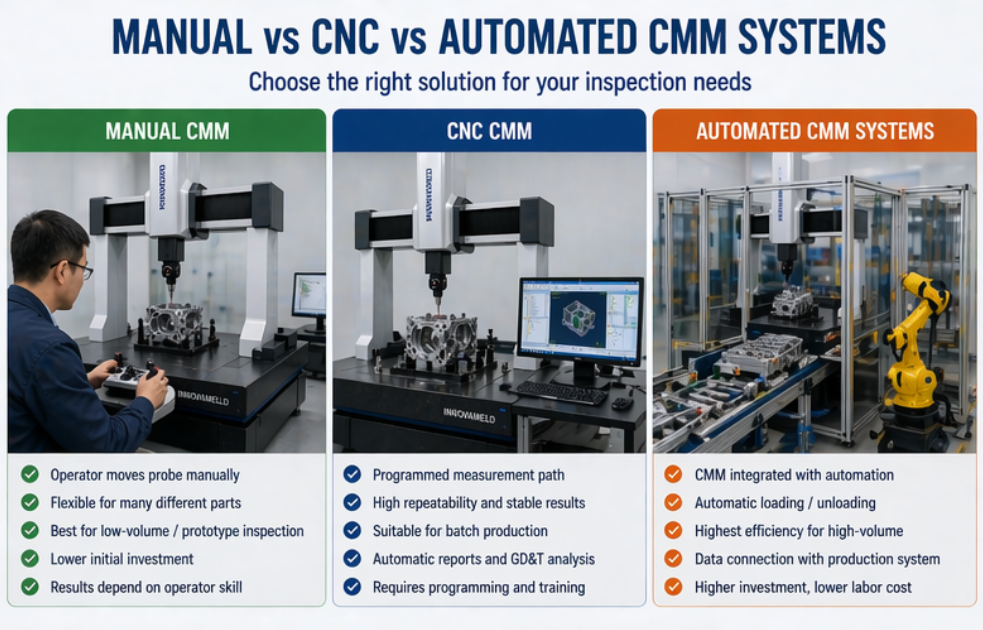
A manual CMM system is operated by the user through hand movement, joystick control, or manual positioning. The operator moves the probe to touch or measure the required features on the workpiece. This type of CMM is often used for simple dimensional checks, small batch inspection, tool room measurement, incoming inspection, and applications where flexibility is more important than speed.
The main advantage of a manual CMM is flexibility. It allows operators to inspect different parts without creating complex programs. It can be suitable for prototypes, repair parts, sample inspection, and low-volume production. However, manual operation depends heavily on operator skill, measurement method, and consistency. If different operators measure the same part in different ways, the results may vary.
Manual CMM systems are usually not the best choice for high-volume production inspection or strict repeatability requirements. They are more suitable when the inspection workload is moderate and the part variety is high.
2. What Is A CNC CMM System?
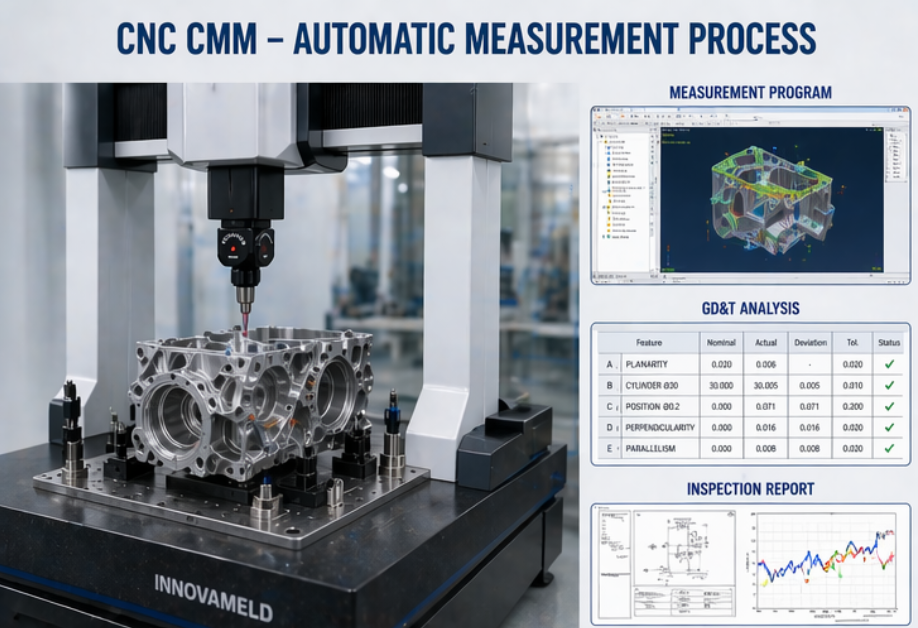
A CNC CMM system uses motorized control and measurement programs to move the probe automatically. Once the program is created, the machine can follow the same measuring path repeatedly. This makes CNC CMM systems suitable for batch inspection, production quality control, first article inspection, and parts that require consistent reporting.
Compared with manual CMMs, CNC CMMs reduce operator influence. The measurement strategy, probing points, movement path, and reporting method can be standardized. This improves repeatability and makes the inspection process more reliable for automotive parts, aerospace components, mold parts, precision machined components, and complex assemblies.
CNC CMM systems usually require stronger software capability and trained operators who can build, edit, and manage measurement programs. For buyers who need stable inspection results and repeated measurement of similar parts, CNC CMM is often the most practical choice.
3. What Is An Automated CMM System?
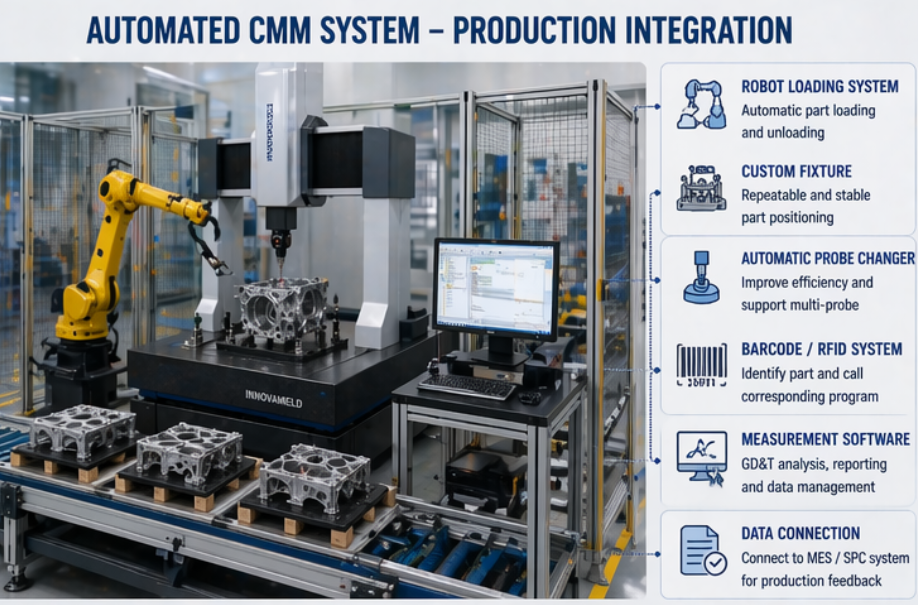
An automated CMM system goes beyond automatic measurement. It may integrate the CMM with automatic fixtures, part loading systems, robots, conveyors, barcode scanners, pallet systems, automatic probe changing, inspection software, and production data platforms. The goal is to reduce manual handling, improve inspection efficiency, and connect measurement results with production control.
Automated CMM systems are commonly considered when inspection volume is high, parts are repeated frequently, quality data must be collected continuously, or production lines need faster feedback. For example, automotive manufacturing, precision machining, electronics, medical devices, and high-volume component production may benefit from automated inspection workflows.
However, automation also requires more planning. Buyers must evaluate part loading method, fixture repeatability, robot or conveyor layout, software integration, safety design, data output, maintenance, and operator training. Automated systems should be designed around the complete production workflow, not only around the CMM machine itself.
4. Manual vs CNC vs Automated CMM: Key Differences
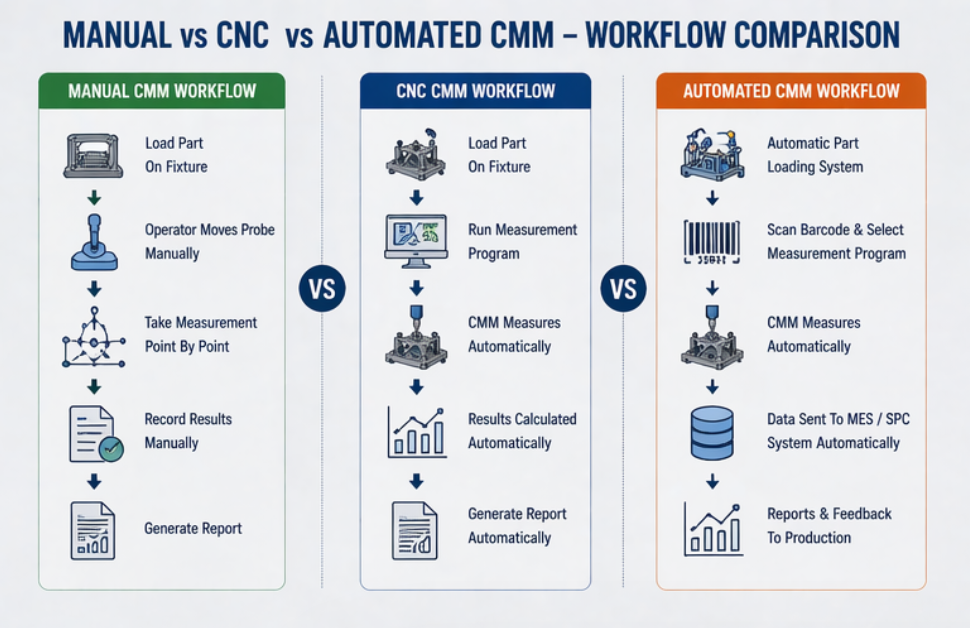
The best system type depends on inspection volume, tolerance requirement, part variety, operator skill, reporting needs, and future production plans. The table below summarizes the main differences buyers should compare before selecting a CMM system.
| Comparison Item | Manual CMM | CNC CMM | Automated CMM System |
|---|---|---|---|
| Operation Method | Operator moves and measures manually | Machine follows programmed measurement paths | CMM integrated with automatic handling and workflow systems |
| Best For | Low-volume, flexible, or sample inspection | Batch inspection and repeatable quality control | High-volume production and process integration |
| Operator Dependence | High | Medium to low after program setup | Low during routine operation, higher during system setup |
| Repeatability | Depends strongly on operator method | Good repeatability with stable programs | High repeatability if fixture and automation are well designed |
| Inspection Speed | Suitable for limited workload | Faster for repeated programs | Highest efficiency for repeated production tasks |
| Software Requirement | Basic measurement and reporting may be enough | Programming, CAD, GD&T, and automatic reports | Advanced software, data output, and production integration |
| Investment Level | Usually lower | Medium to higher | Highest, but can reduce labor and improve throughput |
5. When Should You Choose A Manual CMM?
A manual CMM may be suitable when the inspection workload is not heavy, part variety is high, and measurement tasks change frequently. It is often used in tool rooms, prototype workshops, small batch production, maintenance inspection, and basic quality checks. If the inspection process requires frequent judgment from experienced operators, manual operation can provide useful flexibility.
Choose A Manual CMM If You Need:
Flexible inspection for many different parts
Low to medium inspection volume
Basic dimensional checks and sample measurement
Lower initial investment
Operator-controlled measurement for special cases
Buyers should remember that manual CMM results depend heavily on operator training and measurement procedures. If strict repeatability is required, CNC operation may be a better long-term option.
6. When Should You Choose A CNC CMM?
A CNC CMM is usually the best choice when parts must be inspected repeatedly with consistent measurement methods. Once the inspection program is created, operators can run the same measurement routine with less variation. This is important for automotive components, aerospace parts, mold components, precision machining, and production quality control.
Choose A CNC CMM If You Need:
Repeatable inspection for batch production
Automatic measurement programs
Reduced operator influence
Stable GD&T evaluation and reporting
Better efficiency for repeated part families
Compatibility with advanced probe systems and software
For many industrial buyers, CNC CMM provides the best balance between accuracy, repeatability, flexibility, and investment cost.
7. When Should You Choose An Automated CMM System?
An automated CMM system is suitable when inspection must be integrated into a larger production or quality control process. If the same parts are measured frequently, if inspection data must be collected continuously, or if manual loading limits productivity, automation may provide strong long-term value.
Choose An Automated CMM System If You Need:
High-volume or repeated production inspection
Automatic part loading and unloading
Integration with robots, conveyors, or pallet systems
Barcode identification and automatic program selection
Inspection data connection with production systems
Reduced manual handling and faster feedback to production
Automated CMM systems require more project planning, but they can improve throughput, reduce labor dependence, and support data-driven quality control when the application is suitable.
8. How To Decide Which CMM System Type Is Right For You
Buyers should not choose the system type only by budget. A lower-cost manual system may become inefficient if inspection volume increases. A fully automated system may be unnecessary if parts change frequently and measurement volume is low. The right choice should match real inspection work and future production plans.
| Your Situation | Recommended System Type | Main Reason |
|---|---|---|
| Many different parts, low inspection volume | Manual CMM | Flexible and suitable for changing tasks |
| Repeated inspection of similar parts | CNC CMM | Improves repeatability and inspection efficiency |
| Strict GD&T and customer reporting | CNC CMM | Supports standardized programs and reports |
| High-volume production inspection | Automated CMM System | Reduces manual handling and improves throughput |
| Need data connection with production systems | Automated CMM System | Supports digital quality control and process feedback |
9. Common Mistakes To Avoid
Choosing a manual CMM when batch inspection requires stable repeatability.
Buying a CNC CMM without considering software programming and operator training.
Choosing automation before confirming part stability, fixture design, and loading method.
Ignoring future production volume and possible part family expansion.
Comparing only machine price instead of total inspection efficiency.
Underestimating the importance of reporting, data output, and quality documentation.
Failing to test the real inspection workflow before final acceptance.
Avoiding these mistakes helps buyers select a CMM system that supports both current inspection tasks and future quality control development.
Conclusion
Manual, CNC, and automated CMM systems serve different inspection needs. A manual CMM is flexible and suitable for low-volume or changing inspection tasks. A CNC CMM is better for repeatable measurement, batch inspection, and standardized quality reports. An automated CMM system is designed for high-volume production, automatic handling, and data-connected quality control. Buyers should evaluate part variety, inspection volume, tolerance requirements, operator skill, software needs, reporting requirements, and future automation plans before selecting the right system.
Need Help Choosing The Right CMM System?
Contact us to discuss your part drawings, inspection volume, tolerance requirements, software needs, and automation plan. We can help you evaluate a suitable manual, CNC, or automated CMM solution for your application.