


How To Choose CMM Probes, Fixtures And Measurement Software Together
2026-05-08 15:32How To Choose CMM Probes, Fixtures And Measurement Software Together
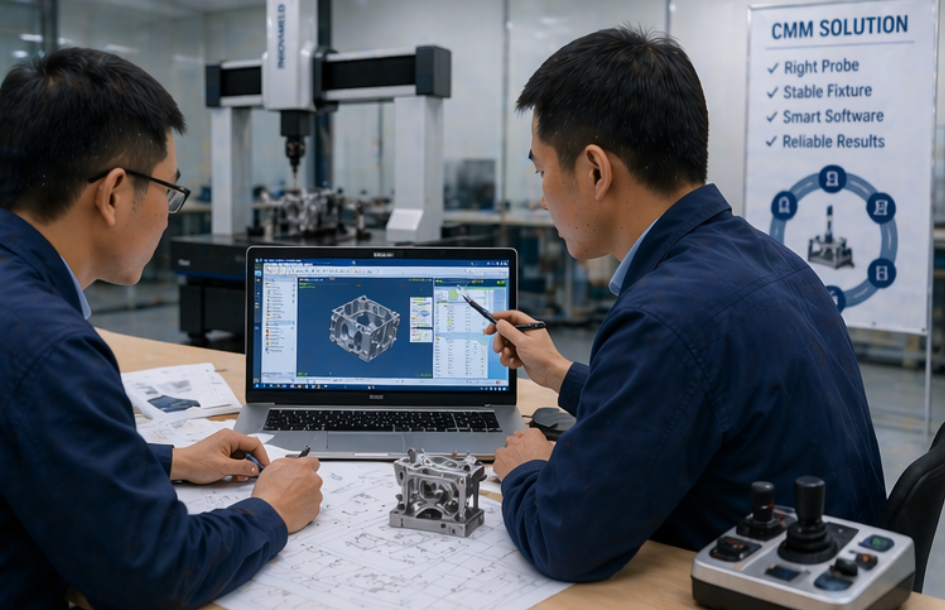
A coordinate measuring machine is not only a machine frame with X, Y, and Z movement. Real inspection performance depends on how well the CMM probe, fixture, measurement software, part geometry, and inspection workflow work together. Many buyers choose the CMM machine first and consider probes, fixtures, and software later. This often leads to poor probe access, unstable part positioning, slow programming, incomplete reports, or measurement results that are difficult to repeat. This guide explains how to select CMM probes, fixtures, and measurement software as one complete inspection system.
Quick Answer
CMM probes, fixtures, and measurement software should be selected together because they directly affect measurement accessibility, repeatability, programming efficiency, GD&T evaluation, and report quality. Buyers should start from the part drawing, tolerance requirements, datum structure, measured features, inspection frequency, and reporting needs, then match the probe system, fixture design, and software functions as one complete solution.
1. Why Probes, Fixtures And Software Should Not Be Selected Separately
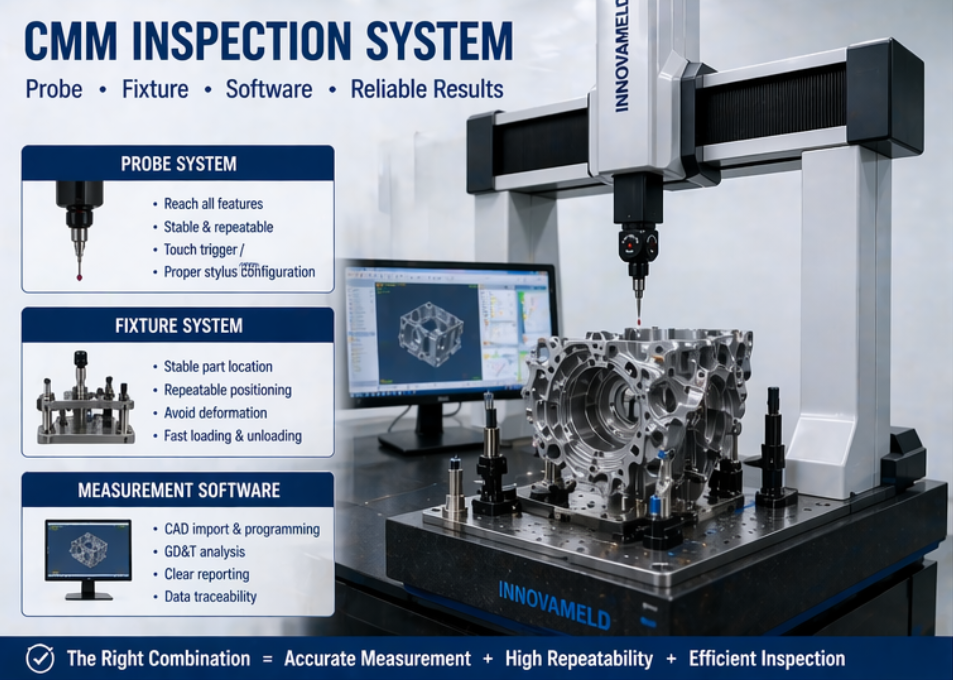
In real industrial inspection, the CMM machine only provides the measurement platform. The probe collects the data, the fixture holds the part, and the software turns measurement data into usable inspection results. If any one of these elements is not matched to the application, the whole inspection process can become inefficient or unreliable.
For example, a high-accuracy CMM may still fail to inspect deep holes if the probe and stylus configuration cannot reach the feature. A powerful software package may still produce unstable reports if the fixture cannot locate the part repeatedly. A well-designed fixture may still be difficult to use if the software program does not match the actual inspection workflow.
This is why buyers should treat the CMM probe system, fixture system, and measurement software as one integrated inspection package. The goal is not only to measure a part once, but to measure it accurately, repeatably, efficiently, and in a way that supports production quality control.
2. Start From The Part Drawing And Inspection Requirement
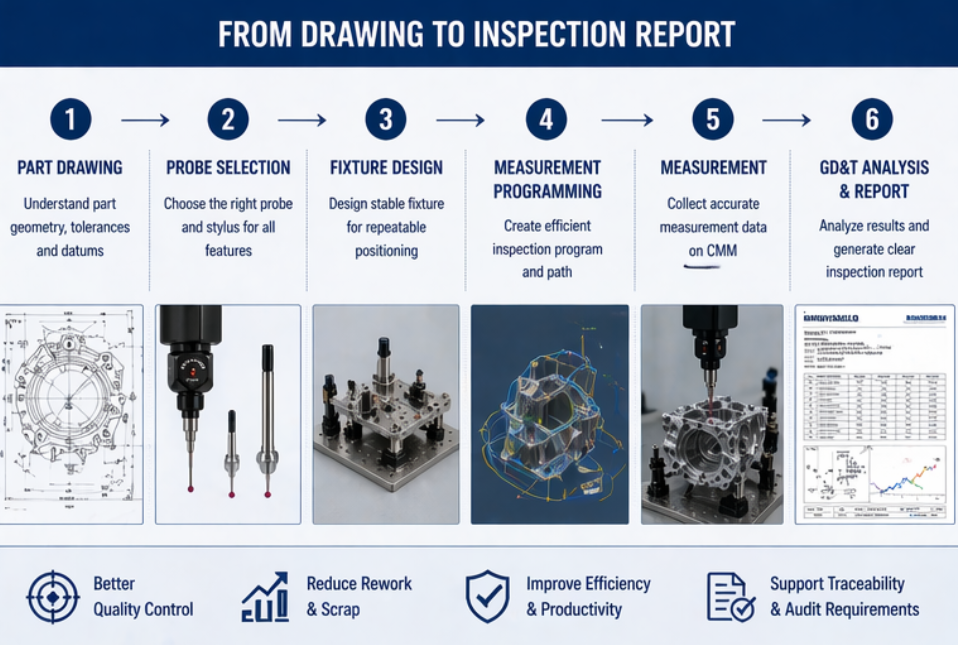
The correct selection process should always start with the part drawing, CAD model, tolerance requirement, and inspection purpose. Buyers should identify which features must be measured, which datums must be used, how tight the tolerances are, and how often the same part will be inspected. These details determine the probe type, stylus length, fixture design, software functions, and reporting format.
A simple machined block may only need a touch trigger probe and basic fixture. A turbine blade, automotive housing, mold insert, or medical component may require scanning probes, complex stylus configurations, dedicated fixtures, CAD comparison, and advanced GD&T reporting.
| Inspection Requirement | Probe Consideration | Fixture And Software Consideration |
|---|---|---|
| Hole position and datum features | Touch trigger probe, suitable stylus length | Repeatable datum location and GD&T evaluation |
| Complex surfaces and profiles | Scanning probe or multi-point strategy | Stable fixture support and CAD comparison software |
| Batch production inspection | Durable probe configuration for repeated programs | Fast loading fixture and automatic reporting |
| Thin or flexible parts | Low-force probing strategy | Support fixture to avoid deformation |
| Hard-to-reach features | Angled styli, star styli, extensions | Collision-free program planning and fixture clearance |
The more clearly the inspection requirement is defined, the easier it is to build a CMM package that works reliably after installation.
3. How To Choose The Right CMM Probe System
The probe system determines how measurement data is collected. A touch trigger probe is commonly used for discrete point measurement, hole positions, planes, edges, and many standard dimensional checks. It is practical, widely used, and suitable for many general industrial inspection tasks.
A scanning probe may be more suitable when the part includes complex surfaces, freeform profiles, turbine blades, molds, curves, or features that require dense measurement data. Scanning can improve data coverage and support better surface or profile analysis, but it also requires suitable software and a stable fixture setup.
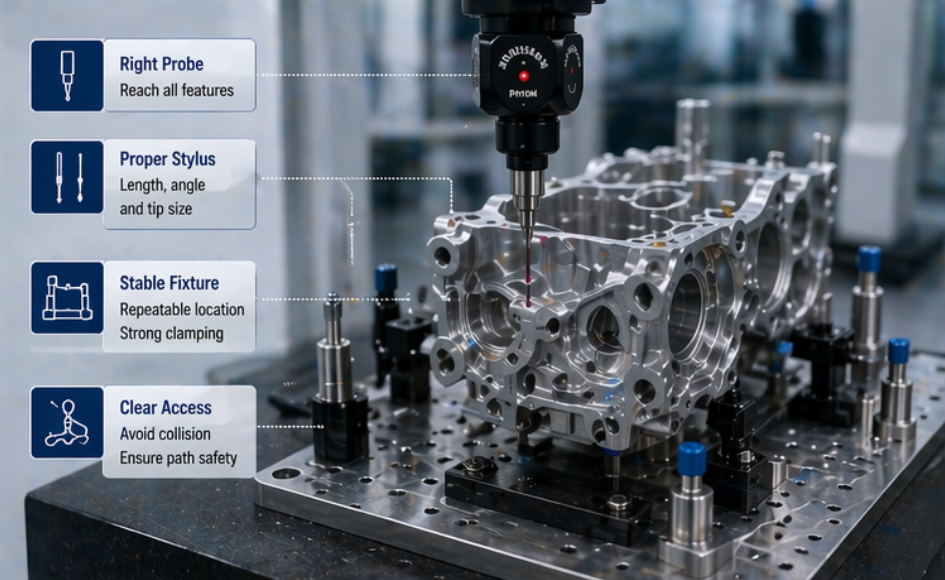
Stylus configuration is also important. Long styli, angled styli, star styli, and extension bars may help reach complex features, but they can also affect measurement stability if not selected properly. The probe system should be chosen according to feature access, tolerance requirement, part material, and measurement strategy.
Probe Selection Checklist
Are the measured features mainly points, holes, planes, profiles, or surfaces?
Is touch trigger measurement enough, or is scanning measurement needed?
Can the probe reach all critical features without collision?
Are long, angled, or star styli required?
Will the probe configuration remain stable for repeated batch inspection?
Does the software support the selected probe and measurement strategy?
4. How To Design A Fixture For Repeatable Measurement
The fixture controls how the part is positioned during measurement. In production inspection, repeatable fixture positioning is often just as important as machine accuracy. If the same part is placed differently every time, the CMM may produce inconsistent results even when the machine itself is accurate.
A good fixture should locate the part based on proper datums, support the workpiece without deformation, provide enough probe access, and allow operators to load and unload parts efficiently. For batch inspection, fixture design should also consider speed, repeatability, maintenance, and possible part variants.
For thin-walled parts, plastic components, aluminum castings, aerospace parts, or complex machined components, clamping force must be controlled carefully. A fixture that is too strong may deform the part, while a fixture that is too loose may reduce repeatability.
5. How Measurement Software Supports The Whole Inspection Process
Measurement software connects the machine, probe, fixture, CAD model, inspection program, and final report. Buyers should evaluate software capability early, not after the machine is ordered. The software should support the actual inspection tasks required by the part drawings and quality system.
Important software functions may include CAD import, offline programming, GD&T analysis, profile evaluation, scanning data processing, automatic report generation, SPC output, pass/fail judgment, and data export. For automotive, aerospace, medical, mold, and precision machining applications, software reporting quality can strongly affect customer communication and audit readiness.
Software usability also matters. If daily operators cannot program, edit, measure, and generate reports efficiently, inspection productivity will suffer. A suitable software platform should be powerful enough for engineering requirements and practical enough for routine quality inspection.
6. Match Probe, Fixture And Software By Application Type
Different applications require different combinations. Buyers should avoid one-size-fits-all configurations and instead build the measurement package around part geometry, tolerance, production volume, and reporting needs.
| Application Type | Recommended Probe Focus | Fixture And Software Focus |
|---|---|---|
| Automotive housings | Touch trigger probe, angled styli for bores and datums | Repeatable fixture, GD&T reporting, batch programs |
| Aerospace blades | Scanning probe for curved surface profiles | Low-deformation fixture, CAD comparison, profile analysis |
| Mold and die components | Scanning or multi-point measurement strategy | Stable support, surface comparison, deviation report |
| Small precision parts | Short stable stylus, high repeatability probe setup | Compact fixture, automatic report templates |
| Batch production inspection | Durable repeatable probe configuration | Fast fixture loading, CNC programs, SPC output |
The right combination reduces inspection time, improves repeatability, and makes measurement results easier to use in daily production quality control.
7. Common Mistakes To Avoid
Choosing the CMM machine first and considering probes, fixtures, and software later.
Using a probe system that cannot reach all critical features.
Selecting long or complex styli without checking measurement stability.
Ignoring fixture repeatability in batch inspection.
Using excessive clamping force on thin or flexible parts.
Buying software without checking GD&T, CAD, scanning, or reporting needs.
Failing to test the complete measurement workflow before final acceptance.
Underestimating operator training for probe setup, fixture use, and software programming.
Avoiding these mistakes helps buyers build a more reliable inspection process and reduces the risk of configuration mismatch after the CMM is delivered.
8. What Information Should Be Prepared Before Quotation?
To recommend the right probe, fixture, and software combination, buyers should prepare complete application information. This allows the technical team to evaluate measurement feasibility, probe access, fixture design, software workflow, and reporting requirements before proposing a configuration.
Recommended Information Checklist
Part drawings and CAD files
Critical dimensions and tolerance requirements
Datum structure and GD&T requirements
Maximum part size and weight
Features that are difficult to reach or measure
Inspection frequency and batch volume
Required report format and data output
Current inspection problems or improvement goals
Conclusion
Choosing CMM probes, fixtures, and measurement software together is essential for reliable industrial inspection. The probe determines how data is collected, the fixture determines how repeatably the part is positioned, and the software determines how measurement data becomes usable quality information. Buyers should start from part drawings, tolerances, geometry, inspection frequency, and reporting requirements, then build a complete measurement package around the real application. A well-matched CMM inspection system can improve accuracy, repeatability, productivity, and long-term quality control.
Need Help Matching CMM Probes, Fixtures And Software?
Contact us to discuss your part drawings, tolerance requirements, probe access, fixture needs, and reporting workflow. We can help you evaluate a suitable CMM inspection configuration for your application.