


How Temperature, Vibration And Environment Affect CMM Accuracy
2026-05-07 15:28How Temperature, Vibration And Environment Affect CMM Accuracy
A coordinate measuring machine can only deliver reliable accuracy when the working environment supports precision measurement. Many buyers focus on machine structure, measuring range, probe system, and software, but underestimate the influence of temperature, vibration, dust, humidity, air flow, floor stability, and workshop layout. Even a high-accuracy CMM may produce unstable measurement results if it is installed in an unsuitable environment. This guide explains how temperature, vibration, and other environmental factors affect CMM accuracy, and what buyers should check before installation.
Quick Answer
Temperature fluctuation, vibration, humidity, dust, air flow, unstable floor conditions, and poor installation layout can all reduce CMM measurement accuracy. Temperature changes may cause material expansion or contraction. Vibration may affect repeatability and probing stability. Dust, humidity, and poor air quality may influence machine reliability. To maintain stable CMM accuracy, buyers should prepare a suitable metrology environment before installation.
1. Why The CMM Environment Matters
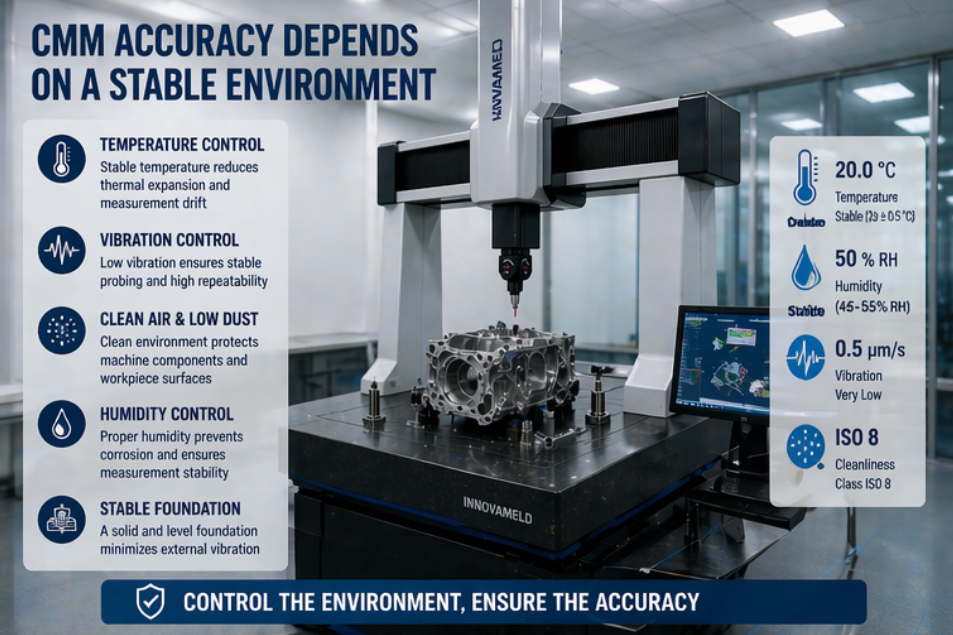
A CMM is a precision measurement system. Its performance depends not only on the machine body, scale system, probe, software, and calibration, but also on the environment in which it operates. A machine that performs well during factory acceptance may not deliver the same results after installation if the site has unstable temperature, strong vibration, dust, or poor foundation conditions.
This is especially important for industries such as automotive, aerospace, precision machining, mold manufacturing, electronics, and medical components. These applications often require stable repeatability, clear inspection reports, and reliable tolerance decisions. If the environment causes measurement drift, the quality team may face false rejections, inconsistent reports, repeated inspections, and production delays.
Before ordering or installing a CMM, buyers should evaluate whether the machine will be placed in a controlled metrology lab, a quality room, or near the production floor. The required environmental control level should match the accuracy and tolerance requirements of the parts being inspected.
2. How Temperature Affects CMM Accuracy
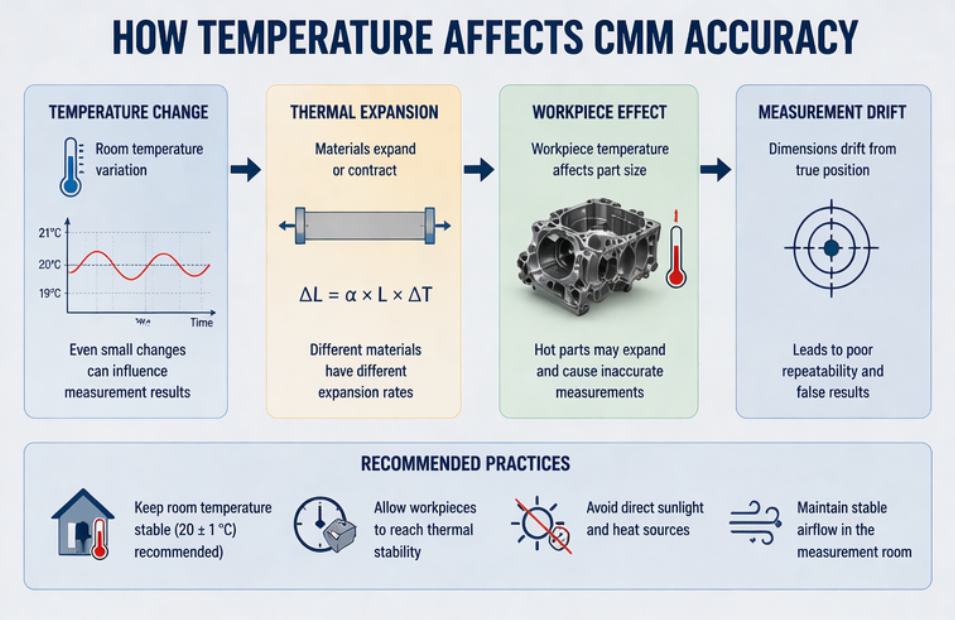
Temperature is one of the most important environmental factors affecting CMM accuracy. When temperature changes, both the workpiece and the machine structure may expand or contract. Even small changes can influence measurement results, especially when measuring long parts, tight tolerances, or high-precision features.
Different materials expand at different rates. A steel part, aluminum part, granite table, fixture, and machine structure may respond differently to temperature changes. If a part is moved directly from a hot production area to a measurement room, it may not immediately reach thermal stability. Measuring too soon can produce inaccurate results.
| Temperature Issue | Possible Effect | Recommended Action |
|---|---|---|
| Room temperature fluctuation | Measurement drift and unstable results | Use controlled room temperature and avoid rapid changes |
| Hot workpieces from production | Part size changes before thermal balance | Allow parts to stabilize before measurement |
| Direct sunlight or local heat source | Uneven thermal expansion | Avoid windows, heaters, and heat-generating machines nearby |
| Operator heat and airflow | Small but noticeable measurement influence | Keep stable room airflow and standard operating procedures |
If the CMM is used for high-accuracy inspection, temperature control should be considered part of the measurement system, not a separate facility issue.
3. How Vibration Affects Repeatability And Measurement Stability
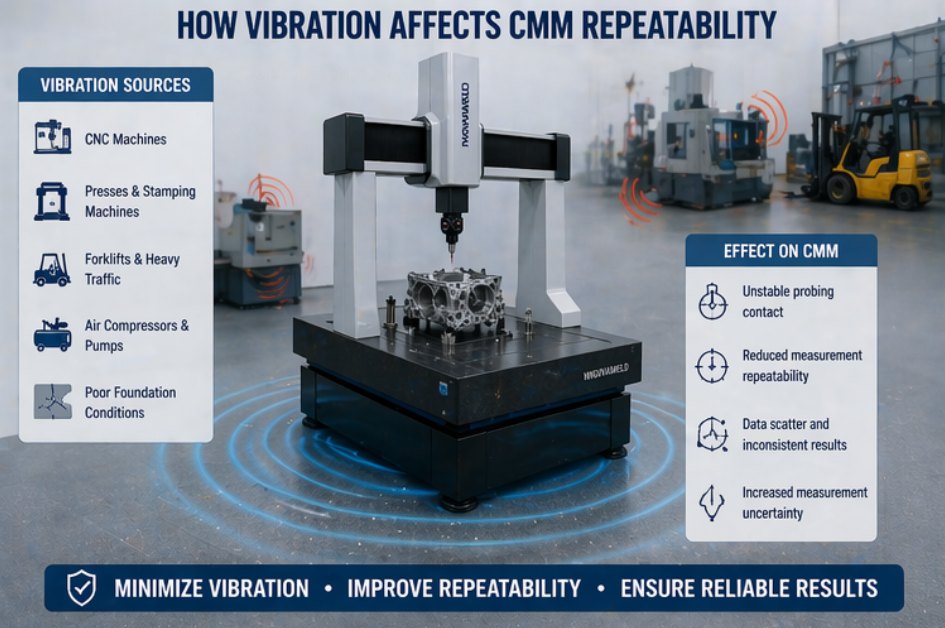
Vibration is another common reason for unstable CMM results. A CMM may be affected by nearby CNC machines, stamping equipment, forklifts, compressors, heavy traffic, cranes, or unstable floors. Even if vibration is not visible, it can still influence probing contact, scale reading, machine movement, and measurement repeatability.
Vibration can be especially problematic when measuring small tolerances, thin features, delicate parts, or complex profiles. It may cause inconsistent measurement results when the same feature is measured repeatedly. This creates confusion for operators and may lead to unnecessary rework or quality disputes.
Common Vibration Sources Around A CMM
CNC machining centers and grinding machines
Stamping presses, forging equipment, and punching machines
Forklifts, cranes, and heavy material handling vehicles
Air compressors, pumps, and large ventilation systems
Unstable floors or weak foundation conditions
Nearby production lines with frequent mechanical movement
To reduce vibration influence, buyers should choose a stable installation location, review floor conditions, avoid heavy machines nearby, and consider vibration isolation when necessary. For high-precision applications, site evaluation before installation is strongly recommended.
4. Dust, Humidity, Air Quality, And Cleanliness
Dust and air contamination may not immediately change a measurement result, but they can affect machine reliability, guideway cleanliness, probe performance, air bearing operation, and long-term stability. In workshops with grinding dust, oil mist, metal chips, or high humidity, the CMM may require additional protection and maintenance.
Humidity can also influence sensitive components, electronics, air systems, and surface condition. If humidity is too high, corrosion risk may increase. If the air supply is not clean and stable, machines that rely on air bearings or pneumatic systems may experience performance issues.
| Environmental Factor | Risk To CMM Performance | Control Method |
|---|---|---|
| Dust | Contamination on guideways, probes, and workpieces | Use clean room area and regular cleaning procedures |
| Oil mist | Surface contamination and machine maintenance issues | Keep CMM away from machining areas or use separation |
| High humidity | Corrosion risk and electronic reliability concerns | Control humidity and maintain stable air quality |
| Poor compressed air | Air bearing or pneumatic system instability | Ensure clean, dry, and stable compressed air supply |
5. Floor Stability And Installation Layout
The floor and layout of the installation area also affect CMM accuracy and operation. A weak or uneven floor may create instability, especially for larger machines. If the CMM is installed in an area with frequent forklift movement, heavy machine operation, or poor foundation, vibration and leveling problems may occur.
The layout should allow safe part loading, operator access, computer workstation placement, maintenance space, and environmental control. If the space is too narrow, operators may have difficulty loading workpieces or maintaining consistent procedures. Poor layout can reduce inspection efficiency even when the machine itself is accurate.
Before installation, buyers should check the machine footprint, table capacity, unloading route, door size, crane access, power supply, compressed air, and room layout. These details help prevent installation delays and daily operation problems.
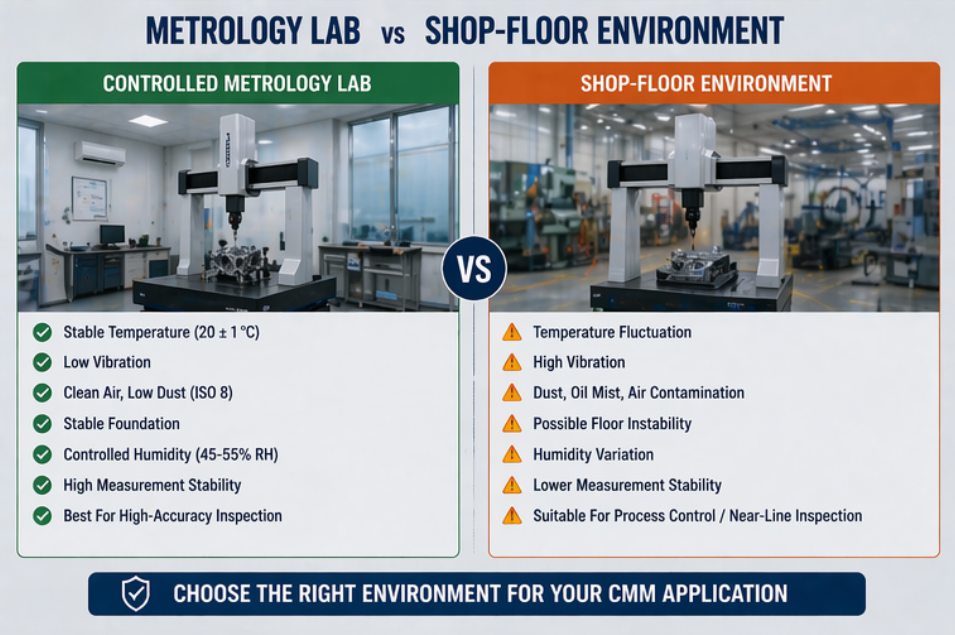
6. Lab CMM vs Shop-Floor CMM Environment
A CMM installed in a dedicated metrology lab usually has better temperature control, lower vibration, cleaner air, and more stable operating conditions. This is suitable for high-precision inspection, calibration-related work, aerospace components, precision molds, and critical tolerance verification.
A CMM used near the production floor may improve inspection speed and reduce part movement, but it faces more environmental challenges. In this case, buyers should consider machine robustness, temperature compensation, vibration control, protective covers, operator procedures, and maintenance frequency.
| Installation Type | Advantages | Main Checks |
|---|---|---|
| Metrology Lab | Better accuracy stability and controlled conditions | Temperature, humidity, cleanliness, calibration workflow |
| Quality Room Near Production | Closer to production while still partially controlled | Airflow, vibration, part stabilization, operator procedure |
| Shop-Floor Area | Fast inspection feedback and reduced part transfer | Vibration, dust, temperature fluctuation, machine protection |
The best choice depends on inspection purpose. High-accuracy final inspection usually benefits from a controlled lab environment, while production process control may require a more practical near-line solution.
7. Environmental Checklist Before Installing A CMM
Is the room temperature stable enough for the required accuracy level?
Are parts given enough time to reach thermal stability before measurement?
Are there vibration sources such as CNC machines, presses, compressors, or forklifts nearby?
Is the floor stable, level, and suitable for the CMM size and weight?
Is the air clean, dry, and free from heavy dust or oil mist?
Is humidity controlled to protect the machine and workpieces?
Is there enough space for loading, unloading, maintenance, and operator movement?
Are power supply, grounding, compressed air, and room layout ready before installation?
Is the machine location protected from direct sunlight, heaters, doors, and strong airflow?
Are operators trained to follow standard measurement procedures?
This checklist helps buyers reduce measurement risk and prepare a stable working environment before CMM installation.
Conclusion
Temperature, vibration, dust, humidity, air quality, floor stability, and installation layout all affect CMM accuracy. A high-performance coordinate measuring machine can only deliver stable results when the environment is properly controlled. Buyers should evaluate the installation site before ordering or installing the machine, especially when measuring tight tolerances, aerospace components, automotive parts, molds, and precision machined components. By preparing a suitable environment, manufacturers can improve repeatability, reduce measurement errors, and get more reliable inspection results from their CMM system.
Need Help Preparing A Suitable CMM Environment?
Contact us to discuss your CMM application, accuracy requirement, installation site, temperature condition, vibration risk, and inspection workflow. We can help you evaluate a suitable CMM solution for stable and reliable measurement.