


What Buyers Should Check Before Ordering A CMM Machine
2026-05-06 15:24What Buyers Should Check Before Ordering A CMM Machine
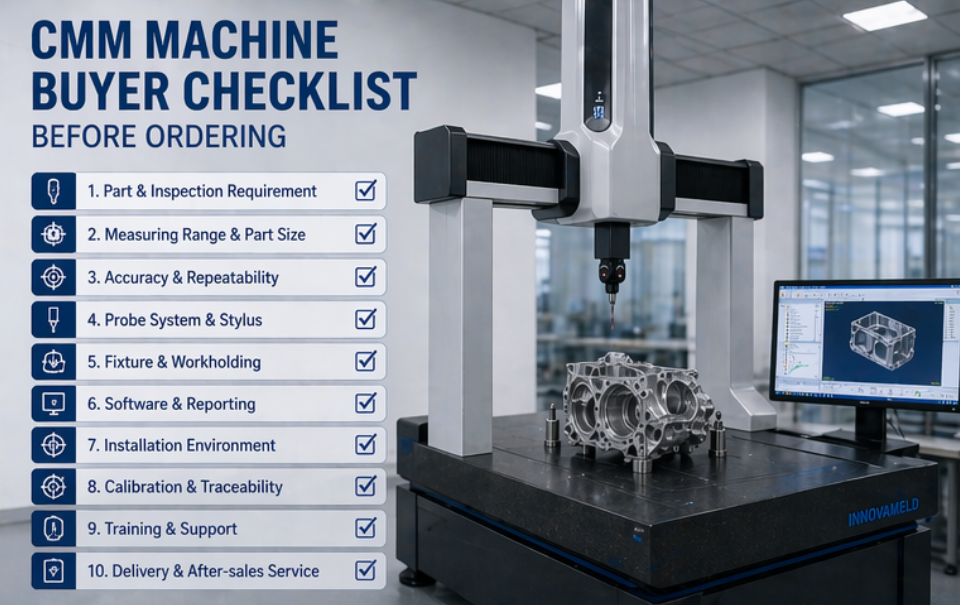
Ordering a coordinate measuring machine is not only a machine purchase. It is a long-term investment in dimensional inspection, production quality, process control, and customer approval. Many buyers compare only price, machine size, or catalog accuracy before placing an order, but a successful CMM project requires much more. Before ordering, buyers should confirm part requirements, measuring range, accuracy level, probe system, software functions, fixture needs, installation environment, calibration support, training, and after-sales service. This guide explains the key points that should be checked before buying a CMM machine for industrial inspection.
Quick Answer
Before ordering a CMM machine, buyers should check the measured part size, tolerance level, machine accuracy, measuring range, probe configuration, software capability, fixture requirements, installation environment, calibration documents, operator training, warranty terms, delivery schedule, and long-term technical support. A complete pre-order review helps avoid configuration mismatch, installation problems, and unnecessary project delays.
1. Confirm The Real Inspection Requirement First
The first thing buyers should check is the real inspection requirement. A CMM should be selected according to the actual parts, not only according to a general machine catalog. Buyers should prepare part drawings, CAD files, tolerance information, material type, weight, geometry, and key features that need to be measured. Without this information, it is difficult to recommend the right CMM configuration.
For example, an automotive housing, aerospace bracket, mold insert, machined aluminum part, and plastic component may require very different measuring strategies. Some parts need high repeatability for batch inspection, while others need scanning capability for complex surfaces. Some parts are easy to locate, while others require dedicated fixtures and special probe access.
Buyers should clearly define whether the CMM will be used for incoming inspection, first article inspection, process control, final inspection, reverse engineering, or long-term quality documentation. This decision affects the machine structure, software, probe system, and workflow design.
2. Check Measuring Range, Part Size, And Fixture Space
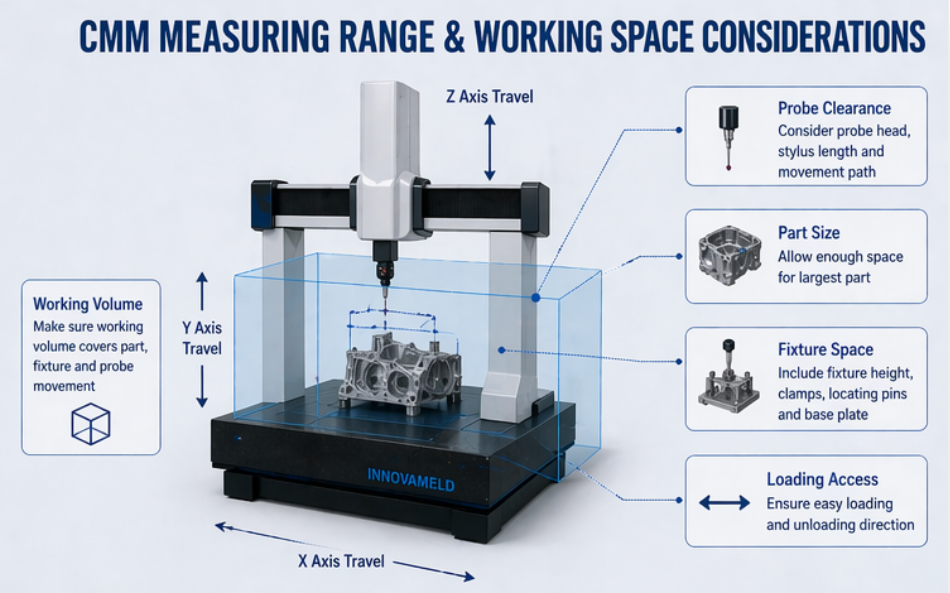
Measuring range is one of the most important points to check before ordering a CMM machine. Buyers should not only compare the maximum part size with the machine travel. They should also consider fixture space, probe movement, stylus clearance, part loading direction, and future part variations. A machine that looks large enough on paper may become limited when the fixture and probe path are added.
It is usually better to leave enough measuring margin for practical operation. If the part is heavy, large, or difficult to load, buyers should also evaluate table capacity, crane access, operator access, and workshop layout. These factors can directly affect daily inspection efficiency.
| Check Item | What To Confirm | Why It Matters |
|---|---|---|
| Maximum Part Size | Length, width, height, and part envelope | Determines basic machine measuring range |
| Part Weight | Maximum workpiece weight and loading method | Affects table capacity and machine layout |
| Fixture Space | Fixture height, clamps, locating pins, base plate | Prevents measurement range shortage after installation |
| Probe Clearance | Stylus length, probe angle, movement path | Ensures all critical features can be reached safely |
| Future Parts | Possible new product sizes and inspection needs | Improves long-term equipment usability |
3. Verify Accuracy, Repeatability, And Calibration Standards
Accuracy is a major factor in CMM purchasing, but buyers should not evaluate accuracy by only one specification value. The machine accuracy must match the real tolerance requirements of the parts. If the CMM uncertainty is too close to the product tolerance, the inspection result may not be reliable enough for quality decisions.
Repeatability is equally important. In industrial production, the same part or feature may be measured repeatedly. Stable repeatability helps reduce disputes, false rejection, rework, and inconsistent quality decisions. Buyers should ask how the machine accuracy is tested, under what conditions it is guaranteed, and what calibration or acceptance documents will be provided.
For export-oriented manufacturing, automotive parts, aerospace components, medical parts, and precision machining, calibration traceability and clear inspection documentation can be very important for customer audits and internal quality management.
4. Review Probe System, Stylus Configuration, And Fixture Needs
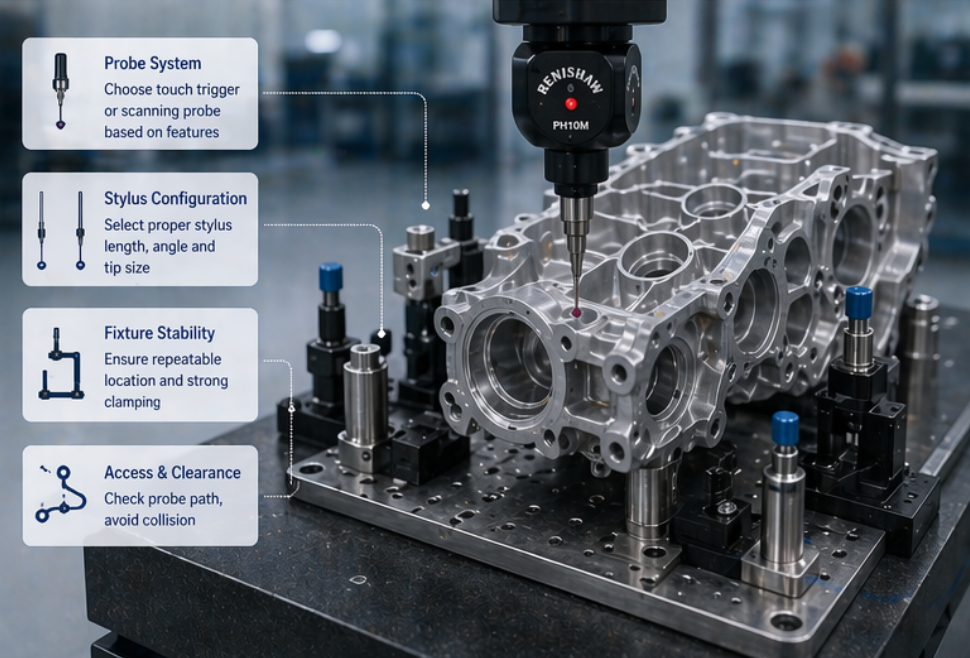
A CMM machine cannot work effectively without the right probe and fixture configuration. Buyers should check whether the proposed probe system can measure all required features, including holes, planes, slots, curved surfaces, deep features, angled faces, and hard-to-reach areas. Touch trigger probes are suitable for many standard dimensional inspections, while scanning probes may be better for profiles and complex surfaces.
Stylus configuration should also be reviewed carefully. Long styli, star styli, angled styli, and extension systems may be required depending on part geometry. If these details are ignored before ordering, the machine may be delivered but still unable to complete the real inspection task efficiently.
Probe And Fixture Checklist
Can the probe reach all required measurement features?
Is touch trigger measurement enough, or is scanning required?
Are special stylus lengths or angles needed?
Does the fixture locate the part repeatably?
Will clamping deform thin or lightweight parts?
Can the fixture support batch inspection efficiency?
A good CMM order should include not only the machine body, but also a practical measurement package that matches the real part and inspection process.
5. Check Software Functions And Reporting Capability
Software can greatly affect daily CMM productivity. Buyers should check whether the software supports CAD import, programming, GD&T evaluation, automatic report generation, profile analysis, data export, and clear pass/fail judgment. A machine with good hardware but weak software may still create slow inspection work and inconsistent reporting.
For production inspection, reporting capability is especially important. Quality teams may need reports for internal review, customer submission, production feedback, and audit records. Buyers should confirm whether the software can generate the required report format and whether operators can use it efficiently.
Before ordering, it is helpful to ask for software screenshots, report samples, and a demonstration based on similar parts. This can reduce the risk of buying a machine that is technically accurate but difficult to use in daily quality control.
6. Confirm Installation Environment And Site Preparation
A CMM machine is sensitive to the working environment. Temperature fluctuation, vibration, dust, humidity, unstable floor conditions, and poor air quality can affect measurement stability. Buyers should check whether the CMM will be installed in a controlled metrology room, quality lab, or shop-floor area.
Site preparation should be discussed before ordering. This may include foundation requirements, compressed air supply, power supply, room temperature control, vibration isolation, machine access path, unloading method, and installation space. If the site is not ready when the machine arrives, installation and acceptance may be delayed.
| Site Condition | What To Check | Possible Risk If Ignored |
|---|---|---|
| Temperature | Room stability and daily fluctuation | Measurement drift and unstable results |
| Vibration | Nearby machines, floor stability, traffic | Poor repeatability and inspection errors |
| Power And Air | Voltage, grounding, air quality, pressure | Installation failure or machine instability |
| Space Layout | Machine footprint, operator access, loading path | Difficult operation and unsafe handling |
| Cleanliness | Dust, oil mist, humidity, airflow | Reduced machine reliability and accuracy stability |
7. Review Delivery, Installation, Training, And After-Sales Support
Before ordering a CMM machine, buyers should clearly confirm the delivery schedule, packaging method, installation process, acceptance procedure, training arrangement, warranty terms, and technical support availability. These details can affect the real project timeline and long-term machine operation.
Operator training is especially important. Even a high-performance CMM may not deliver value if operators are not trained to create programs, use probes properly, interpret reports, and maintain the machine correctly. Buyers should ask what training is included and whether additional training is available after installation.
After-sales support should also be part of the purchasing decision. Buyers should confirm how technical questions, software issues, spare parts, calibration support, and maintenance needs will be handled after the machine is delivered.
8. Final Pre-Order Checklist For CMM Buyers
Have the part drawings, CAD files, and tolerance requirements been reviewed?
Is the measuring range large enough for the part, fixture, and probe movement?
Does the machine accuracy match the real inspection tolerance?
Has repeatability been considered for batch inspection?
Can the probe and stylus configuration reach all critical features?
Is fixture design required for stable and repeatable positioning?
Does the software support CAD, GD&T, reporting, and data export?
Is the installation environment suitable for precision measurement?
Are calibration, acceptance, and documentation requirements clear?
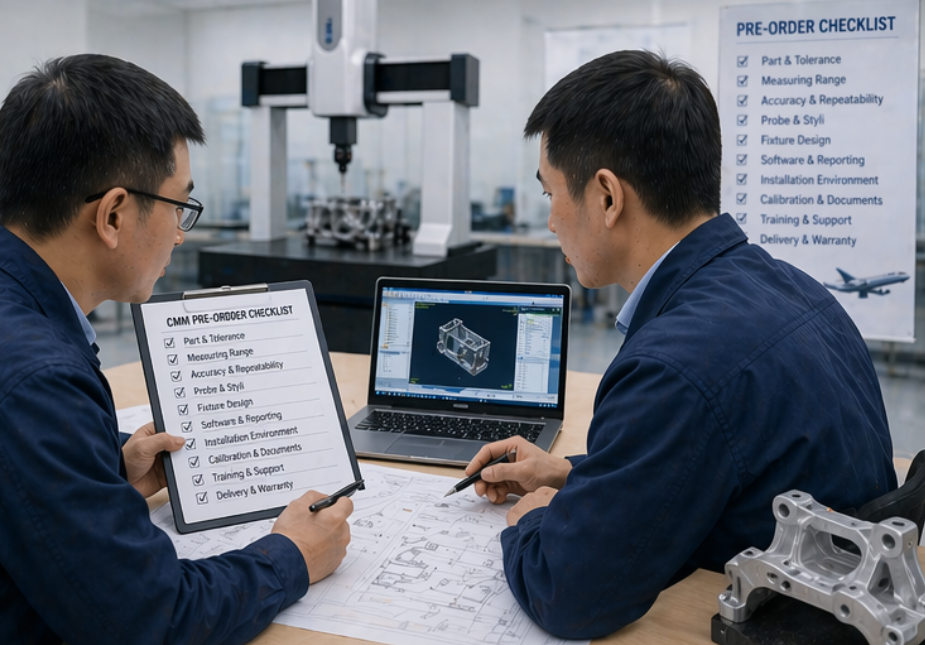
Are delivery, installation, training, warranty, and support terms confirmed?
A complete checklist helps buyers avoid hidden risks and ensures the ordered CMM machine can be used effectively after delivery.
Conclusion
Before ordering a CMM machine, buyers should carefully check inspection requirements, part size, measuring range, accuracy, repeatability, probe configuration, fixture needs, software functions, installation environment, calibration support, training, and after-sales service. A CMM should not be selected only by price or catalog specifications. It should be selected as a complete measurement solution that fits real parts, real tolerances, and real production workflows. With a thorough pre-order review, buyers can reduce procurement risk, avoid configuration mistakes, and build a more reliable industrial inspection process.
Need Help Reviewing Your CMM Machine Requirements?
Contact us to discuss your part drawings, tolerance requirements, measuring range, software needs, and installation environment. We can help you evaluate a suitable CMM configuration before ordering.