


How To Choose A CMM For Aerospace Component Measurement
2026-05-05 15:21How To Choose A CMM For Aerospace Component Measurement
Aerospace component measurement requires much more than basic dimensional inspection. Parts such as turbine blades, structural brackets, precision housings, engine components, landing gear parts, and machined aerospace assemblies often involve tight tolerances, complex geometry, strict traceability, and demanding reporting requirements. Choosing the right coordinate measuring machine is critical for ensuring measurement confidence, process control, and quality documentation. This guide explains what industrial buyers should evaluate before selecting a CMM for aerospace component measurement.
Quick Answer
For aerospace component measurement, buyers should focus on CMM accuracy, repeatability, volumetric performance, probing flexibility, scanning capability, fixture stability, software GD&T functions, environmental control, calibration traceability, and inspection reporting. The right CMM should match the part geometry, tolerance level, measurement workflow, and quality documentation requirements.
1. Start From The Aerospace Part And Measurement Purpose
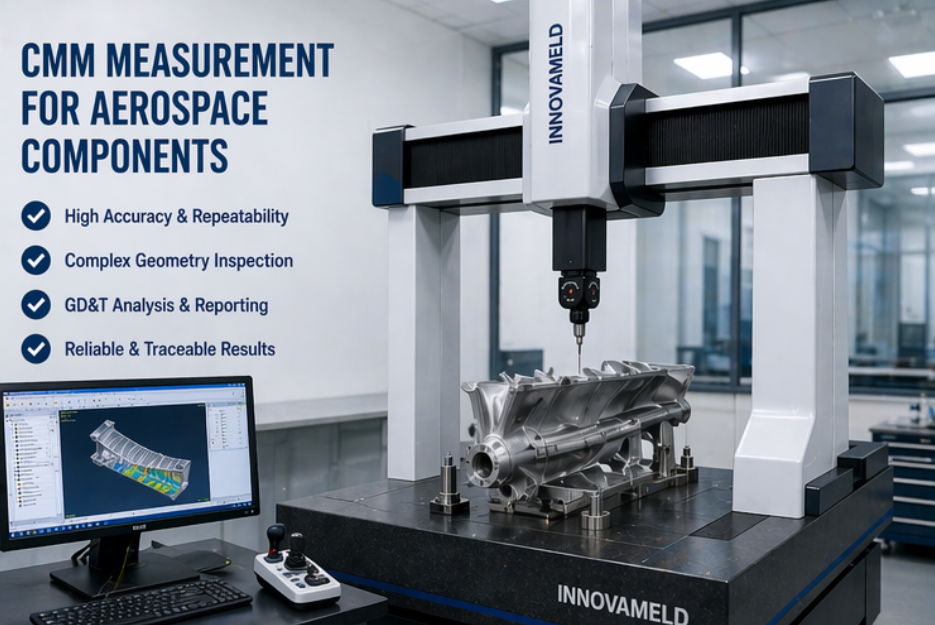
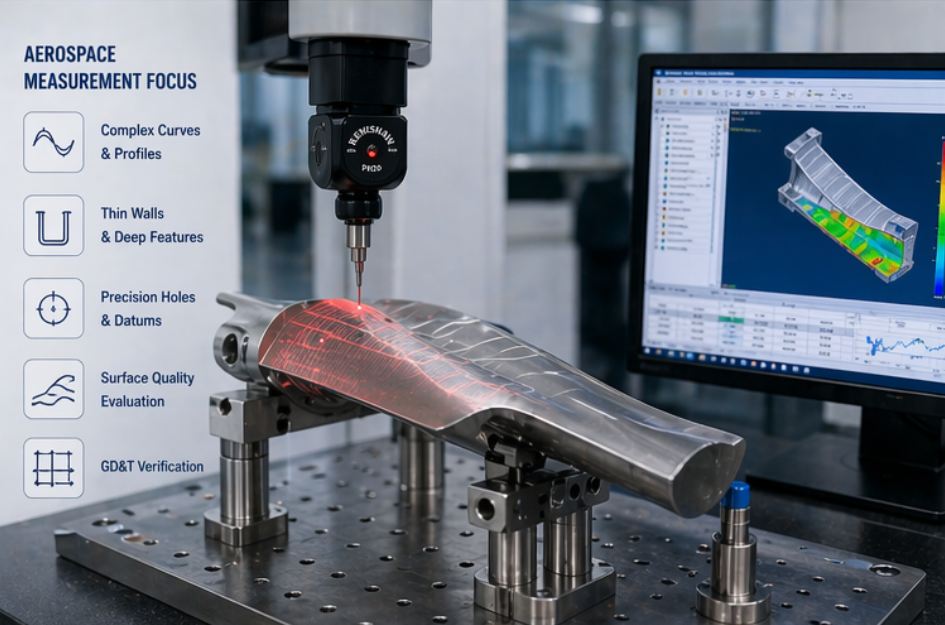
Aerospace parts are often difficult to measure because they may include thin walls, curved surfaces, deep holes, tight datum relationships, complex profiles, and strict geometric tolerances. Before selecting a CMM, buyers should clearly define what type of aerospace component will be measured and what inspection purpose the machine must support.
Some CMMs are used for first article inspection, while others are used for batch quality control, process verification, tooling inspection, or final outgoing inspection. Each purpose may require a different machine configuration. For example, turbine blades may require scanning capability and surface profile evaluation, while structural brackets may require accurate hole position, flatness, perpendicularity, and datum relationship measurement.
A suitable CMM solution should be selected based on part size, part weight, tolerance range, inspection frequency, drawing requirements, and the level of reporting needed by the aerospace quality system.
2. Match Accuracy And Repeatability To Aerospace Tolerances
Accuracy is one of the most important considerations for aerospace measurement, but buyers should not evaluate accuracy by one catalog number alone. The CMM must provide stable measurement confidence for the actual tolerances on the drawing. Repeatability is also critical because aerospace inspection often requires consistent results across multiple measurements, operators, programs, and production batches.
Volumetric accuracy is especially important when features are distributed across a large workpiece. If the CMM measures only a small area accurately but loses stability across the full measuring volume, the inspection result may not be reliable for large aerospace structures or complex assemblies.
| Aerospace Part Type | Typical Measurement Focus | CMM Selection Priority |
|---|---|---|
| Turbine Blades | Profile, curved surfaces, leading edge, trailing edge | Scanning probe, CAD comparison, profile analysis |
| Aerospace Brackets | Hole position, datum relationship, flatness, angles | Repeatability, GD&T software, fixture stability |
| Engine Components | Bores, planes, profiles, coaxiality, position | Volumetric accuracy, probe access, inspection program stability |
| Structural Parts | Large dimension, hole patterns, assembly interfaces | Large measuring range, stable structure, fixture planning |
| Precision Housings | Datum surfaces, bore alignment, position tolerance | High repeatability, probing accuracy, clear reporting |
Buyers should provide drawings, tolerance requirements, and critical inspection features before requesting a quotation. This helps match the CMM accuracy level to the real aerospace measurement task.
3. Choose The Right CMM Structure And Measuring Range
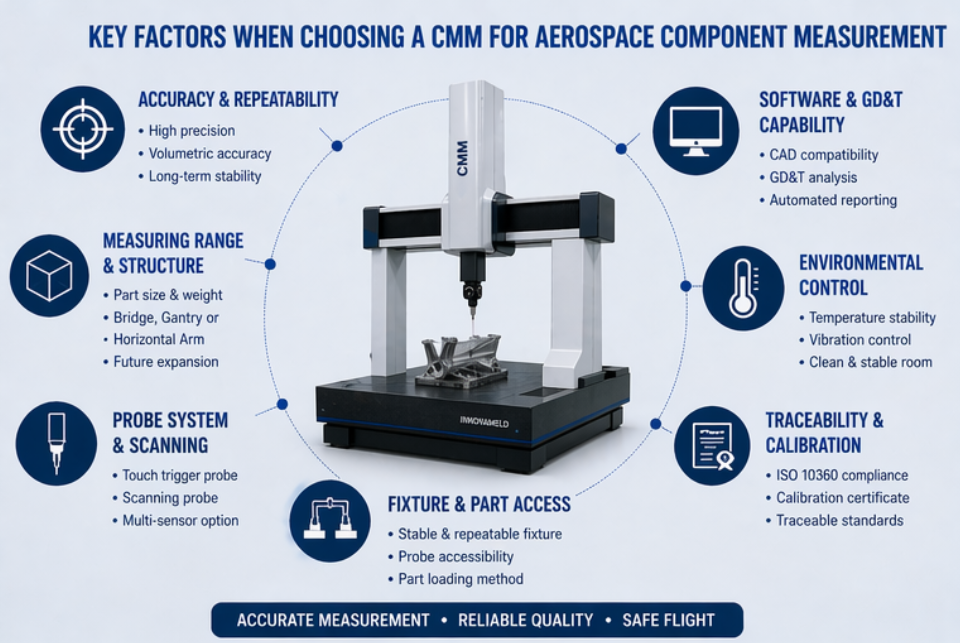
Aerospace components vary greatly in size. Some parts are small precision components, while others are large structural parts or tooling-related components. The CMM measuring range must be large enough to cover the part, fixture, probe movement, and future part variations. Choosing a machine only slightly larger than the current part may cause access limitations after installation.
A bridge CMM is often suitable for many aerospace precision parts because it provides stable structure, good repeatability, and strong compatibility with CNC inspection programs. For larger components, special structures, larger measuring ranges, or custom measurement solutions may be required. The machine layout should also consider loading method, operator access, part weight, and fixture space.
For aerospace inspection, the CMM should be selected as a long-term measurement platform. Buyers should consider not only current parts but also future programs, new product development, and possible changes in measurement requirements.
4. Evaluate Probe System, Scanning Capability, And Fixture Stability
The probe system is critical in aerospace component measurement. Touch trigger probes are useful for many dimensional features, hole positions, planes, and standard geometric checks. However, aerospace parts often include complex profiles, curved surfaces, and freeform features. In these cases, scanning probes or more advanced measurement strategies may be required to collect sufficient data and evaluate the part accurately.
Fixture stability is also essential. Aerospace components may be lightweight, thin-walled, or sensitive to clamping force. A poor fixture can deform the part or create inconsistent positioning, which affects measurement reliability. A good fixture should locate the component repeatably, support critical datums, avoid deformation, and allow the probe to reach all required features.
Probe And Fixture Checklist
Can the probe reach all critical features without collision?
Are long styli, angled styli, or special probe configurations required?
Does the part require scanning measurement or only point measurement?
Can the fixture hold the part without deformation?
Does the fixture repeatably locate datum surfaces or datum holes?
Can the inspection setup support future part variants?
For aerospace applications, the machine, probe, stylus, fixture, software, and reporting process must be planned together. Selecting the CMM body without considering the full measurement system may lead to incomplete inspection capability.
5. Software, GD&T, And Reporting Are Critical
Aerospace measurement usually requires more than simple length, width, and height data. Buyers should evaluate whether the CMM software supports CAD import, offline programming, GD&T evaluation, profile analysis, automatic report generation, data traceability, and clear inspection result output. For complex aerospace components, software capability may strongly influence inspection efficiency and reporting reliability.
A good software platform should help quality teams create repeatable inspection programs, reduce manual calculation, compare measured results with CAD models, and generate professional reports for internal review or customer submission. It should also support clear pass/fail judgment, deviation visualization, and historical data management when needed.
For aerospace inspection, traceability is especially important. Buyers should ask how calibration data, inspection reports, measurement programs, and result records can be managed and reviewed over time.
6. Control The Measurement Environment
A CMM can only deliver stable accuracy when the installation environment supports precision measurement. Aerospace component measurement often requires strong control of temperature, vibration, air cleanliness, humidity, floor stability, and operator procedure. If the machine is installed in an unstable environment, real measurement performance may be lower than the specification suggests.
Buyers should determine whether the CMM will be placed in a dedicated metrology room, quality lab, or near production. If the inspection environment cannot be tightly controlled, additional solutions such as temperature compensation, vibration isolation, stable foundation, air filtration, or controlled inspection procedures may be required.
For aerospace measurement, environmental control is not an optional detail. It directly affects the confidence of inspection results, especially when tolerances are tight and documentation requirements are strict.
7. What Information Should Be Prepared Before Requesting A Quote?
A professional CMM recommendation depends on complete application information. Before requesting a quote, aerospace buyers should prepare drawings, CAD files, tolerance data, part samples if available, inspection standards, required report format, and installation environment details. This helps the technical team recommend a suitable CMM configuration instead of a generic machine model.
| Information Needed | Why It Matters |
|---|---|
| Part drawings and CAD files | Confirm geometry, datums, inspection features, and software needs |
| Maximum part size and weight | Determine measuring range, table capacity, and loading method |
| Critical tolerance requirements | Select suitable accuracy, repeatability, and probe configuration |
| Inspection purpose | Define whether the machine is for FAI, process control, or final inspection |
| Report and traceability requirements | Confirm software functions and documentation output |
| Installation environment | Evaluate temperature, vibration, foundation, and room condition |
The more complete the technical information is, the easier it becomes to recommend a reliable and cost-effective CMM solution for aerospace measurement.
8. Common Mistakes To Avoid
Choosing a CMM only by machine price without checking aerospace tolerance requirements.
Selecting measuring range without considering fixtures, probe clearance, and loading method.
Ignoring scanning capability for curved surfaces and complex profiles.
Using a fixture that may deform thin-walled aerospace components.
Underestimating the importance of GD&T software and reporting traceability.
Installing the CMM in an environment with poor temperature or vibration control.
Requesting a quote without drawings, tolerance data, or inspection workflow details.
Avoiding these mistakes helps aerospace manufacturers improve measurement confidence, reduce inspection risk, and build a more reliable quality control process.
Conclusion
Choosing a CMM for aerospace component measurement requires a complete evaluation of part geometry, tolerance level, measuring range, machine structure, probe system, fixture stability, software capability, environmental control, and reporting traceability. A suitable CMM should not only measure accurately, but also deliver repeatable, documented, and trustworthy inspection results. By preparing drawings, CAD files, tolerance data, inspection purpose, and installation conditions before quotation, buyers can select a CMM solution that better supports aerospace quality control and long-term production requirements.
Need A CMM Solution For Aerospace Component Measurement?
Contact us to discuss your aerospace part drawings, tolerance requirements, inspection workflow, and measurement environment. We can help you evaluate a suitable CMM configuration for accurate and reliable aerospace component measurement.