


How To Select A CMM For Automotive Parts Inspection
2026-05-04 15:16How To Select A CMM For Automotive Parts Inspection
Automotive parts inspection requires stable accuracy, repeatable measurement results, efficient reporting, and reliable support for complex dimensional requirements. From engine housings, transmission parts, brake components, steering parts, aluminum castings, plastic assemblies, sheet metal parts, and precision machined components, different automotive applications require different coordinate measuring machine configurations. Choosing the right CMM is not only about machine size or price. Buyers must evaluate part geometry, tolerance requirements, production volume, fixture repeatability, probe configuration, software capability, and the real inspection environment.
Quick Answer
For automotive parts inspection, buyers should choose a CMM based on part size, tolerance level, batch inspection frequency, fixture method, probe access, GD&T requirements, software reporting, and production environment. A bridge CMM is often suitable for precision automotive components, while larger or special parts may require customized measuring range, dedicated fixtures, scanning probes, or automated inspection solutions.
1. Start With The Automotive Part Type
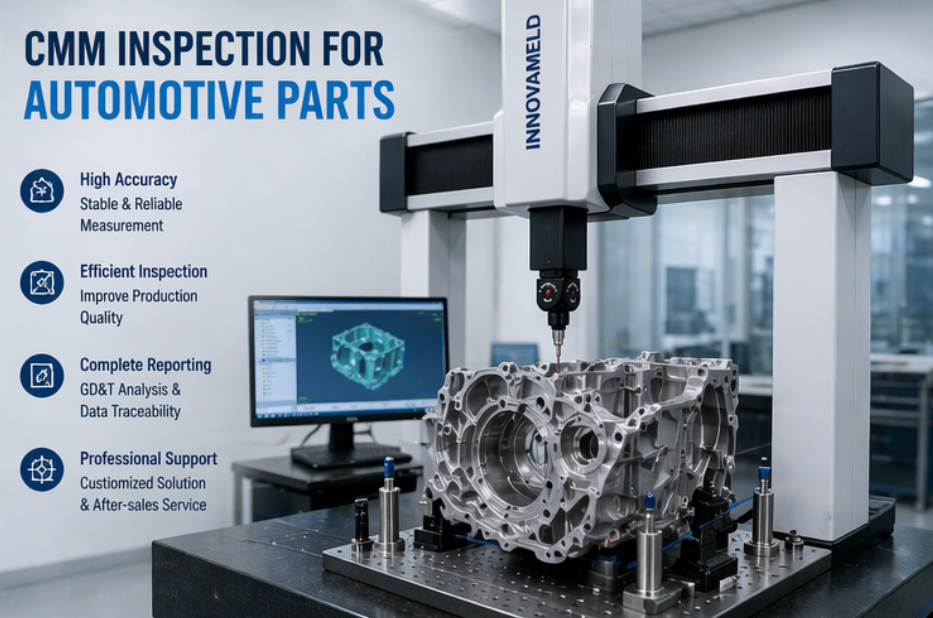
Automotive parts are highly diverse. A CMM used for inspecting small precision machined shafts may not be suitable for large aluminum housings, castings, welded assemblies, or complex engine components. Before selecting a machine, buyers should clearly define the part family that needs to be inspected. This includes maximum part size, weight, material, datum structure, surface condition, and key features to be measured.
For example, engine blocks, cylinder heads, transmission housings, and differential cases often have multiple datum surfaces, deep holes, machined planes, and complex geometric tolerance requirements. Brake components, steering parts, and suspension components may require accurate position, concentricity, flatness, profile, and hole location measurement. Plastic automotive parts may require dimensional inspection of molded features, assembly points, and deformation-sensitive surfaces.
The part type directly affects the CMM measuring range, probe system, fixture design, software functions, and inspection speed. A professional selection process should always begin with real parts and drawings, not only machine catalog specifications.
2. Match CMM Accuracy To Automotive Tolerance Requirements
Accuracy is important in automotive inspection, but the right accuracy level depends on the tolerance that must be verified. Buyers should not simply choose the highest accuracy machine or the lowest-cost option. The CMM must provide stable measurement confidence for the actual tolerance range of the automotive components.
Automotive production often requires repeated inspection of the same features across many parts. Therefore, repeatability is just as important as nominal accuracy. If the machine produces inconsistent results during batch inspection, the quality team may face false rejection, unnecessary rework, or delayed production decisions.
| Automotive Part Type | Typical Inspection Focus | CMM Selection Priority |
|---|---|---|
| Engine Housing | Hole position, flatness, datum surfaces, profile | Measuring range, volumetric accuracy, probe access |
| Transmission Components | Coaxiality, position, bore dimensions, GD&T | Repeatability, fixture stability, software capability |
| Brake Components | Thickness, roundness, runout, hole pattern | Fast inspection, stable probing, reporting efficiency |
| Steering And Suspension Parts | Position, angle, profile, assembly points | Probe flexibility, fixture design, GD&T analysis |
| Plastic Automotive Parts | Assembly dimensions, deformation, molded features | Light contact strategy, fixture support, CAD comparison |
For automotive applications, the CMM should be selected as a complete inspection system. Machine accuracy, probe performance, fixture repeatability, and software calculation method all influence the final measurement result.
3. Choose The Right Measuring Range And Machine Structure
Measuring range is one of the most common selection mistakes in automotive CMM procurement. Buyers sometimes choose a machine only slightly larger than the part size, but forget to consider fixture space, probe movement, stylus clearance, part loading direction, and future part changes. This can limit the usefulness of the machine after installation.
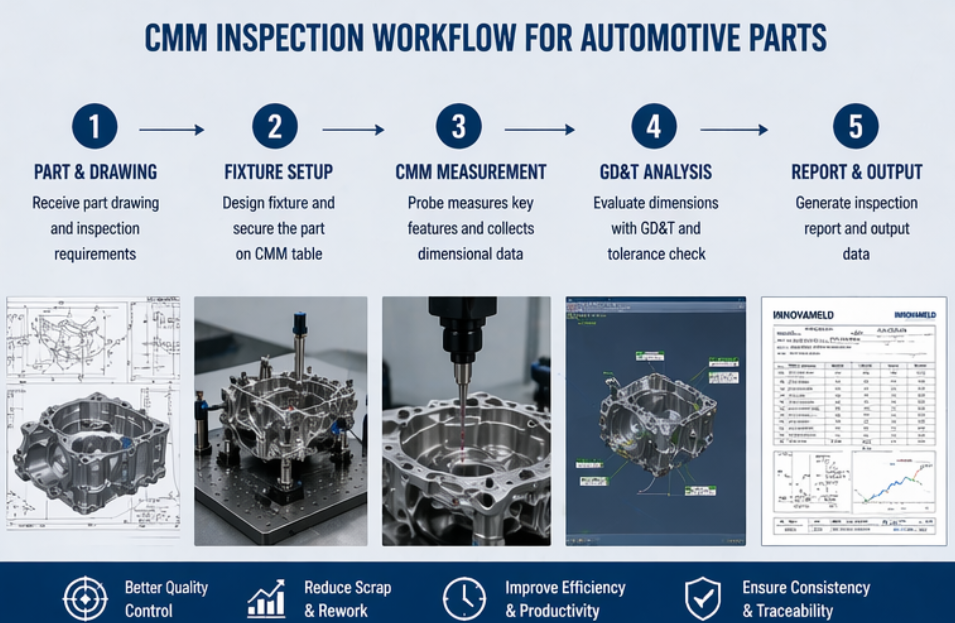
For most precision automotive components, a bridge CMM is often a practical choice because it offers stable accuracy, strong repeatability, and good compatibility with CNC measurement programs. For large parts, special loading methods, or production-side measurement, buyers may need to consider larger measuring ranges, customized structures, or automated inspection solutions.
The machine structure should match not only the largest part but also the daily inspection workflow. If parts are heavy, require crane loading, or need frequent fixture changes, loading access and operator movement should be considered during the layout design.
4. Evaluate Probe System And Fixture Design Together
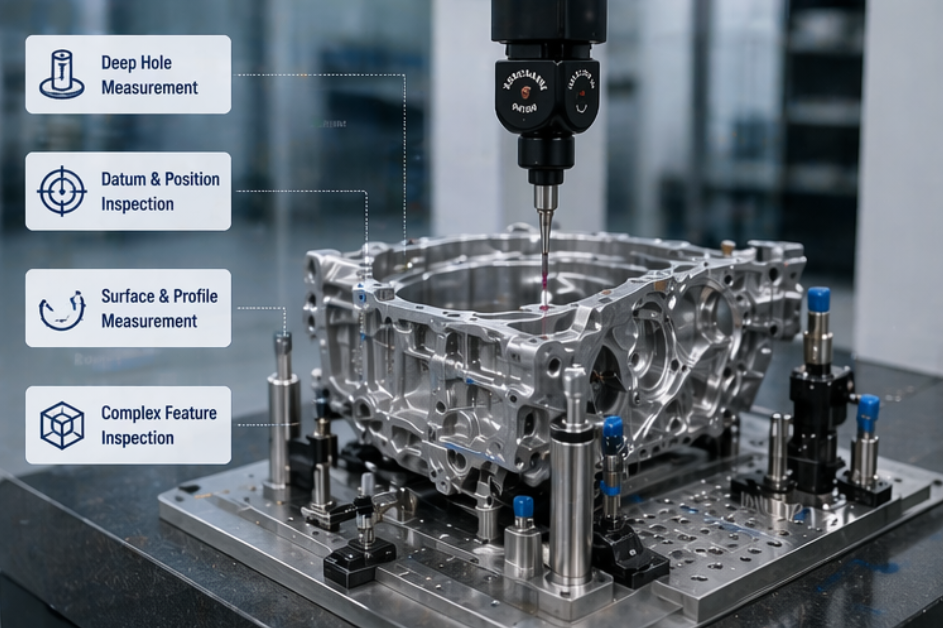
Automotive parts often have deep holes, angled surfaces, narrow features, curved profiles, and multiple datum references. A suitable probe system is essential for stable and efficient inspection. Touch trigger probes are commonly used for standard dimensional checks and hole positions. Scanning probes may be more suitable for profiles, curves, complex surfaces, and applications requiring more data points.
Fixture design is equally important. In batch automotive inspection, the same part may be measured repeatedly. If the fixture cannot locate the part consistently, even a high-accuracy CMM may produce unstable results. A good fixture should support repeatable positioning, easy loading, stable clamping, and clear access for the probe.
Probe And Fixture Checklist
Can the probe reach all critical features without collision?
Are long styli or angled stylus configurations required?
Is scanning measurement needed for profiles or complex surfaces?
Can the fixture locate the automotive part repeatedly?
Does the fixture allow fast loading and unloading?
Will the same fixture support future part variants?
For automotive inspection, the machine, probe, stylus, fixture, and software should be selected together. Separating these decisions may lead to inefficient inspection programs or incomplete measurement coverage.
5. Software And Reporting Matter In Automotive Quality Control
Automotive inspection often requires more than basic dimensional measurement. Buyers should evaluate whether the CMM software supports CAD import, GD&T evaluation, inspection program creation, automatic reporting, data comparison, and statistical process control. For automotive production, consistent reporting can be as important as the measurement itself.
A good CMM software system should help operators create repeatable programs, reduce manual calculation, standardize inspection reports, and improve communication between production, quality, and engineering teams. If the inspection data must be provided to customers or used in audits, report clarity and traceability become even more important.
Buyers should also consider operator skill level. A powerful software platform should still be practical for daily use. If programming is too difficult, measurement efficiency may decline and the machine may not be fully utilized.
6. Consider Inspection Volume And Automation Potential
Automotive production often involves repeated measurement of similar parts. If inspection volume is low, a standard CMM with manual loading may be enough. If inspection volume is high, buyers should consider CNC measurement programs, fixture repeatability, automatic probe changing, barcode identification, batch reporting, or integration with automated loading systems.
Automation potential is especially important for manufacturers planning long-term production growth. Even if full automation is not required at the beginning, selecting a CMM platform that can support future upgrades may reduce future investment risk. This may include automatic program execution, data export, SPC integration, robotic loading, or connection with manufacturing quality systems.
For automotive quality control, the goal is not only to measure accurately but also to measure consistently and efficiently across repeated production batches.
7. What Information Should Be Prepared Before Requesting A Quote?
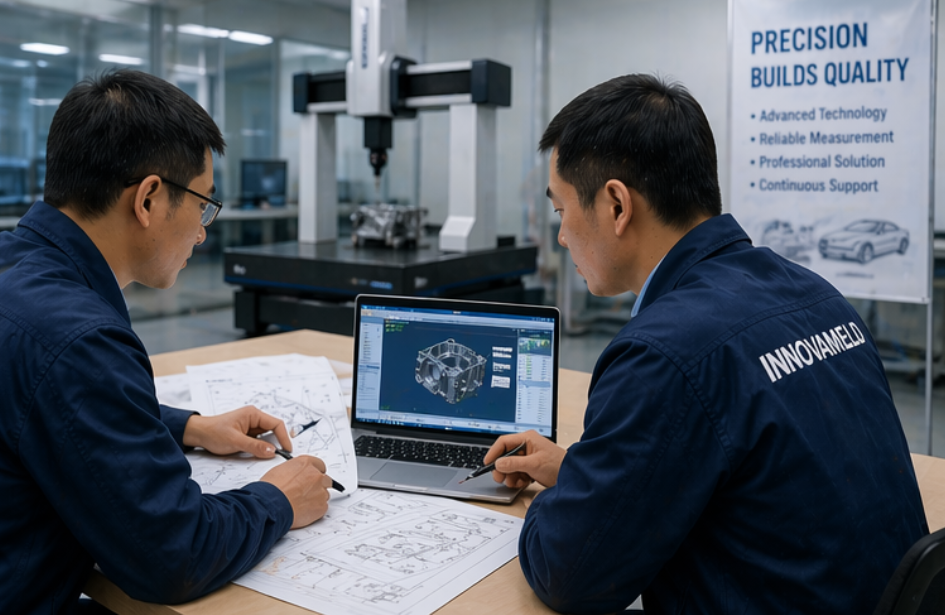
A useful CMM recommendation depends on accurate application information. Before requesting a quote, automotive buyers should prepare drawings, CAD files, tolerance requirements, part samples, material information, inspection frequency, and expected reporting needs. This helps the technical team recommend the right measuring range, probe system, fixture design, and software configuration.
| Information Needed | Purpose |
|---|---|
| Part drawings and CAD files | Confirm measured features, datum structure, and software needs |
| Maximum part size and weight | Determine measuring range, table capacity, and loading method |
| Tolerance requirements | Select suitable accuracy and repeatability level |
| Inspection frequency | Evaluate manual, CNC, or automated inspection needs |
| Installation environment | Check temperature, vibration, dust, and layout conditions |
| Report format requirements | Confirm software, data output, and quality documentation functions |
Providing complete technical information can reduce communication time, prevent configuration mismatch, and help buyers receive a more accurate quotation.
8. Common Mistakes To Avoid When Selecting A CMM For Automotive Parts
Choosing a CMM only by price without checking part tolerance and inspection workflow.
Selecting a measuring range without considering fixture space and probe clearance.
Ignoring fixture repeatability in batch automotive inspection.
Using an unsuitable probe system for deep holes, angled surfaces, or complex profiles.
Underestimating software reporting requirements for automotive quality documentation.
Ignoring future production growth and automation needs.
Installing a precision CMM in an unsuitable environment without temperature or vibration control.
Avoiding these mistakes helps automotive manufacturers improve measurement reliability, reduce inspection delays, and build a more stable quality control process.
Conclusion
Selecting a CMM for automotive parts inspection requires a complete evaluation of part size, tolerance, geometry, inspection volume, fixture method, probe access, software reporting, and production environment. For many automotive applications, a bridge CMM with suitable accuracy, stable repeatability, proper probe configuration, and strong software capability can provide reliable dimensional inspection. For high-volume or specialized applications, customized fixtures, scanning probes, automated programs, and data integration may also be required. The best CMM solution is the one that supports accurate, repeatable, and efficient inspection for real automotive production needs.
Need A CMM Solution For Automotive Parts Inspection?
Contact us to discuss your automotive part drawings, tolerance requirements, inspection workflow, and production environment. We can help you evaluate a suitable CMM configuration for stable and efficient automotive quality control.