


What Accuracy Matters Most When Buying A CMM Machine
2026-05-03 15:16What Accuracy Matters Most When Buying A CMM Machine?
Accuracy is one of the most important factors when selecting a coordinate measuring machine, but many industrial buyers misunderstand what CMM accuracy really means. A higher accuracy number on a catalog does not automatically mean the machine is the best choice for your inspection task. The most important question is whether the CMM can reliably verify your real part tolerances, maintain repeatability in your working environment, and support stable measurement results over long-term production. This guide explains which accuracy factors matter most when buying a CMM machine and how to evaluate them in a practical procurement decision.
Quick Answer
The most important CMM accuracy is not only the machine's listed maximum permissible error. Buyers should also check repeatability, volumetric accuracy, probing accuracy, thermal stability, software compensation, calibration standard, and whether the machine accuracy is suitable for the part tolerance. A practical CMM selection should match real inspection needs instead of simply choosing the lowest accuracy number on paper.
1. Why CMM Accuracy Should Be Linked To Part Tolerance
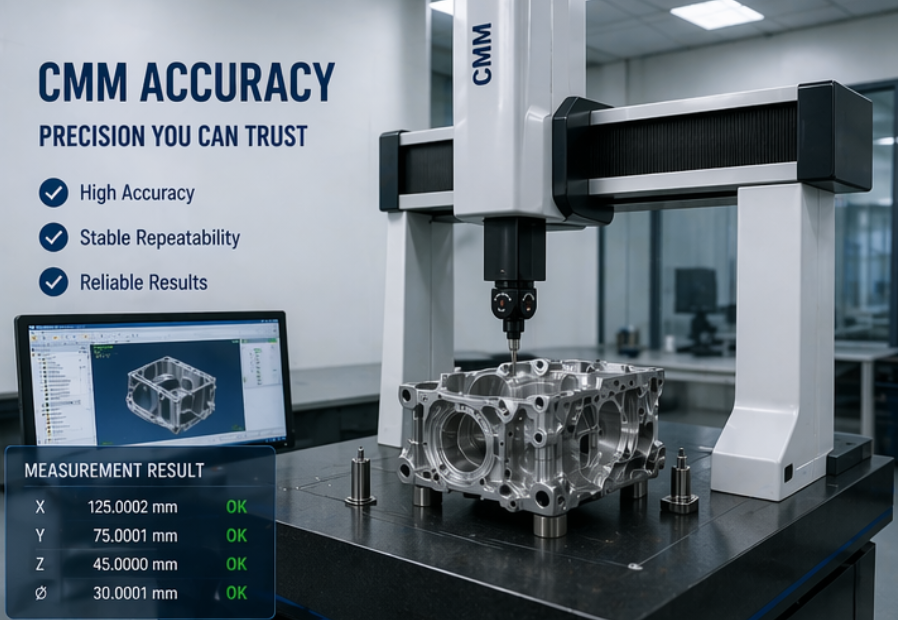
The first rule of choosing CMM accuracy is to start from the part tolerance, not from the machine brochure. A CMM is used to verify whether a workpiece meets dimensional requirements. If the machine uncertainty is too close to the product tolerance, the inspection result may not be reliable enough for quality control. If the machine is far more accurate than necessary, the investment cost may be higher than needed.
For example, a manufacturer inspecting general machined housings may not need the same accuracy level as a company measuring aerospace components, precision molds, medical implants, or high-tolerance mechanical assemblies. Different industries have different requirements for dimensional confidence, repeatability, traceability, and reporting. Therefore, buyers should clearly define the smallest tolerance that must be verified before selecting the machine accuracy level.
A good CMM selection is not about buying the highest specification available. It is about choosing a machine that can measure your parts confidently, consistently, and economically under real working conditions.
2. Key Accuracy Terms Buyers Should Understand
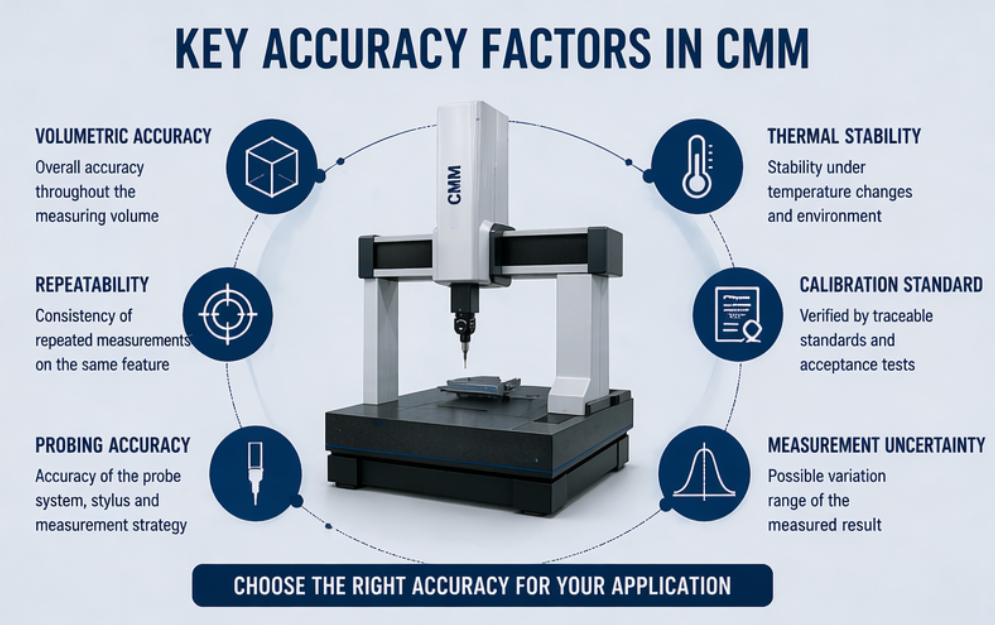
CMM accuracy is usually described through several technical indicators. Buyers do not need to become metrology experts, but they should understand the meaning of the most important terms before comparing quotations.
| Accuracy Factor | What It Means | Why It Matters In Procurement |
|---|---|---|
| Volumetric Accuracy | Overall measuring accuracy across the machine's working volume | Important for large parts and features measured across different positions |
| Repeatability | Ability to get consistent results when measuring the same feature repeatedly | Critical for batch inspection and process control |
| Probing Accuracy | Accuracy related to probe contact, stylus system, and measurement strategy | Affects holes, edges, profiles, and complex features |
| Thermal Stability | Measurement stability under temperature changes | Important for shop-floor or non-controlled environments |
| Calibration Standard | How the machine accuracy is verified and documented | Supports quality audits and customer acceptance |
| Measurement Uncertainty | Possible variation range of the measured result | Helps determine whether results are trustworthy for tolerance decisions |
When comparing machines, buyers should ask for more than one accuracy number. A professional CMM evaluation should include how accuracy is defined, how it is tested, under what conditions it is guaranteed, and whether the machine can maintain stable results in the user's actual inspection environment.
3. Volumetric Accuracy: Important For Real 3D Measurement
Volumetric accuracy describes how accurately the CMM measures across its three-dimensional working space. This is especially important when the part is large, when features are spread across different areas, or when the inspection program measures multiple surfaces, holes, and reference datums in one setup.
A machine may show good performance in a small area, but real industrial inspection often requires measuring features across the full measuring range. This is why buyers should not only focus on local accuracy or a simple specification line. They should consider whether the machine maintains reliable performance throughout the working volume.
For automotive parts, castings, molds, large machined components, and structural parts, volumetric accuracy can be more important than a single-point measurement value. It directly affects the reliability of dimensional inspection across the entire part.
4. Repeatability: The Accuracy Factor That Affects Daily Production
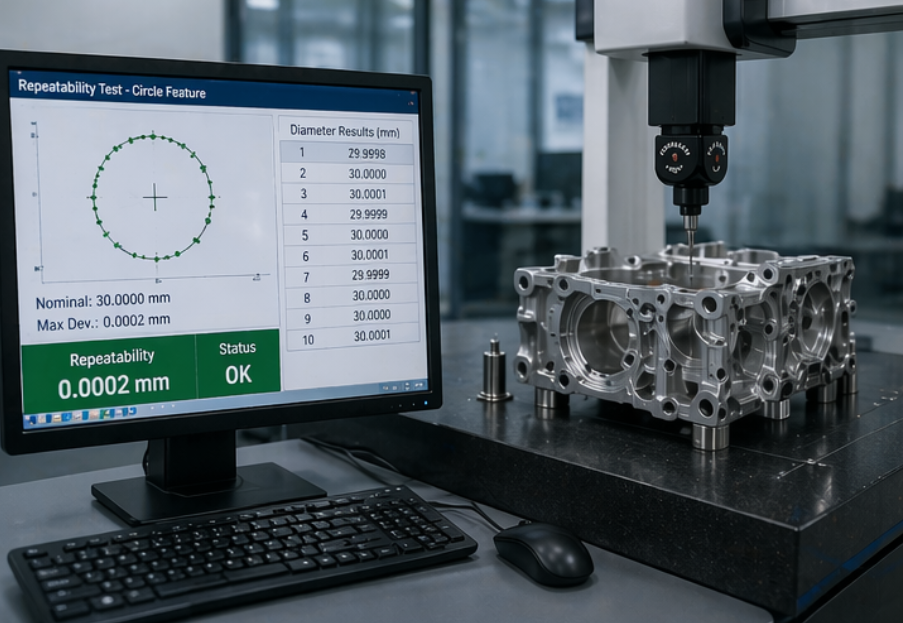
Repeatability is the ability of a CMM to produce consistent results when the same feature is measured multiple times under the same conditions. For daily production inspection, repeatability is extremely important because quality teams need stable data, not just a good result once.
In batch production, unstable repeatability can cause confusion. One inspection may show a part is acceptable, while another measurement may show it is close to the tolerance limit. This can lead to unnecessary rework, delayed shipments, internal disputes, or customer quality concerns. A CMM with strong repeatability helps manufacturers make more confident decisions.
Repeatability depends on the machine structure, guideway quality, probe system, fixture design, operator method, software strategy, and environmental stability. Therefore, buyers should treat repeatability as a complete system performance indicator rather than a machine frame specification alone.
5. Probing Accuracy: Do Not Ignore The Probe And Stylus System
Some buyers only compare the CMM machine body and overlook the probe system. In real inspection, the probe, stylus, measurement speed, contact force, approach angle, and probing strategy all influence the final result. A high-quality machine with an unsuitable probe configuration may still produce inefficient or inconsistent measurement performance.
Touch trigger probes are widely used for standard point measurement, hole positions, edges, and common dimensional features. Scanning probes may be more suitable for profiles, curves, surfaces, and applications that require more data points. If the part has deep holes, complex angles, thin walls, or hard-to-reach features, stylus length and probe accessibility must also be considered.
When evaluating CMM accuracy, buyers should ask whether the proposed probe system is suitable for the part geometry and tolerance requirement. The machine, probe, fixture, and software must work together to achieve reliable measurement.
6. Environmental Accuracy: Lab Performance vs Real Factory Conditions
CMM accuracy is often specified under controlled conditions. However, many industrial facilities face temperature variation, vibration, dust, air movement, operator traffic, and floor stability issues. These environmental factors may influence real measurement performance more than buyers expect.
If the machine will be installed in a metrology room, accuracy stability is easier to maintain. If the machine will be placed near production, buyers should carefully check whether the CMM is designed for that environment and whether additional control measures are needed. Temperature compensation, vibration isolation, air filtration, stable foundation, and controlled inspection procedures may all become important.
A machine with excellent laboratory accuracy may not deliver the same results if installed in an unsuitable environment. Therefore, the installation condition should be discussed before the quotation is finalized.
7. How To Decide The Right Accuracy Level
The right accuracy level depends on your parts, tolerances, inspection purpose, and quality control method. Buyers should avoid both under-specification and over-specification. Under-specification can create unreliable inspection results, while over-specification can increase cost without improving actual production value.
| Inspection Situation | Accuracy Priority | Recommended Focus |
|---|---|---|
| General machined parts | Balanced accuracy and repeatability | Stable CMM structure, practical software, suitable probe system |
| Automotive components | Repeatability and reporting consistency | Batch inspection programs, fixture repeatability, SPC reporting |
| Aerospace precision parts | High accuracy and traceability | Calibration, uncertainty control, GD&T capability |
| Mold and die inspection | Profile and surface measurement capability | Scanning probe, CAD comparison, surface analysis |
| Shop-floor inspection | Environmental stability | Temperature compensation, vibration control, robust workflow |
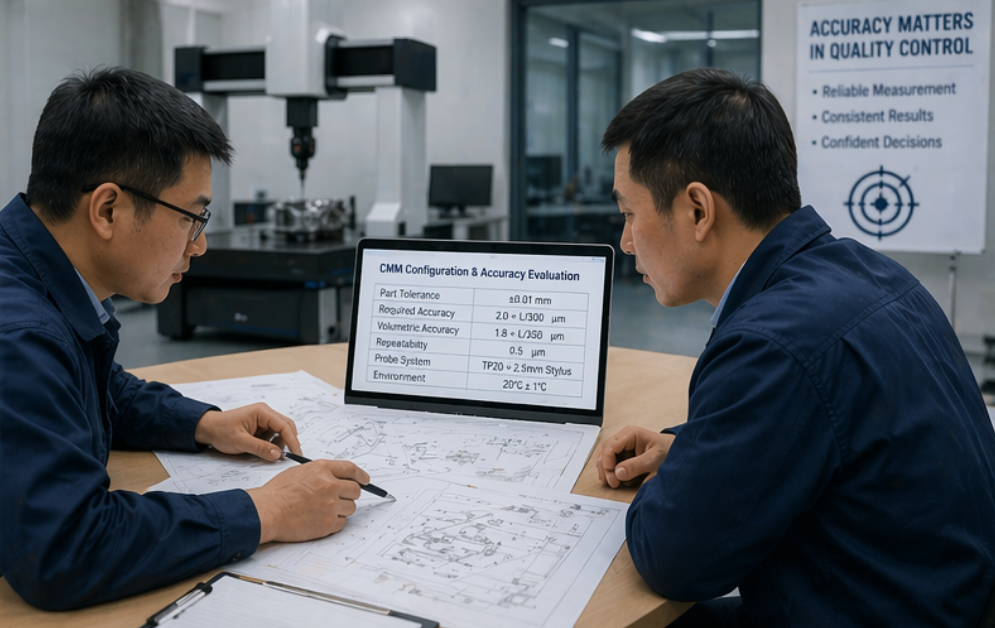
A useful purchasing approach is to provide part drawings, tolerance requirements, material information, measuring features, and expected inspection frequency. With these details, the recommended CMM accuracy level can be matched to the real application instead of selected blindly.
8. Common Accuracy Selection Mistakes To Avoid
Choosing a CMM only by the smallest accuracy number in the catalog.
Ignoring whether the accuracy is suitable for the actual part tolerance.
Comparing machine accuracy without considering probe configuration.
Forgetting that temperature and vibration can affect real inspection results.
Underestimating repeatability in batch production inspection.
Not checking calibration documents, acceptance standards, and reporting needs.
Buying an ultra-high accuracy machine when the workflow and environment cannot support it.
These mistakes can lead to unnecessary cost, unstable measurement results, or a machine that does not fit daily inspection work. Accuracy should always be evaluated as part of a complete measurement system, including machine structure, probe, software, fixture, environment, and operator process.
Conclusion
When buying a CMM machine, the most important accuracy is the accuracy that supports reliable inspection for your actual parts. Buyers should evaluate volumetric accuracy, repeatability, probing accuracy, thermal stability, calibration standard, and measurement uncertainty in relation to real tolerance requirements. A suitable CMM is not simply the machine with the highest accuracy specification. It is the machine that delivers stable, repeatable, and trustworthy measurement results in your working environment. Before purchasing, prepare part drawings, tolerance data, inspection frequency, and installation conditions so that the CMM configuration can be matched to your real industrial inspection needs.
Need Help Choosing The Right CMM Accuracy Level?
Contact us to discuss your part drawings, tolerance requirements, inspection workflow, and production environment. We can help you evaluate a suitable CMM machine configuration for stable and reliable industrial measurement.