


Bridge CMM vs Cantilever CMM: Which One Should You Choose
2026-05-02 15:09Bridge CMM vs Cantilever CMM: Which One Should You Choose?
When selecting a coordinate measuring machine for industrial inspection, one of the first decisions is choosing the right machine structure. Bridge CMM and cantilever CMM are both widely used in precision measurement, but they are designed for different workpiece sizes, inspection workflows, accessibility needs, and accuracy expectations. Choosing the wrong structure may lead to limited measuring access, inefficient operation, unstable results, or unnecessary investment cost. This guide explains the key differences between bridge CMM and cantilever CMM, helping industrial buyers choose a more suitable solution for their inspection requirements.
Quick Answer
A bridge CMM is usually better for high-accuracy dimensional inspection, stable laboratory measurement, and general precision parts. A cantilever CMM is often suitable when easier workpiece access, open-side loading, faster manual operation, or specific shop-floor inspection flexibility is more important. The best choice depends on part size, tolerance, loading method, measurement volume, operator workflow, and installation environment.
1. What Is A Bridge CMM?
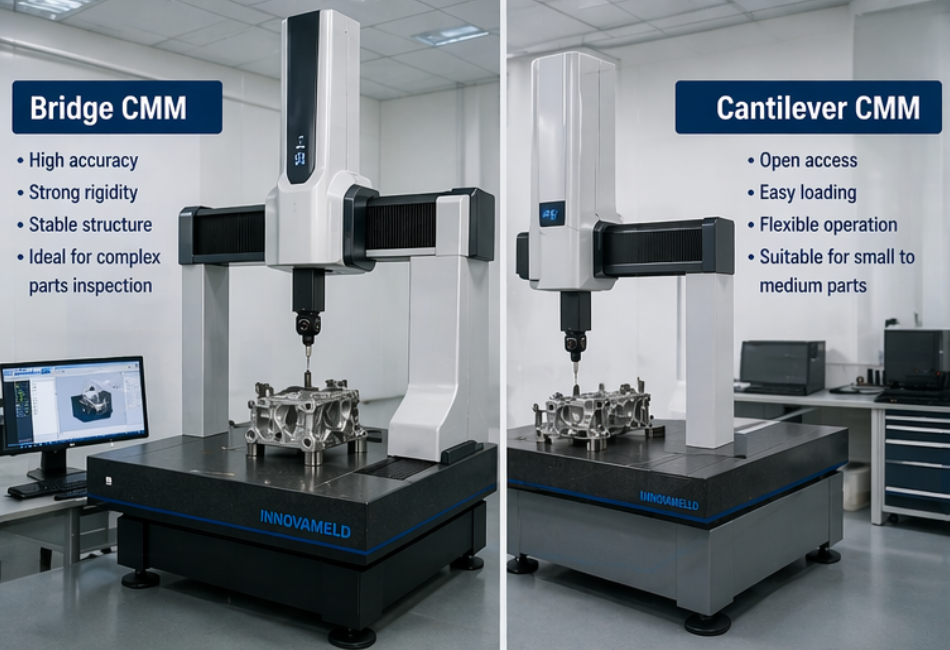
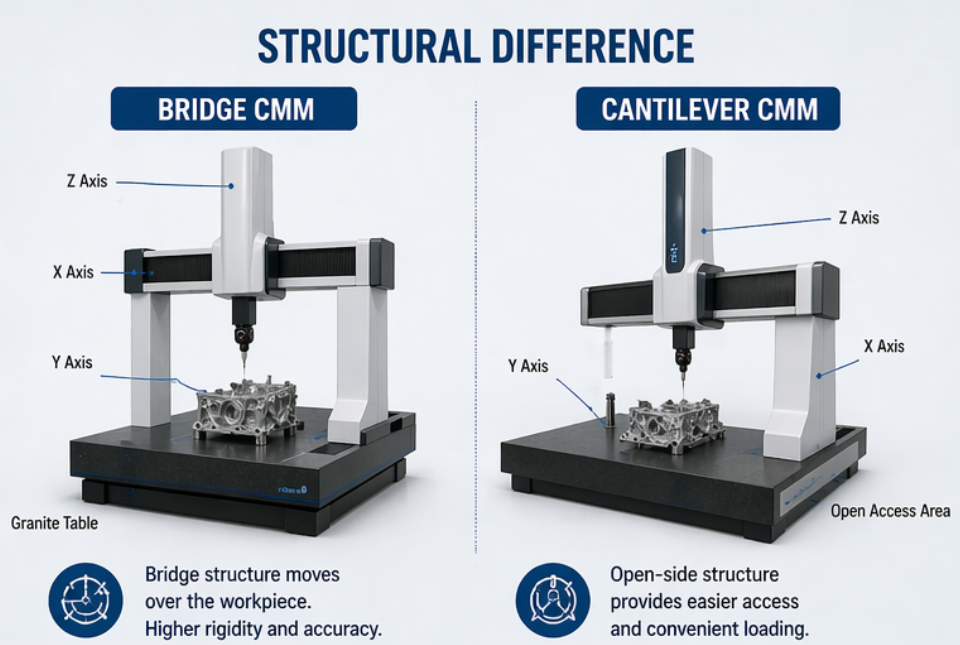
A bridge coordinate measuring machine uses a bridge-like structure that moves over a fixed granite table. The measuring head travels along the X, Y, and Z axes to inspect dimensional features on the workpiece. Because of its stable structure and balanced mechanical design, the bridge CMM is one of the most common choices for precision inspection in manufacturing, quality control, tooling, automotive, aerospace, electronics, and mechanical component production.
The main advantage of a bridge CMM is measurement stability. Its structure provides good rigidity and repeatability, making it suitable for parts that require reliable dimensional verification, GD&T inspection, surface position checks, hole location measurement, profile evaluation, and complex feature analysis. It can also work with different probe systems, including touch trigger probes and scanning probes.
For buyers who need a general-purpose CMM with strong accuracy, good software compatibility, and stable long-term performance, a bridge CMM is often the safest and most widely accepted option.
2. What Is A Cantilever CMM?
A cantilever coordinate measuring machine uses an open-side structure where the measuring arm extends from one side of the machine. Unlike a bridge CMM, the cantilever design provides easier access to the measuring area. This makes it convenient for operators to load, unload, position, and inspect certain workpieces, especially when open access is important.
Cantilever CMMs are often considered for small to medium-sized parts, production inspection, fast manual measurement, fixture-based repetitive inspection, and applications where the operator needs quick access to the workpiece. The open structure may improve workflow efficiency in some factories, especially when the inspection process involves frequent part changes.
However, cantilever machines may not always provide the same structural rigidity as bridge CMMs in demanding high-accuracy applications. Therefore, buyers should carefully evaluate tolerance requirements, part weight, machine size, and real inspection conditions before choosing this structure.
3. Bridge CMM vs Cantilever CMM: Key Comparison
The right choice should not be based only on machine appearance. Buyers should compare structure, accuracy, loading convenience, part accessibility, measuring range, installation environment, and long-term inspection plan. The table below summarizes the most important differences.
| Comparison Item | Bridge CMM | Cantilever CMM |
|---|---|---|
| Machine Structure | Bridge structure moving over a stable table | Open-side arm structure extending from one side |
| Accuracy Stability | Usually stronger for precision and repeatability | Suitable for many tasks but should be checked by tolerance needs |
| Workpiece Access | Access may be limited by bridge structure | Open access, easier loading and positioning |
| Typical Part Size | Small, medium, and many larger precision parts | Small to medium parts with frequent access needs |
| Operation Style | Ideal for CNC programs, repeatable inspection, detailed reports | Convenient for manual operation and fast part handling |
| Application Focus | Precision quality control, complex components, high consistency | Flexible inspection, production support, open-side measurement |
| Best For | Factories that need stable accuracy and broad measurement capability | Factories that need easy access and faster handling workflow |
4. When Should You Choose A Bridge CMM?
A bridge CMM is usually the better choice when your inspection task requires stable accuracy, repeatability, and strong measurement confidence. It is suitable for precision machined parts, automotive components, aerospace parts, molds, fixtures, die components, mechanical assemblies, and parts with complex GD&T requirements.
If your quality team needs CNC inspection programs, repeated batch measurement, reliable dimensional reports, and compatibility with different probe configurations, a bridge CMM normally provides a stronger foundation. It is also suitable when the machine will be installed in a quality lab or controlled inspection room where accuracy is the top priority.
Choose A Bridge CMM If You Need:
Higher measurement stability and repeatability
Inspection of precision machined parts or complex components
CNC automatic measurement programs
GD&T analysis and professional inspection reports
Long-term quality control for multiple part families
Better compatibility with advanced probe systems
For most industrial buyers who are not sure which structure to choose, a bridge CMM is often the more universal option because it can cover a wider range of inspection tasks.
5. When Should You Choose A Cantilever CMM?
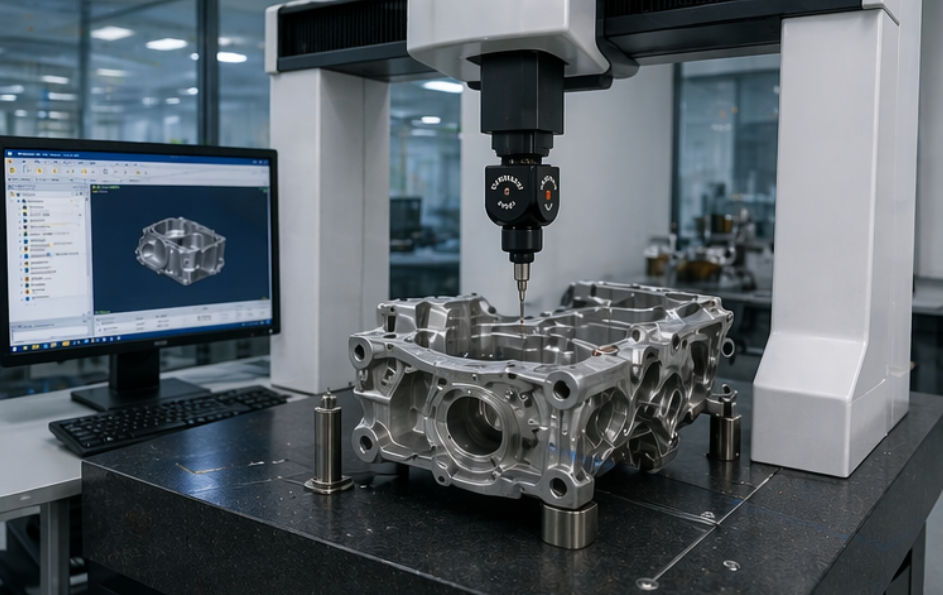
A cantilever CMM may be the better choice when open access and operation convenience are more important than maximum structural rigidity. Because one side of the measuring area is more open, operators can load and position parts more easily. This can improve efficiency when inspecting smaller parts, frequent samples, production-line components, or fixture-based repeated workpieces.
It can also be useful when the inspection task requires quick manual checks or when the operator needs to approach the part from the open side. In some production environments, this convenience can reduce handling time and improve daily inspection speed.
Choose A Cantilever CMM If You Need:
Easier open-side workpiece access
Faster loading and unloading workflow
Inspection of small to medium-sized parts
Flexible manual or semi-automatic inspection
Production support with frequent part changes
A practical solution for specific accessibility requirements
Before choosing a cantilever CMM, buyers should confirm whether the machine accuracy, measuring range, and workpiece weight capacity can meet real inspection requirements. It is important to match the structure to the application instead of choosing only for convenience.
6. Key Questions To Ask Before Making A Decision
Before selecting between a bridge CMM and a cantilever CMM, buyers should prepare technical information about the parts and inspection workflow. The clearer the application details are, the easier it becomes to recommend a suitable CMM structure and configuration.
| Question | Why It Matters |
|---|---|
| What is the maximum part size and weight? | Determines machine range, table capacity, and structure suitability |
| What tolerance level must be verified? | Helps confirm required accuracy and repeatability |
| How often will parts be measured? | Affects CNC automation, loading method, and inspection speed needs |
| Is open access important for loading parts? | May make cantilever structure more convenient |
| Will the machine be used in a lab or near production? | Influences environmental protection and measurement stability |
| Do you need CAD programming and GD&T reports? | Determines software, probe, and reporting configuration |
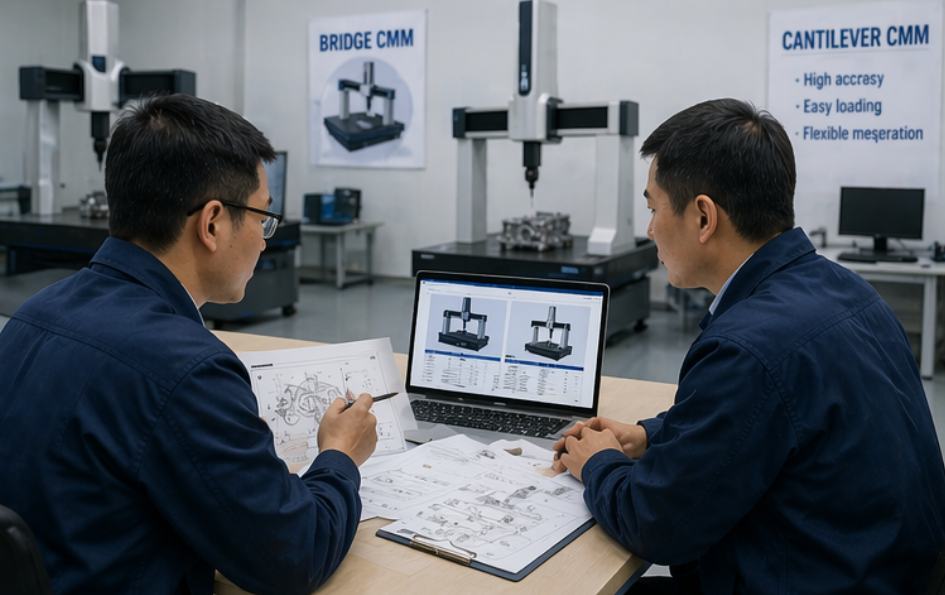
If high accuracy, long-term stability, and broad application coverage are the top priorities, a bridge CMM is usually recommended. If fast access, operator convenience, and open-side handling are more important for your workflow, a cantilever CMM may be a practical choice.
7. Common Selection Mistakes To Avoid
Choosing a cantilever CMM only because it is easier to access, without checking accuracy requirements.
Choosing a bridge CMM only because it is common, without considering loading efficiency and operator workflow.
Ignoring the fixture space required around the workpiece.
Underestimating future part size changes or production volume growth.
Comparing only machine price instead of total inspection efficiency.
Not confirming software, probe system, and reporting requirements before quotation.
A good CMM selection should balance machine structure, measurement accuracy, workpiece accessibility, software function, and daily operation efficiency. The best machine is not always the largest or most expensive one. It is the one that fits your parts, tolerances, workflow, and long-term inspection plan.
Conclusion
Bridge CMM and cantilever CMM each have their own advantages. A bridge CMM is generally preferred for stable high-accuracy inspection, complex parts, CNC measurement, and long-term quality control. A cantilever CMM is useful when open access, fast handling, and flexible operation are important. Before making a purchase decision, buyers should review part size, tolerance level, measurement frequency, loading method, installation environment, software needs, and future inspection plans. With the right evaluation process, manufacturers can choose a CMM structure that improves measurement reliability and inspection efficiency.
Need Help Choosing Between Bridge CMM And Cantilever CMM?
Contact us to discuss your part size, tolerance requirements, inspection workflow, and production environment. We can help you evaluate a suitable coordinate measuring machine solution for your industrial inspection needs.
Related product and article resources
For procurement comparison and technical evaluation, readers can continue with these related product pages and supporting articles.
- Products
- Product catalog
- Contact the sales team
- Contact us
- 100% Inline Automatic Inspection for Automotive Body-in-White: Technology Breakdown
- 5-Axis Machining Centers: Capabilities for Complex Geometry Manufacturing
- 5 Key Features of High-End CMMs
- A Look Inside a Fully Automated Chassis Arc Welding Production Line