



How To Improve CMM Inspection Efficiency In Batch Production
2026-05-17 23:16How To Improve CMM Inspection Efficiency In Batch Production
In batch production, CMM inspection efficiency directly affects delivery speed, quality control, rework cost, and production decision-making. A coordinate measuring machine can provide accurate dimensional data, but if the inspection process is slow, unstable, or overly dependent on operators, it may become a bottleneck in manufacturing. To improve CMM inspection efficiency, manufacturers should optimize fixture design, probe configuration, measurement programs, software reporting, operator workflow, part preparation, and data management. This guide explains how to build a faster and more repeatable CMM inspection process for batch production.
Quick Answer
To improve CMM inspection efficiency in batch production, manufacturers should use repeatable fixtures, standardized CNC measurement programs, optimized probe paths, suitable probe and stylus configurations, automatic report templates, clear pass/fail judgment, operator SOPs, part preparation procedures, and data output for process control. The goal is to reduce setup time, operator variation, repeated measurement, and manual reporting work.
1. Identify Where CMM Inspection Time Is Being Lost
Before improving CMM inspection efficiency, manufacturers should first identify where time is being lost. In many factories, the CMM itself is not the only bottleneck. Time may be wasted during part loading, fixture adjustment, probe qualification, program selection, datum setup, repeated measurement, report generation, or communication between quality and production teams.
Batch production requires stable and repeatable inspection. If operators need to manually adjust each part, recreate measurement paths, edit reports, or recheck uncertain results, the inspection process becomes slow. These small delays accumulate quickly when hundreds or thousands of parts must be inspected over time.
A good improvement plan should look at the complete inspection workflow, not only the machine speed. The best results usually come from combining fixture repeatability, optimized software programs, standard operating procedures, and faster reporting.
2. Use Repeatable Fixtures To Reduce Setup Time
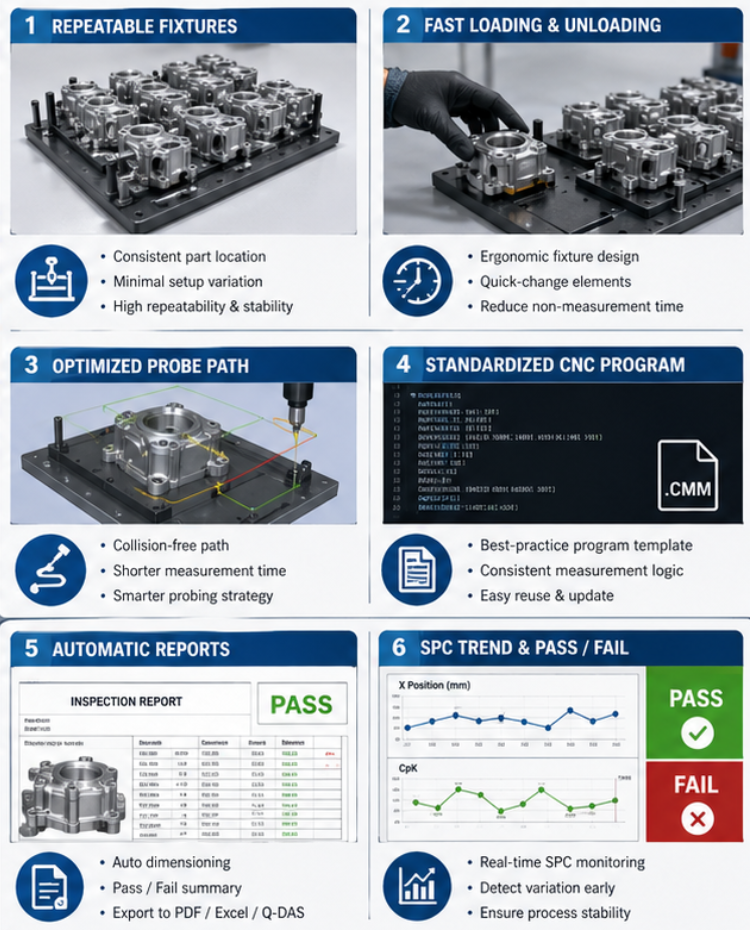
Fixture design is one of the most important factors in batch CMM inspection. If the part can be located quickly and repeatably, the operator spends less time adjusting the setup and the measurement program can run more consistently. Poor fixtures lead to unstable positioning, repeated alignment work, and higher risk of measurement variation.
A batch inspection fixture should support the correct datums, avoid part deformation, allow safe probe access, and make loading and unloading easy. For repeated production parts, a dedicated fixture is often more efficient than a universal fixture because it reduces operator judgment and setup adjustment.
| Fixture Improvement | How It Improves Efficiency | Buyer / Factory Check |
|---|---|---|
| Repeatable locating points | Reduces alignment variation and setup time | Check datum structure and part loading direction |
| Fast clamping design | Speeds up loading and unloading | Avoid deformation from excessive clamping force |
| Probe clearance planning | Prevents collision and unnecessary path changes | Confirm all critical features can be reached |
| Multi-part fixture | Allows several parts to be inspected in one cycle | Useful when part size and batch volume are suitable |
| Fixture standardization | Reduces operator training and setup mistakes | Create fixture use instructions and loading marks |
3. Optimize Probe And Stylus Configuration
Probe and stylus selection can strongly affect inspection speed. If the stylus is too long, unstable, or poorly matched to the part features, the machine may need slower probing speeds or repeated checks. If the probe cannot reach features easily, operators may need to change stylus configurations frequently, which increases downtime.
For batch production, the ideal probe setup should cover as many required features as possible without frequent manual changes. Automatic probe changing may be useful when parts require multiple probe angles or different stylus types. Scanning probes may improve efficiency for profiles and surfaces, while touch trigger probes may be more practical for standard holes, planes, and discrete features.
Probe Efficiency Checklist
Can one probe setup measure most critical features?
Are stylus changes minimized during batch inspection?
Is the stylus short and stable enough for repeatable results?
Are angled or star styli needed to reduce repositioning?
Would automatic probe changing improve inspection workflow?
Is scanning useful for profiles, surfaces, or dense data collection?
4. Standardize CNC Measurement Programs
Standardized CNC measurement programs are essential for efficient batch CMM inspection. Once a reliable program is created, the machine can repeat the same measurement routine with less operator influence. This improves consistency and reduces the time needed for manual decision-making.
Measurement programs should use a clear datum strategy, safe probe paths, optimized point distribution, suitable probing speed, and automatic report output. Unnecessary points should be reduced, but critical features must still be measured with enough data for reliable judgment. The goal is not simply to make the program faster, but to make it fast and trustworthy.
| Program Optimization | Efficiency Benefit |
|---|---|
| Use stable datum alignment | Reduces repeated setup correction and result variation |
| Optimize probe path order | Shortens machine travel and cycle time |
| Remove unnecessary points | Improves speed while keeping key inspection reliability |
| Use program templates | Speeds up new part family programming |
| Control program versions | Prevents operators from using wrong or outdated programs |
5. Automate Reports And Data Output
Manual report editing is one of the easiest ways to lose time in batch inspection. CMM software should generate standard reports automatically after the measurement cycle. Reports should include part ID, program name, measured values, nominal values, deviation, tolerance, pass/fail result, operator, machine, date, and key inspection notes when required.
For batch production, SPC data output can be even more valuable than individual reports. Trend data helps engineers understand whether the process is drifting before parts become nonconforming. This allows production teams to adjust machines, tools, or fixtures earlier and reduce scrap.
Useful Software Functions For Batch Inspection
Automatic inspection report generation
Clear pass/fail result display
SPC data export for process control
Barcode or part ID input
Program selection by product model or work order
Report templates for customers and internal quality teams
Data connection with quality or production management systems
6. Improve Part Preparation And Operator Workflow
Inspection efficiency also depends on what happens before the part reaches the CMM. Parts should be cleaned, deburred, thermally stabilized, and organized before measurement. If operators must clean parts, search for drawings, find the correct fixture, or confirm the inspection program during CMM time, machine utilization drops.
A clear operator workflow can reduce waiting time and mistakes. Each batch should have defined part preparation steps, fixture setup instructions, program selection rules, reporting procedures, and abnormal result handling methods. This allows different operators to follow the same process across shifts.
| Workflow Step | Efficiency Improvement |
|---|---|
| Clean parts before inspection | Reduces false readings from chips, oil, dust, or burrs |
| Prepare fixtures in advance | Reduces machine waiting time |
| Use standard loading instructions | Improves repeatability across operators |
| Use correct program naming | Prevents wrong program selection |
| Define abnormal result handling | Avoids repeated unnecessary measurement and delay |
7. Consider Semi-Automation Or Full Automation When Volume Is High
When batch volume is high, semi-automation or full automation may improve inspection efficiency. This may include automatic probe changing, barcode scanning, automatic program selection, fixture pallets, robot loading, conveyor connection, or data integration with production systems. Automation is not always necessary, but it can reduce manual handling and improve consistency when the application is stable.
Buyers should evaluate automation based on part volume, part family stability, inspection cycle time, operator cost, reporting needs, and return on investment. If the production part changes frequently, flexible CNC programs and good fixtures may be more practical than full automation. If the same part is inspected repeatedly in large quantities, automation can provide strong long-term value.
The best automation plan should be built around the inspection workflow, not only the machine hardware.
8. Common Mistakes That Reduce CMM Efficiency
Using unstable or slow-loading fixtures for batch inspection.
Measuring too many unnecessary points without improving quality decisions.
Changing stylus configurations too frequently during one inspection cycle.
Manually editing reports after every measurement.
Allowing different operators to use different datum strategies.
Using unclear program names that cause wrong program selection.
Skipping part cleaning and causing repeated measurement errors.
Not using SPC data to identify production trends early.
Trying to automate before the basic fixture and program workflow is stable.
Improving CMM efficiency is often not about one large change. It is usually the result of many small process improvements that make inspection faster, more stable, and easier to repeat.
Conclusion
Improving CMM inspection efficiency in batch production requires a complete workflow approach. Manufacturers should reduce setup time with repeatable fixtures, optimize probe and stylus configurations, standardize CNC measurement programs, automate report generation, prepare parts before inspection, train operators, and use data output for production feedback. When volume is high, semi-automation or full automation may further improve productivity. A well-designed CMM inspection process can reduce bottlenecks, improve repeatability, support faster quality decisions, and strengthen production quality control.
Need To Improve CMM Inspection Efficiency?
Contact us to discuss your batch inspection parts, tolerance requirements, fixture setup, probe configuration, measurement software, reporting workflow, and automation plan. We can help you evaluate a suitable CMM solution for faster and more repeatable production inspection.