


Coordinate Measuring Machine Supplier For Export Projects
2026-05-30 13:25Coordinate Measuring Machine Supplier For Export Projects
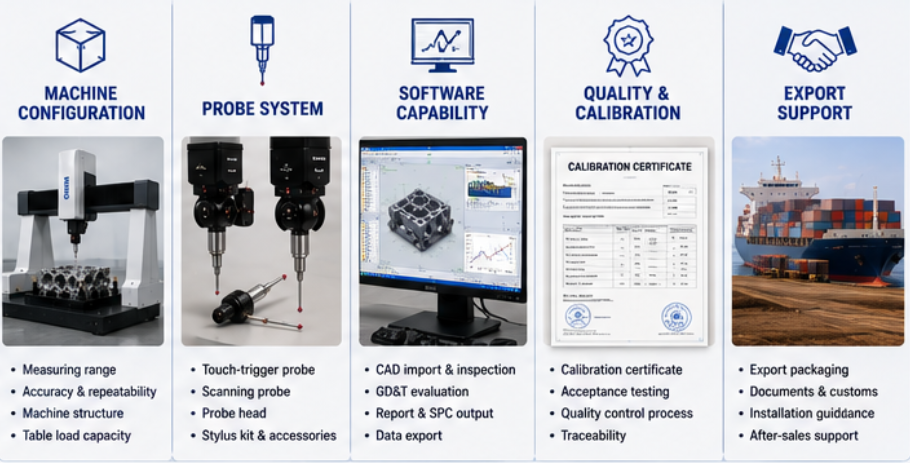
For overseas buyers, choosing a coordinate measuring machine supplier is not only about comparing machine price. Export projects require reliable machine configuration, stable accuracy, suitable probe system, measurement software, export packaging, documentation, installation guidance, calibration support, training, and long-term after-sales service. A CMM is a precision inspection system, so buyers should work with a supplier who understands industrial measurement requirements, international delivery, and real application support. This guide explains what buyers should check when selecting a coordinate measuring machine supplier for export projects.
Quick Answer
When choosing a coordinate measuring machine supplier for export projects, buyers should compare machine accuracy, measuring range, probe system, software capability, calibration documents, export packaging, delivery support, installation guidance, training, warranty, spare parts, and after-sales response. A suitable supplier should help buyers select the right CMM configuration according to part drawings, tolerance requirements, inspection workflow, and destination country conditions.
1. Choose A Supplier Who Understands Real Inspection Applications
A coordinate measuring machine should be selected according to real inspection requirements, not only a product catalog. Overseas buyers should choose a supplier who can evaluate part drawings, CAD files, tolerance requirements, GD&T items, measured features, production volume, and installation environment before recommending a machine model.
A reliable CMM supplier should ask about part size, part weight, material, critical dimensions, fixture needs, probe access, software reporting, and calibration expectations. If a supplier only sends a price list without understanding the application, the recommended machine may not fit the buyer’s real inspection task.
For export projects, technical communication before quotation is especially important because installation, training, and after-sales support may be more complex than domestic projects.
2. Compare Machine Configuration, Not Only Price
CMM quotations can vary significantly because different suppliers may include different machine structures, measuring ranges, accuracy levels, probe systems, software modules, accessories, calibration services, and export support. Buyers should compare the complete configuration instead of only the final price.
| Comparison Item | What Buyers Should Check | Why It Matters |
|---|---|---|
| Measuring Range | X, Y, Z travel, usable working volume, fixture space | Ensures the machine fits real parts and probe movement |
| Accuracy Level | Machine accuracy, repeatability, calibration report | Supports reliable tolerance verification |
| Probe System | Touch-trigger probe, scanning probe, stylus kit, probe changer | Determines what features the CMM can measure |
| Software | CAD import, GD&T, automatic report, SPC data output | Improves inspection workflow and reporting capability |
| Service Package | Installation guidance, training, warranty, spare parts support | Reduces long-term export project risk |
3. Check Export Packaging And Transportation Protection
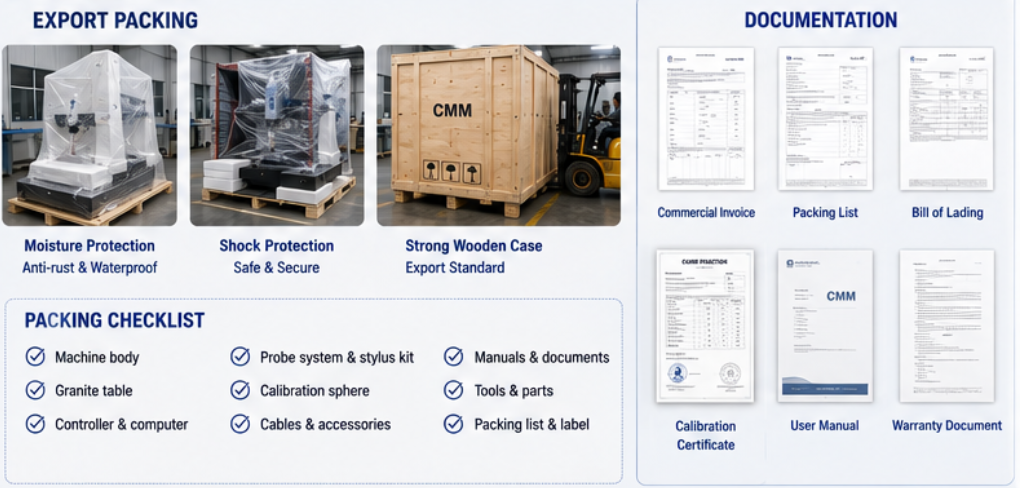
A coordinate measuring machine is precision equipment. During export transportation, poor packaging may cause damage, vibration impact, moisture problems, or accuracy risk. Buyers should confirm whether the supplier provides suitable wooden case packaging, moisture protection, shock protection, accessory protection, and clear packing photos before shipment.
The supplier should also provide packing list, shipping dimensions, gross weight, equipment list, and photos of machine packaging. For overseas projects, buyers should confirm whether the shipment includes machine body, controller, computer, probe system, stylus kit, calibration sphere, software license, cables, tools, manuals, and spare accessories.
Export Packaging Checklist
Strong wooden case or export-grade packaging
Moisture protection and anti-rust protection
Shock protection for precision components
Separate protection for probe system and accessories
Packing list, shipping size, and gross weight
Pre-shipment photos and delivery confirmation
4. Confirm Documentation For Customs, Installation And Quality Audit
Export projects require complete documentation. Buyers should confirm whether the supplier can provide commercial invoice, packing list, contract documents, user manual, operation guide, maintenance guide, calibration report, acceptance testing record, warranty document, and software information.
For industrial buyers, documentation is not only for customs clearance. It is also important for machine installation, quality audits, internal equipment records, operator training, maintenance planning, and future calibration management.
| Document Type | Purpose |
|---|---|
| Commercial Invoice And Packing List | Used for customs clearance and shipment verification |
| Machine Manual And Maintenance Guide | Supports daily operation and maintenance planning |
| Calibration Report | Confirms machine accuracy and traceability condition |
| Acceptance Testing Record | Helps buyers verify machine performance after installation |
| Warranty And Service Information | Clarifies after-sales responsibility and support process |
5. Installation Guidance And Site Acceptance Support
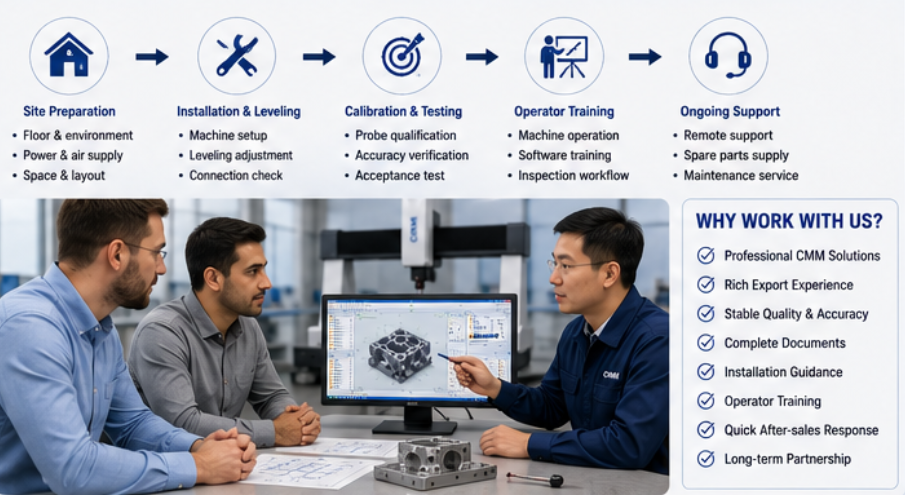
Overseas buyers should confirm how the supplier supports installation after delivery. A CMM usually requires site preparation, machine positioning, leveling, air supply connection, power connection, probe setup, software installation, calibration verification, and acceptance testing. Without clear guidance, buyers may face delays after the machine arrives.
The supplier should provide installation instructions, remote video support, training materials, software setup guidance, and acceptance checklist. If on-site service is needed, buyers should confirm cost, schedule, visa arrangement, local support availability, and service scope before placing the order.
Installation Support Checklist
Site preparation guide before machine arrival
Machine positioning and leveling instructions
Air supply, power supply, and grounding requirements
Probe installation and qualification guidance
Software activation and report setup support
Site acceptance testing and accuracy verification support
6. Training, Warranty And Long-Term After-Sales Service
A good coordinate measuring machine supplier should support buyers after delivery. Training should cover machine operation, probe qualification, part alignment, program execution, report generation, basic maintenance, and troubleshooting. If the machine includes advanced software, GD&T functions, scanning probes, or SPC output, additional software training may be required.
Buyers should also compare warranty period, spare parts availability, remote support response, software update policy, calibration advice, and maintenance support. For export projects, long-term service response can be more important than a small price difference.
| Service Item | Buyer Should Confirm |
|---|---|
| Operator Training | Machine operation, probe setup, alignment, report generation |
| Software Training | CAD import, GD&T, automatic reports, SPC output |
| Warranty | Warranty period, covered parts, response process |
| Spare Parts | Probe accessories, cables, controller parts, maintenance items |
| Remote Support | Video guidance, online diagnosis, software support, troubleshooting |
7. What Information Should Buyers Provide Before Quotation?
To receive a practical CMM export quotation, buyers should provide complete application and project information. This helps the supplier recommend a suitable machine, avoid missing accessories, prepare correct packaging, and arrange export support.
Recommended Information Checklist
Part drawings and CAD files
Maximum part size, weight, and material
Critical dimensions and tolerance requirements
GD&T items and datum structure
Inspection purpose and production volume
Probe, stylus, scanning, and fixture needs
Software reporting, SPC, and data export requirements
Installation country, site environment, and available space
Required Incoterms, packaging requirements, and delivery schedule
Training, calibration, warranty, and after-sales support expectations
8. Common Mistakes Overseas Buyers Should Avoid
Choosing a CMM supplier only by the lowest machine price.
Comparing quotations without checking probe, software, calibration, and service details.
Ignoring export packaging and transport protection for precision equipment.
Not confirming documentation for customs, installation, and quality audit.
Buying a machine without clear installation and acceptance guidance.
Underestimating training, spare parts, and remote support needs.
Requesting a quote without part drawings, tolerance data, or inspection workflow.
Not checking whether the supplier has export project communication experience.
Avoiding these mistakes helps overseas buyers reduce procurement risk and build a more reliable dimensional inspection process after delivery.
Conclusion
Selecting a coordinate measuring machine supplier for export projects requires careful comparison of technical configuration, export packaging, documentation, installation support, calibration, training, warranty, and after-sales service. Overseas buyers should not compare only the machine price. A suitable supplier should understand the buyer’s parts, tolerances, inspection workflow, destination country requirements, and long-term service needs. By providing complete application information before quotation, buyers can receive a more accurate CMM solution and reduce export project risk.
Need A Coordinate Measuring Machine For An Export Project?
Related product and article resources
For procurement comparison and technical evaluation, readers can continue with these related product pages and supporting articles.
- Products
- Product catalog
- Contact the sales team
- Contact us
- 100% Inline Automatic Inspection for Automotive Body-in-White: Technology Breakdown
- 5-Axis Machining Centers: Capabilities for Complex Geometry Manufacturing
- 5 Key Features of High-End CMMs
- A Look Inside a Fully Automated Chassis Arc Welding Production Line
Send us your part drawings, tolerance requirements, inspection workflow, destination country, and service expectations. We can help evaluate a suitable CMM configuration and export support plan for your project.