


Bridge CMM Price Guide: What Affects The Cost
2026-05-21 12:46Bridge CMM Price Guide: What Affects The Cost
Bridge coordinate measuring machines are widely used in industrial inspection because they provide stable 3D dimensional measurement for machined parts, molds, fixtures, automotive components, aerospace parts, and many other precision workpieces. However, when buyers start requesting quotations, they often find that bridge CMM prices vary significantly. A basic machine may fit one budget, while a more advanced system with higher accuracy, scanning capability, software modules, and automation features may cost much more. To make a good purchasing decision, buyers should understand what really affects the price of a bridge CMM and which cost factors are necessary for their application.
Quick Answer
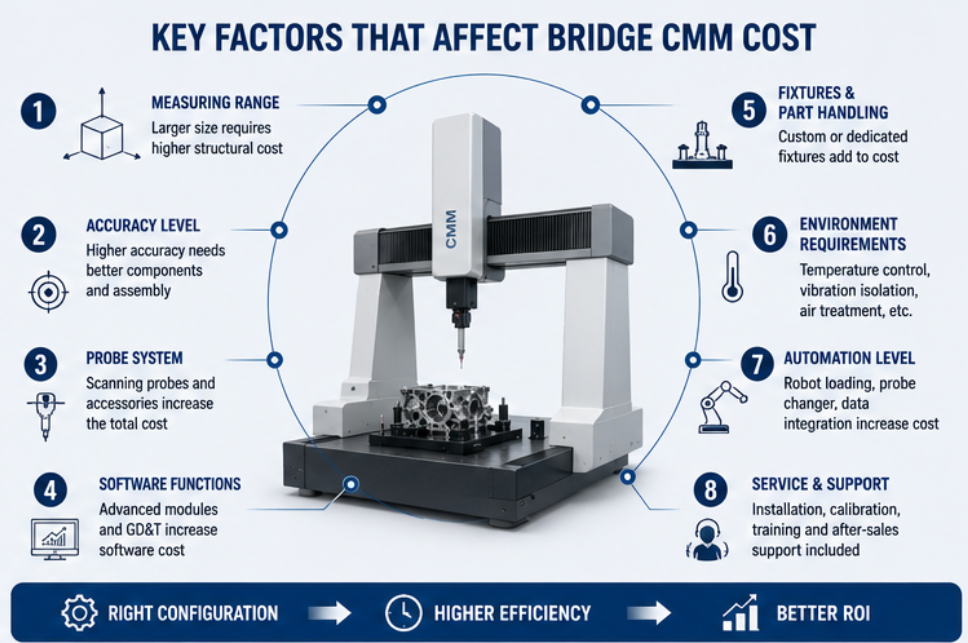
The price of a bridge CMM is mainly affected by measuring range, accuracy level, structure quality, probe system, software functions, fixture requirements, environmental adaptation, automation level, installation service, calibration, training, and after-sales support. A buyer should not compare bridge CMM prices by machine size alone. The best quotation depends on the part size, tolerance requirement, inspection task, report needs, and long-term quality control plan.
1. Machine Size And Measuring Range
One of the first price factors is the machine size. A bridge CMM with a larger X, Y, and Z measuring range usually costs more because it requires a larger structure, more material, longer guideways, and more demanding control of geometric stability. Buyers should provide the maximum part size, fixture height, and probe clearance requirement before requesting a quote.
Choosing an oversized machine may increase cost unnecessarily, while choosing a machine that is too small may create loading problems and limit future applications. The right measuring range should be based on real part size plus enough room for fixtures and probe movement.
2. Accuracy Level And Tolerance Requirement
Higher accuracy usually means higher cost. A bridge CMM designed for tighter tolerances needs better structural quality, more precise scale systems, improved compensation, and stricter assembly standards. Buyers should not simply ask for the highest possible accuracy. Instead, they should match the machine specification to the actual tolerance of the parts being inspected.
For example, precision machined parts for aerospace or high-end automotive components may require stronger accuracy performance than general industrial castings or large mechanical parts. A higher-accuracy machine can increase the quotation significantly, so this decision should be based on real quality requirements rather than assumption.
| Price Factor | How It Affects Cost | Buyer Check Point |
|---|---|---|
| Measuring Range | Larger structure usually costs more | Maximum part size and fixture space |
| Accuracy Level | Higher precision increases machine cost | Smallest tolerance to be measured |
| Probe System | Scanning and advanced probes cost more | Touch trigger or scanning requirement |
| Software | Advanced modules raise package price | GD&T, CAD, SPC, reporting needs |
| Automation | Robot loading and data integration add cost | Production volume and ROI target |
3. Probe System And Measurement Capability
The probe system is a major cost driver. A basic touch trigger probe is often enough for holes, planes, slots, and standard dimensions. However, if the application requires scanning, surface profile analysis, complex geometry inspection, or fast batch inspection, the machine may need a more advanced probe system. Probe heads, stylus kits, probe changers, extensions, and calibration accessories all influence total cost.
Buyers should clearly define the features to be measured. If the part has deep bores, angled surfaces, fine profiles, or freeform shapes, the quotation will usually be higher than that of a simple dimensional inspection system.
4. Software Functions And Reporting Needs
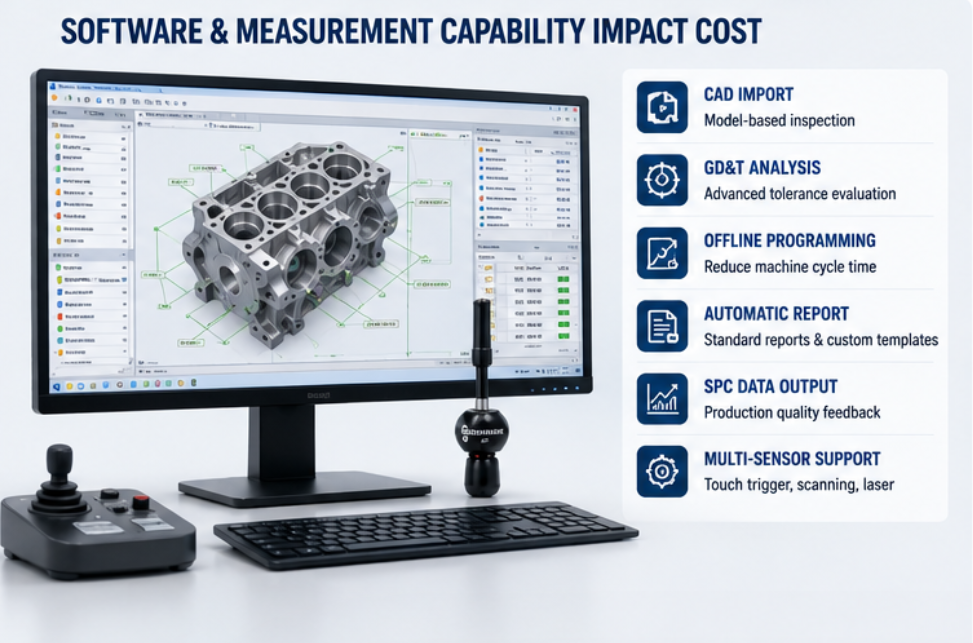
Many buyers focus on the machine hardware and forget that software can strongly affect the final quotation. Basic software may be enough for simple dimensions, but if the buyer needs CAD import, offline programming, GD&T analysis, SPC data output, automatic reporting, or data integration with internal systems, the software package becomes more expensive.
This is especially important for automotive, aerospace, and export-oriented manufacturing, where customers often require traceable reports and standardized quality documents. Software capability should be selected according to actual inspection workflow rather than added blindly.
Common Software Cost Drivers
CAD import and model-based inspection
GD&T evaluation and advanced tolerance analysis
Offline programming functions
Automatic report templates and traceability output
SPC data export and production data connection
Multi-user license or future software upgrade options
5. Fixture Requirements And Part Handling
Some bridge CMM quotations include only the machine, while others may include dedicated fixtures, modular fixtures, loading supports, or special part handling arrangements. If the workpiece needs stable repeatable positioning, custom fixtures may be necessary. For small batch inspection, modular fixtures may be sufficient. For high-volume production, dedicated fast-loading fixtures may improve efficiency but also increase project cost.
Large or heavy parts may also need lifting tools or special loading procedures. Buyers should mention these details at the quotation stage to avoid hidden costs later.
6. Installation Environment And Shop Conditions
The working environment can also affect the bridge CMM quotation. A machine installed in a controlled metrology room may require a different setup than one placed near production. Temperature fluctuation, vibration, dust, oil mist, compressed air quality, and floor stability all influence the final solution.
If environmental challenges are significant, buyers may need extra protection, vibration isolation, air treatment, or environmental compensation. These are not always visible in a basic machine price comparison, but they can affect the real cost of ownership.
7. Automation Level And Production Integration
A standard bridge CMM for manual or CNC operation will cost less than an automated measurement system. If the buyer needs automatic loading, probe changing, barcode identification, SPC feedback, or integration with MES and other factory systems, the quotation will increase. However, for high-volume production, this additional investment may improve efficiency and reduce labor cost over time.
Buyers should evaluate automation based on production volume, part repeatability, and return on investment. Not every application needs a high-automation solution, but some lines can benefit greatly from faster closed-loop inspection.
8. Installation, Calibration, Training, And Service
A professional bridge CMM quotation often includes more than the machine itself. Installation, leveling, calibration, acceptance testing, operator training, warranty, and after-sales support can all affect the total price. A lower machine price without sufficient service may create risk after delivery.
Buyers should ask what is included in the quotation. Is on-site installation included? Is software training included? Are annual calibration services available? Is remote or local technical support offered? These service items may not always be visible in the base price, but they are important for long-term use.
9. New Machine vs Total Cost Of Ownership
Buyers sometimes focus only on the purchase price, but the total cost of ownership is more important. A cheaper configuration may lead to measurement limitations, software restrictions, lower efficiency, or future upgrade cost. A more complete system may have a higher initial price but provide stronger long-term value.
The best pricing decision should balance current budget, part tolerance, inspection workload, future expansion, and operational reliability. Price should support the application, not drive the selection alone.
10. What Information Should Buyers Provide For An Accurate Quote?
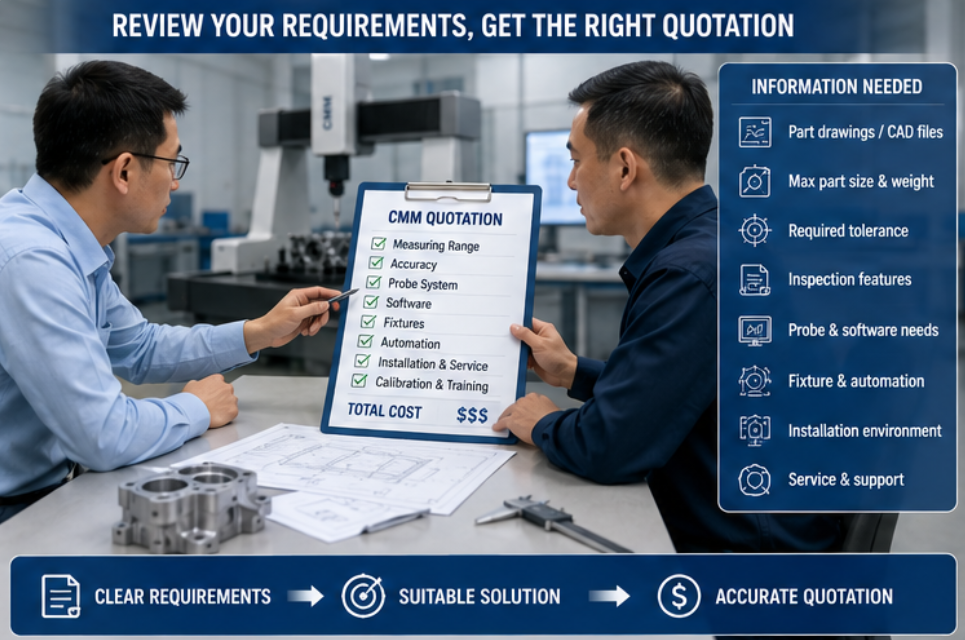
To receive a useful bridge CMM quotation, buyers should prepare more than a simple request for “price.” The supplier needs application details in order to recommend a suitable configuration.
Recommended Quotation Information
Part drawings or CAD files
Maximum part size and weight
Required tolerance and critical dimensions
Feature types such as holes, bores, profiles, or surfaces
Need for touch trigger probe or scanning probe
Software requirements such as GD&T, SPC, or CAD
Fixture and loading requirements
Installation environment and production conditions
Need for automation, training, calibration, or after-sales support
Conclusion
The cost of a bridge CMM is affected by much more than machine size. Measuring range, accuracy, probe system, software, fixture needs, environmental adaptation, automation level, and service package all contribute to the final quotation. Buyers who provide clear application details can receive a more suitable and cost-effective recommendation. Instead of comparing prices without context, it is better to compare bridge CMM solutions based on inspection requirements, operational efficiency, and long-term quality value.
Need A Bridge CMM Quotation?
Related product and article resources
For procurement comparison and technical evaluation, readers can continue with these related product pages and supporting articles.
- Products
- Product catalog
- Contact the sales team
- Contact us
- 100% Inline Automatic Inspection for Automotive Body-in-White: Technology Breakdown
- 5-Axis Machining Centers: Capabilities for Complex Geometry Manufacturing
- 5 Key Features of High-End CMMs
- A Look Inside a Fully Automated Chassis Arc Welding Production Line
Send us your part drawing, tolerance requirement, measuring range, and inspection task. We can help recommend a suitable bridge CMM configuration and provide a more accurate quotation for your application.