


- Home
- >
News
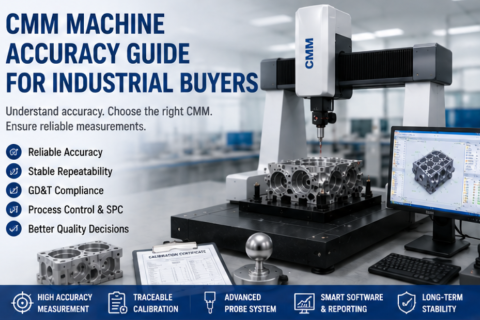
CMM machine accuracy should be evaluated as a complete measurement system, not just a catalog number. Industrial buyers should consider part tolerance, machine structure, measuring range, probe system, software, fixture stability, environment, calibration, and operator workflow. A suitable CMM should provide reliable accuracy and repeatability for the buyer’s real inspection tasks. By providing clear drawings, tolerance data, measured features, and installation conditions before quotation, buyers can receive a more practical CMM recommendation and reduce procurement risk.
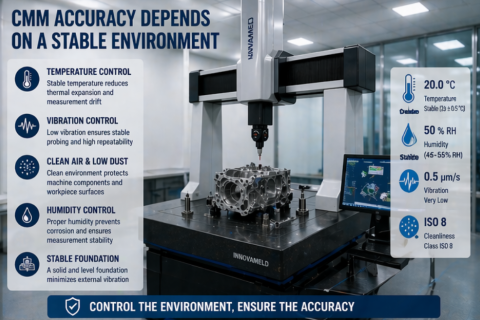
Temperature, vibration, dust, humidity, air quality, floor stability, and installation layout all affect CMM accuracy. A high-performance coordinate measuring machine can only deliver stable results when the environment is properly controlled. Buyers should evaluate the installation site before ordering or installing the machine, especially when measuring tight tolerances, aerospace components, automotive parts, molds, and precision machined components. By preparing a suitable environment, manufacturers can improve repeatability, reduce measurement errors, and get more reliable inspection results from their CMM system.
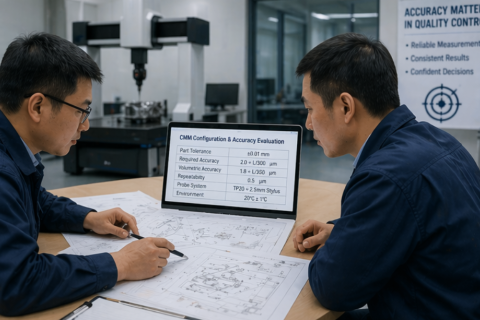
When buying a CMM machine, the most important accuracy is the accuracy that supports reliable inspection for your actual parts. Buyers should evaluate volumetric accuracy, repeatability, probing accuracy, thermal stability, calibration standard, and measurement uncertainty in relation to real tolerance requirements. A suitable CMM is not simply the machine with the highest accuracy specification. It is the machine that delivers stable, repeatable, and trustworthy measurement results in your working environment. Before purchasing, prepare part drawings, tolerance data, inspection frequency, and installation conditions so that the CMM configuration can be matched to your real industrial inspection needs.
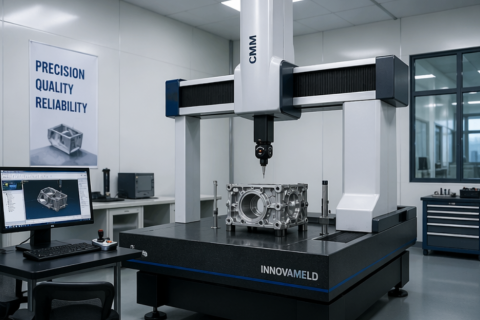
Choosing a coordinate measuring machine for industrial inspection requires a practical and application-driven approach. Buyers should begin with the actual part and inspection objective, then evaluate measuring range, accuracy, machine structure, software, probe system, environment, and future automation potential. A well-selected CMM can improve inspection reliability, reduce production risk, and support long-term quality control across different industrial applications. If you are planning a new inspection project or upgrading your current measurement capability, preparing the right technical information in advance will help you choose a more suitable and cost-effective solution.
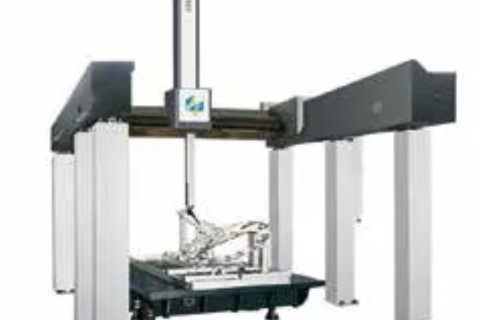
In conclusion, achieving and maintaining CMM accuracy is a multi-faceted endeavor. It begins with a clear understanding of the MPE specification to set realistic expectations. It is sustained by the mathematical precision of temperature compensation, which corrects for the physical realities of material behavior. And it is protected by the rigorous discipline of environmental control, which shields the delicate measurement process from external chaos. Together, these three pillars—specification, compensation, and control—form the foundation of reliable dimensional metrology, ensuring that every measurement is not just a number, but a verifiable fact.