


How CNC Shot Peening Improves Fatigue Life of Aircraft Turbine Blades
2026-04-13 13:56The Physics of Fatigue and the Compressive Solution
Aircraft turbine blades operate in one of the most demanding environments in engineering, enduring extreme centrifugal forces, thermal gradients, and high-frequency vibration. These conditions create cyclical tensile stresses that can initiate microscopic cracks on the component's surface, leading to fatigue failure. Crucially, fatigue cracks almost always originate at the surface, where tensile stress is highest and defects are most likely to exist. CNC shot peening is a proven, critical surface enhancement process that directly counters this failure mode. The process involves bombarding the surface of the blade with millions of small, spherical media (shot) at high velocity. Each impact acts like a miniature hammer, causing local plastic deformation of the surface material. This creates a thin, work-hardened layer. More importantly, as the deformed surface layer attempts to expand laterally, it is constrained by the underlying, undisturbed core material. This elastic mismatch induces a state of deep, residual compressive stress in the surface and near-surface layers. For a turbine blade under operational tensile loads, this beneficial compressive stress must first be overcome before any net tensile stress can act on the material. This effectively raises the stress threshold for crack initiation and dramatically slows or even stops the propagation of existing micro-cracks. The precision of CNC technology is what makes this process reliably effective for complex airfoil geometries.
Precision Application: The Critical Role of CNC Control and Process Consistency
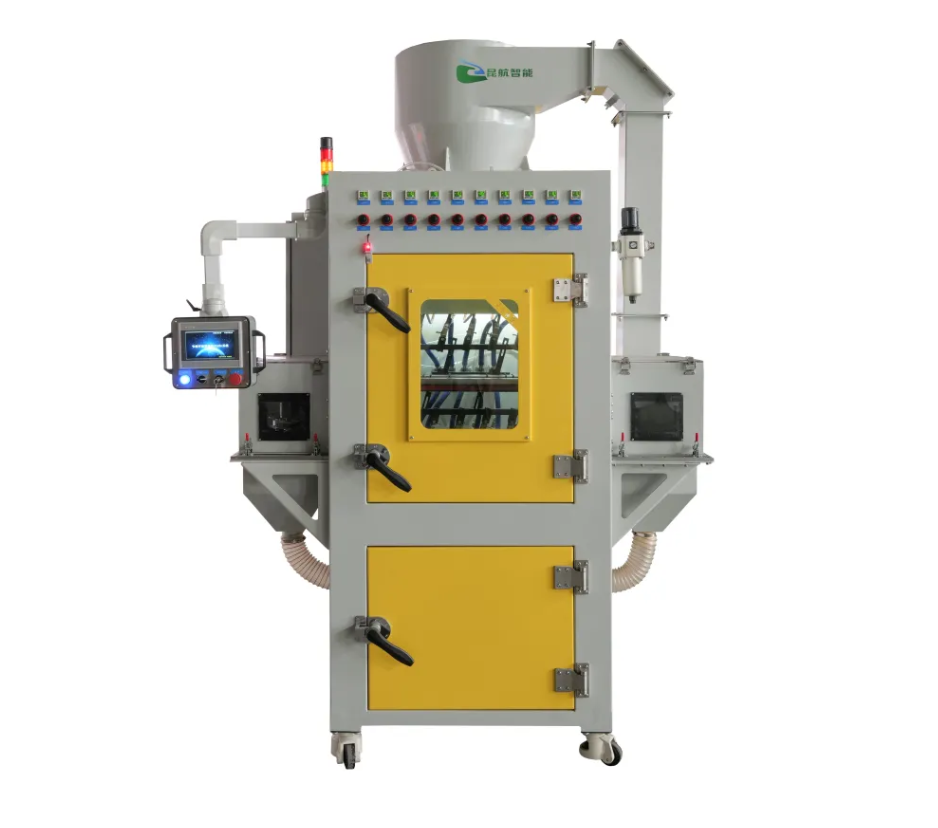
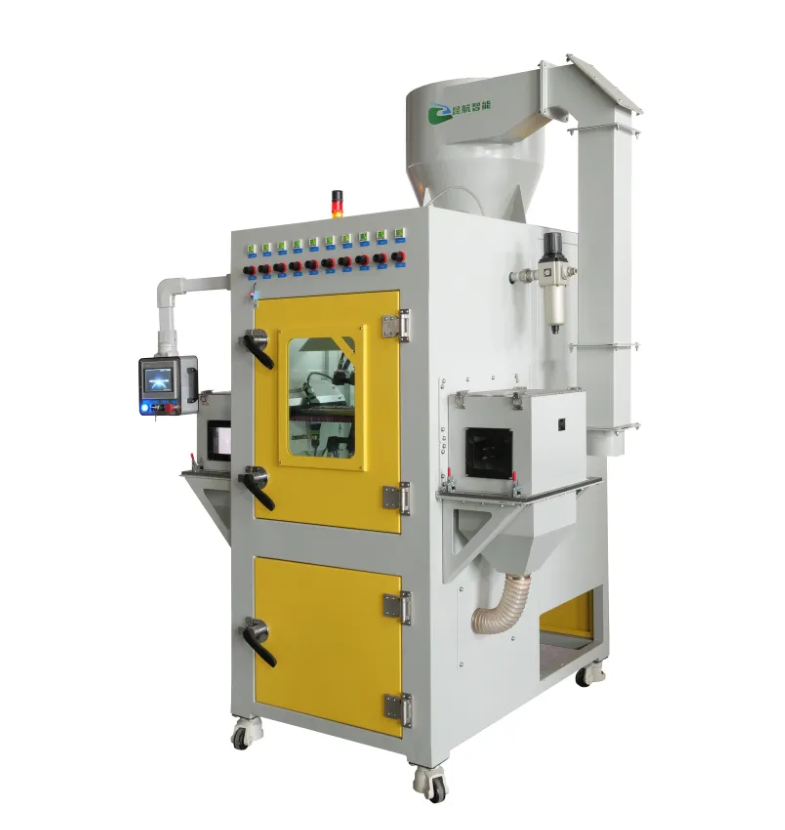
The superior fatigue performance is not achieved by the peening process in principle alone, but by its precise, controlled, and repeatable application. This is where Computer Numerical Control (CNC) transforms shot peening from a manual art into a certified aerospace manufacturing process. A CNC shot peening system meticulously controls every critical variable. The robot or multi-axis manipulator follows a digitally programmed path, ensuring the nozzle maintains the exact standoff distance and optimal impact angle relative to the complex contours of the turbine blade's concave and convex surfaces. The system precisely regulates the shot media velocity (via air pressure or wheel speed) and the media flow rate. This digital control guarantees uniform coverage and consistent Almen intensity—a standardized measure of the peening energy—across every blade, from the root and platform to the thin, critical airfoil section and tip. For a supplier like HUACELIANGYI, engineering these systems involves integrating high-accuracy motion control with real-time process monitoring. This ensures that the specified intensity, which correlates directly to the depth and magnitude of the compressive stress layer, is achieved and documented for every part. Such process consistency is non-negotiable; it eliminates the variability inherent in manual methods and provides the auditable data trail required for aerospace certification (e.g., NADCAP). The result is a fatigue-resistant compressive layer that is uniformly deep and stable, exactly as the part design engineer intended.
Synergistic Benefits: Beyond Fatigue to Foreign Object Damage and Stress Corrosion
The benefits of CNC shot peening for turbine blades extend significantly beyond just improved high-cycle fatigue life. The process delivers a suite of synergistic performance enhancements. The work-hardened surface layer created by the impacts directly increases the blade's surface hardness and wear resistance. This is particularly valuable for providing enhanced resistance to foreign object damage (FOD), such as impacts from sand, dust, or small debris ingested into the engine, which can create dangerous stress concentrators. A peened surface is more resistant to the initiation of dents and nicks. Furthermore, the same layer of residual compressive stress that closes fatigue cracks also makes the component highly resistant to stress corrosion cracking (SCC). SCC is a dangerous failure mechanism where the combined action of tensile stress and a corrosive environment (which can exist in engine atmospheres) causes crack propagation. The compressive stress layer effectively suppresses the tensile stress required for SCC to occur. For aerospace manufacturers, this means a single, well-controlled process—delivered by advanced CNC peening equipment—simultaneously addresses multiple critical failure modes, enhancing overall component reliability and engine safety. It allows for lighter, more efficient designs by enabling the use of materials to their full fatigue potential, contributing directly to improved thrust-to-weight ratios and operational economics.
CNC shot peening is a vital, engineered process that fundamentally enhances the durability and safety of aircraft turbine blades. By imparting a deep, stable layer of residual compressive stress, it directly combats the primary causes of in-service failure: fatigue, foreign object damage, and stress corrosion cracking. The transition to CNC-controlled peening is what elevates this process to meet the stringent, data-driven demands of modern aerospace manufacturing, ensuring repeatable, certifiable, and optimal results for every critical component. Investing in advanced CNC peening technology from specialized providers like HUACELIANGYI is not merely a production step; it is a strategic commitment to component longevity, engine performance, and ultimately, flight safety. In the relentless pursuit of aerospace efficiency and reliability, the precise impact of CNC shot peening provides an indispensable margin of safety.