


Quick Answer
A coordinate measuring machine for precision mold and die components should be selected according to part size, tolerance level, cavity depth, profile requirement, datum structure, probe access, surface finish, fixture method, CAD comparison needs, GD&T software, report format, and inspection workflow. For mold inserts, die plates, cavities, cores, guide holes, and precision tooling parts, the CMM should support accurate 3D measurement and repeatable inspection before assembly or shipment.
1. Why Mold And Die Components Need CMM Inspection
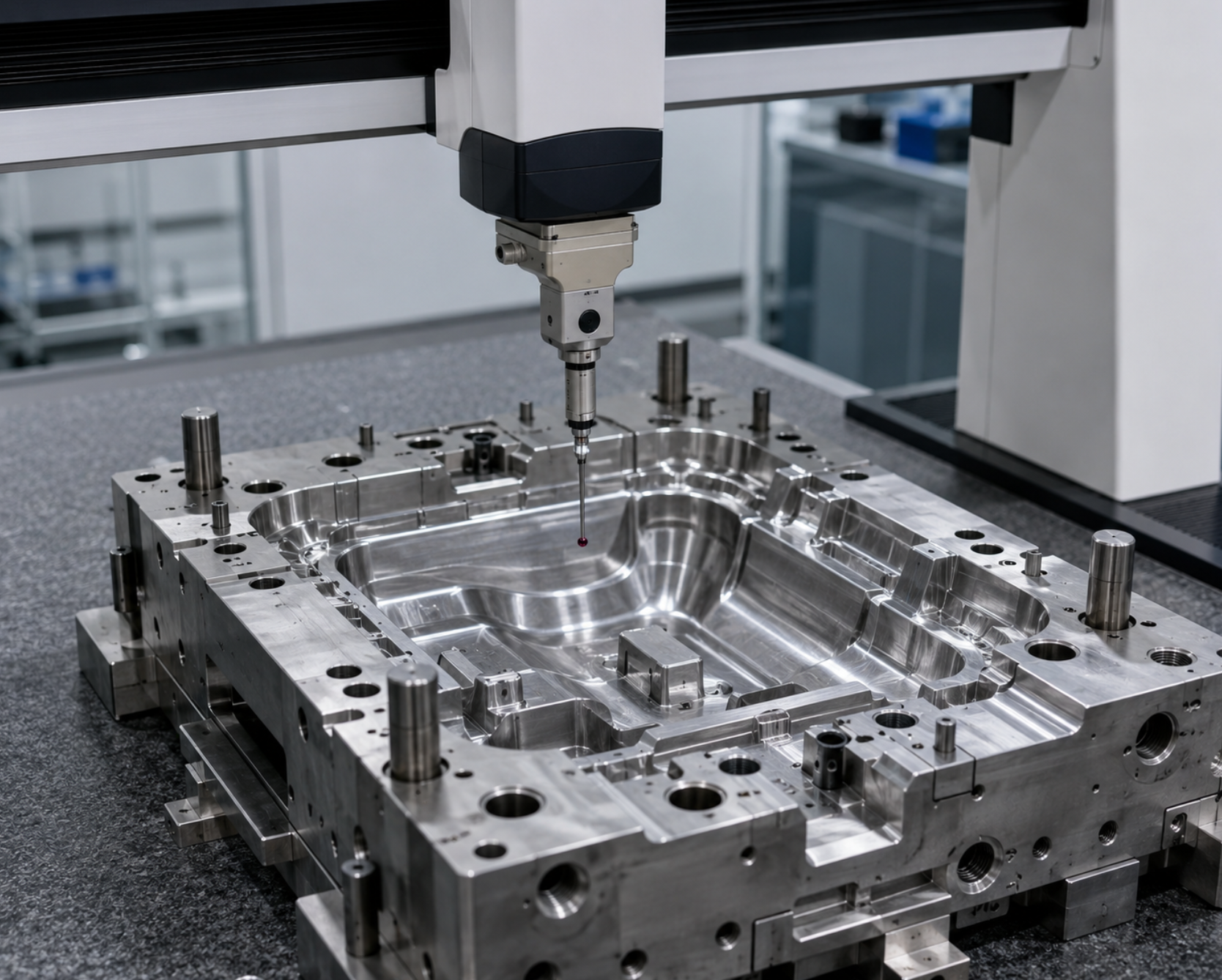
Mold and die components often include complex machined geometry, small tolerance zones, polished surfaces, EDM details, CNC-milled pockets, locating holes, guide holes, slide features, and mating surfaces. These parts must fit accurately with other tooling components, and any dimensional deviation can affect the final product.
A mold insert may fail because the cavity profile is slightly out of tolerance. A die plate may cause assembly problems if the guide hole position is incorrect. A core may produce molding defects if the surface profile does not match the CAD model. These problems are difficult to judge by visual inspection alone.
A CMM machine provides three-dimensional measurement data and helps quality teams confirm whether mold and die components meet the drawing, CAD model, and assembly requirements.
2. Typical Mold And Die Components Measured By CMM
Mold and die shops usually inspect many different tooling parts. Each part type may require a different measurement strategy, probe setup, fixture method, and report format.
| Component Type | Inspection Focus | CMM Selection Priority |
|---|---|---|
| Mold Inserts | Cavity profile, datum surfaces, locating holes, parting surfaces | CAD comparison, profile measurement, small feature access |
| Mold Cores | Core profile, curved surfaces, shut-off surfaces, ribs and pockets | Scanning option, CAD import, stable fixture support |
| Die Plates | Guide holes, mounting holes, flatness, parallelism, thickness | Larger measuring range, hole position accuracy, GD&T software |
| Slide Blocks | Angled faces, slots, wedge surfaces, guide surfaces | Angled stylus access, datum alignment, surface relationship measurement |
| Ejector Plates | Ejector hole position, flatness, hole pitch, mounting interfaces | Repeatable hole pattern inspection and report output |
| Precision Tooling Parts | Small bores, slots, pockets, precision faces, alignment features | High repeatability, stylus kit, fixture flexibility |
3. Key Features To Inspect On Precision Mold Components
Tooling inspection should focus on functional features that affect assembly, molding performance, stamping accuracy, product geometry, and tool life.
| Measured Feature | Why It Matters | CMM Inspection Focus |
|---|---|---|
| Cavity And Core Profile | Affects final product shape, fit, surface appearance and shrinkage control | Profile tolerance, CAD comparison, section analysis, surface deviation |
| Guide Holes And Bushings | Controls mold closing accuracy and die alignment | Hole diameter, position, perpendicularity, coaxiality and pitch |
| Parting Surfaces | Affects flash, sealing, mold closure and product quality | Flatness, parallelism, surface profile and datum relationship |
| Locating Features | Ensures repeatable assembly of inserts, cores and plates | Position tolerance, datum setup, slot and pin hole relationship |
| Ejector Holes | Affects ejector movement and product release | Hole pitch, diameter, straightness and plate relationship |
| Angled Slide Surfaces | Controls slide movement and shut-off accuracy | Angle, flatness, profile, parallelism and mating surface relationship |
4. CMM Inspection After CNC, EDM And Grinding
Mold and die components often pass through several machining stages. CNC milling creates cavities, pockets and profiles. EDM may create sharp corners, deep features and fine details. Grinding controls flatness, parallelism and precision surfaces. Each process may introduce different dimensional risks.
A CMM can be used after key machining steps to check whether the process is stable. This helps manufacturers detect tool wear, fixture shift, EDM electrode error, grinding deviation, datum mismatch or local profile problems before final assembly.
Recommended Process Inspection Points
After rough machining: check material allowance and datum position.
After CNC finishing: inspect cavity profile, holes, pockets and mounting features.
After EDM: verify fine details, corner geometry and electrode-related features.
After grinding: check flatness, parallelism, thickness and precision datum surfaces.
Before assembly: confirm guide holes, locating features, parting surfaces and mating faces.
Before shipment: generate final inspection report for customer approval.
5. Probe And Software Configuration For Mold And Die Components
The correct CMM configuration depends on the type of mold and die parts being inspected. Standard holes and planes may be measured with a touch-trigger probe. Complex profiles, curved surfaces, mold cavities and freeform features may require scanning capability and CAD comparison software.
| Configuration Area | Recommended Focus | Buyer Benefit |
|---|---|---|
| Machine Measuring Range | Based on the largest insert, die plate, fixture height and probe clearance | Prevents inspection limitation after installation |
| Touch-Trigger Probe | Useful for holes, planes, bores, slots and standard geometric features | Efficient for routine tooling inspection |
| Scanning Probe Option | Recommended for profile, cavity, freeform surface and CAD comparison | Provides dense data for complex mold surfaces |
| Stylus Kit | Small ball styli, long styli, angled styli, star styli and extensions | Improves access to deep pockets, narrow slots and side features |
| Software | CAD import, GD&T, profile evaluation, automatic report and SPC output | Supports customer approval and process quality control |
6. Fixture Design For Precision Tooling Inspection
Mold and die components may be heavy, polished, hardened, or have precision surfaces that cannot be damaged. Fixture design should hold the part securely while protecting critical surfaces and allowing probe access.
The fixture should follow the functional datum structure. For insert inspection, this may mean locating from the assembly datums rather than from a convenient outside edge. For die plates, this may mean supporting the plate without bending while keeping guide holes and mounting features accessible.
Fixture Checklist
Does the fixture follow the drawing datum structure?
Can the part be held without scratching polished or finished surfaces?
Does the fixture avoid bending thin plates or slender inserts?
Can the probe reach cavities, pockets, holes and side surfaces?
Can the same fixture be used repeatedly for batch inspection?
Is modular fixturing enough, or is a custom tooling fixture required?
7. What Should Be Included In A Mold And Die CMM Report?
A useful CMM report should help mold makers, quality engineers and buyers understand whether the tooling component is ready for assembly, trial or shipment.
Recommended Report Content
Part name, part number, drawing number, CAD model version and revision
Material, heat treatment status, machining stage and inspection date
Cavity profile, core profile, hole position, flatness and datum relationships
Guide hole diameter, pitch, perpendicularity and coaxiality if required
Parting surface flatness, parallelism and profile measurement
Nominal value, measured value, deviation, tolerance and pass/fail result
Probe setup, fixture method, operator and machine information
CAD comparison or section analysis if the part requires profile verification
8. What Buyers Should Provide Before Requesting A Quote
To recommend the right CMM for precision mold and die components, the supplier needs real application information. A simple request for CMM price may lead to an incomplete configuration.
Quotation Information Checklist
Mold insert, die plate or tooling component drawings and CAD files
Maximum part length, width, height and weight
Material, hardness, heat treatment and surface finish condition
Critical dimensions, tolerance requirements and GD&T items
Measured features: cavities, cores, guide holes, ejector holes, parting surfaces, slots and pockets
Whether scanning, CAD comparison or profile report is required
Fixture height, clamping method and surface protection requirements
Inspection purpose: process inspection, final inspection, mold trial approval or customer acceptance
Required report format, software output, destination country and service expectations
9. Common Mistakes To Avoid
Checking only outside dimensions while ignoring cavity profile and functional datums.
Using manual tools for complex profiles that require CAD comparison.
Ignoring parting surface flatness and guide hole relationship.
Choosing a CMM without considering deep cavity access and stylus length.
Using fixtures that scratch polished surfaces or deform thin die plates.
Buying software that cannot support profile tolerance or CAD model inspection.
Skipping inspection between machining stages and only checking after final assembly.
Requesting a quotation without drawings, CAD files, tolerance data and measured feature details.
Conclusion
Precision mold and die components require accurate inspection of cavities, cores, inserts, die plates, guide holes, ejector holes, parting surfaces, locating features, profiles and datum relationships. A suitable coordinate measuring machine should combine proper measuring range, stable accuracy, probe access, stylus flexibility, CAD import, GD&T reporting, optional scanning capability, fixture support, calibration certificate, training and after-sales service.
By providing drawings, CAD files, tolerance requirements, machining process information and inspection workflow before quotation, buyers can receive a more practical CMM recommendation for mold and die quality control.
FAQ
1. Why is CMM inspection important for mold and die components?
Mold and die components often have precision cavities, cores, guide holes, parting surfaces and locating features. CMM inspection helps verify dimensional accuracy, assembly fit and customer drawing requirements.
2. Does mold inspection need a scanning probe?
Not always. Simple holes and planes can often be measured with a touch-trigger probe. Scanning is more useful for complex profiles, freeform surfaces, cavity shapes and CAD comparison.
3. What software functions are useful for mold and die inspection?
CAD import, profile evaluation, GD&T reporting, automatic inspection reports, section analysis and CAD comparison are useful for precision mold and die components.
4. What should buyers send before requesting a quote?
Buyers should send drawings, 3D CAD files, part size, part weight, tolerance requirements, profile inspection needs, fixture method, report format and destination country.
Need A CMM For Precision Mold And Die Components?
Send us your mold insert drawings, die plate CAD files, cavity profile requirements, tolerance data, fixture method and report format. We can help evaluate a suitable coordinate measuring machine configuration for your tooling inspection project.
Contact Us Request Quote