


Quick Answer
A bridge CMM with scanning probe should be considered when the inspected parts require profile measurement, surface form analysis, CAD comparison, continuous contour inspection, complex geometry verification, or higher-density measurement data. Buyers should confirm the part geometry, surface tolerance, scanning speed, probe system, software capability, CAD import, report format, fixture method, calibration requirement, and whether scanning is truly needed before requesting a quotation.
1. Why Choose A Scanning Probe Instead Of Only Touch-Trigger Measurement?
A touch-trigger probe is useful for measuring discrete points, holes, bores, planes, and standard geometric features. It is widely used for many CMM inspection tasks. However, when the part includes complex surfaces, profiles, curves, contoured edges, or freeform geometry, single-point measurement may not provide enough data to understand the full surface condition.
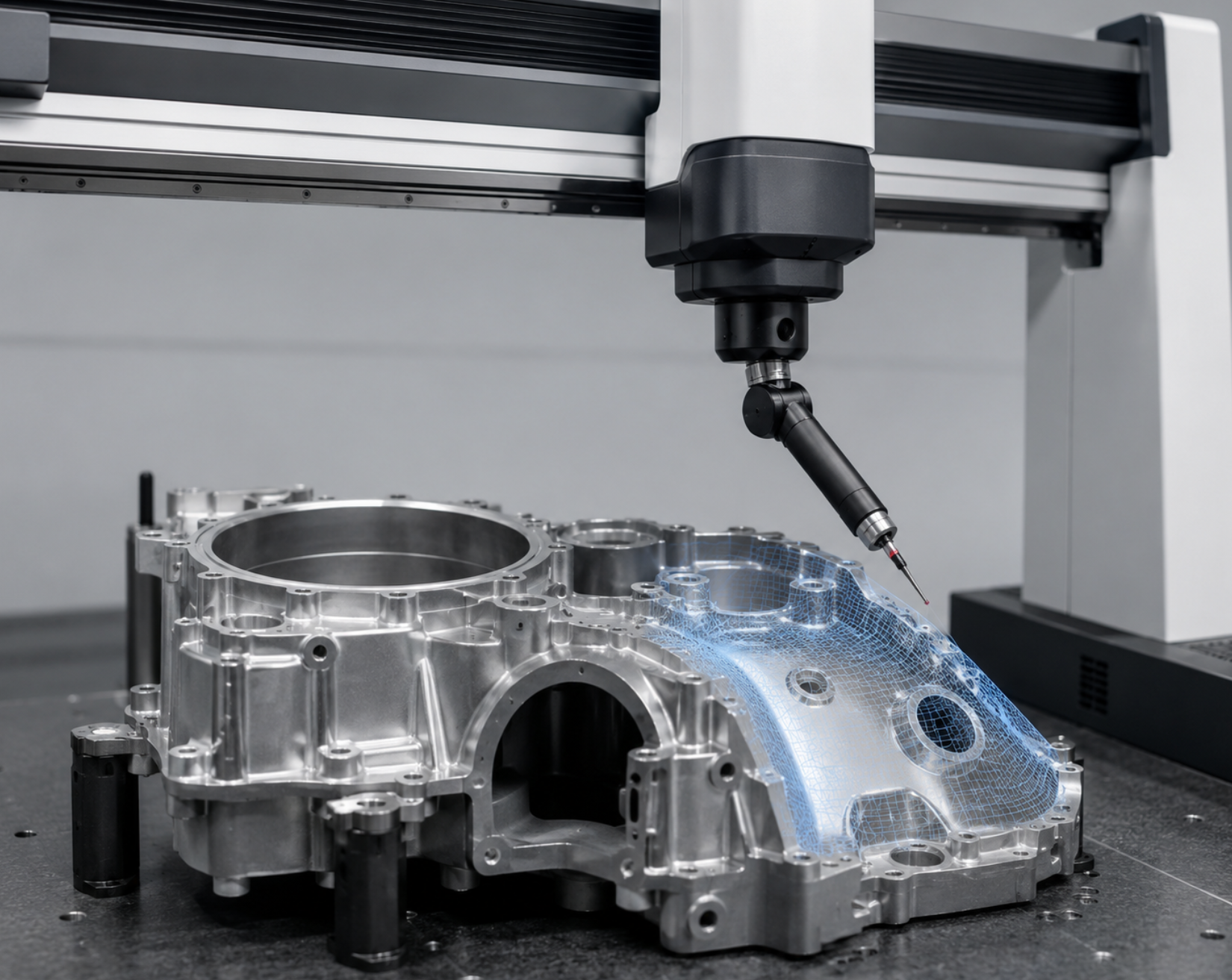
A scanning probe can collect continuous data along a surface or profile. This helps quality engineers evaluate whether the actual part shape matches the CAD model or drawing requirement. It is especially useful when profile tolerance, surface form, sealing surface quality, or contour deviation matters.
For buyers inspecting mold components, aerospace brackets, aluminum housings, precision structural parts, turbine-related components, and complex CNC parts, scanning capability can make the inspection report more complete and easier to analyze.
2. Typical Parts Suitable For Bridge CMM Scanning Probe Inspection
Not every part requires scanning. The value of a scanning probe depends on whether the part has surface geometry that cannot be fully judged by simple point measurement.
| Part Type | Inspection Focus | Why Scanning Helps |
|---|---|---|
| Mold And Die Components | Cavities, cores, parting surfaces, guide features, complex profiles | Supports profile verification and CAD comparison |
| Aerospace Brackets | Curved edges, lightweight pockets, mounting interfaces, profile tolerance | Provides more data for complex structural geometry |
| Aluminum Housings | Sealing faces, machined surfaces, pockets, bores, datum surfaces | Helps evaluate surface relationship and local deviations |
| Precision Structural Parts | Long profiles, mounting slots, milled surfaces, datum relationships | Improves inspection coverage for large and complex parts |
| Freeform CNC Machined Parts | Curved surfaces, complex contours, blended transitions | Useful for comparing actual surface to CAD model |
3. What Can A Scanning Probe Measure?
A scanning probe can measure continuous features and collect more data than standard touch-trigger probing. This makes it suitable for shape-related inspection tasks and high-density measurement requirements.
| Measurement Item | Application | Report Value |
|---|---|---|
| Profile Measurement | Curved edges, contours, surfaces, molded or machined profiles | Shows deviation from nominal profile or CAD model |
| Surface Form Measurement | Sealing faces, machined planes, contoured surfaces, functional surfaces | Helps evaluate surface flatness, form, and local distortion |
| CAD Comparison | Parts with 3D models and complex geometry | Compares actual measured data with nominal CAD geometry |
| Contour Inspection | Long edge profiles, slots, curved paths, pockets and ribs | Improves understanding of shape deviation across the feature |
| Section Analysis | Mold surfaces, housing sections, complex machined profiles | Supports detailed review of specific cross-section geometry |
4. When Is Scanning Probe Necessary?
Scanning probe is not always required. For many parts, a touch-trigger probe is enough. Buyers should consider scanning probe when the inspection task requires dense surface data, continuous profile verification, or CAD-based comparison.
Scanning Probe Is Recommended When:
The drawing includes profile tolerance for surfaces or contours.
The part has curved or freeform surfaces that cannot be checked by simple points.
The buyer needs CAD comparison with color deviation maps or section analysis.
The component has sealing surfaces where local surface deviation matters.
The part has complex mold cavities, structural pockets, or machined contours.
The customer requires a detailed inspection report for surface form approval.
5. Bridge CMM Configuration For Scanning Probe Measurement
A bridge CMM with scanning probe should be configured as a complete inspection solution. The machine structure, controller, probe system, software, stylus setup, calibration accessories, fixture method, and report format all affect the final measurement performance.
| Configuration Area | Recommended Focus | Buyer Benefit |
|---|---|---|
| Machine Measuring Range | Selected by part size, fixture height, probe clearance, and future workpiece plan | Ensures scanning path can cover the full feature area |
| Scanning Probe System | Probe type, scanning capability, stylus compatibility, probe changer if needed | Supports continuous data collection for profile and surface measurement |
| Stylus Package | Ball size, stylus length, extension bars, angled styli and calibration sphere | Improves access to curved surfaces, pockets and side features |
| Software | CAD import, profile evaluation, GD&T, scanning data processing, automatic report | Converts scanned data into practical inspection results |
| Fixture Support | Datum-based fixture with enough access for scanning paths | Improves repeatability and reduces deformation during measurement |
6. CAD Comparison And Profile Report Requirements
One of the main reasons buyers choose scanning probe is to compare the measured part with the CAD model. This is useful when the drawing uses profile tolerance or when the part geometry is difficult to describe with simple dimensions.
A good scanning CMM report should clearly show nominal geometry, measured geometry, deviation value, tolerance range, pass/fail result, datum reference, and inspection alignment strategy. For complex parts, section views and surface deviation results can help engineers understand where the part is changing.
Recommended Report Content
Part name, part number, CAD model version, and drawing revision
Profile tolerance, measured deviation, and pass/fail result
CAD comparison result and section analysis if required
Datum reference and alignment strategy
Probe setup, stylus information, and scanning path details
Nominal value, measured value, deviation and tolerance
Inspection date, operator, machine information and calibration status
7. Fixture Design For Profile And Surface Measurement
Fixture design is very important for scanning measurement. If the fixture blocks the scanning path, the probe may not collect enough data. If the fixture clamps a thin-wall part too strongly, the surface may deform during measurement. If the part is unstable, scanning repeatability may become poor.
The fixture should follow the drawing datum structure, support the part without deformation, and allow the scanning probe to reach critical surfaces, profiles, pockets, edges and side features.
Fixture Checklist
Does the fixture follow functional datums?
Can the part be supported without distortion?
Does the fixture leave enough clearance for scanning movement?
Can the probe scan the complete profile or surface area?
Can different operators load the part repeatedly?
Is a modular fixture enough, or is a custom fixture required?
8. What Buyers Should Provide Before Requesting A Quote
A scanning probe configuration should not be quoted blindly. The supplier needs to understand the actual part geometry, tolerance, inspection purpose, and report requirements before recommending the correct package.
Quotation Information Checklist
Part drawings and 3D CAD files
Maximum part length, width, height and weight
Material, machining process, surface condition and finish requirement
Profile tolerance, surface form requirement and GD&T items
Measured features: surfaces, contours, pockets, slots, holes, bores and datum planes
Whether CAD comparison, section analysis or deviation report is required
Fixture height, clamping method and access limitations
Inspection purpose: first article, batch inspection, customer approval or final inspection
Required report format, software output and destination country
9. Common Mistakes To Avoid
Buying a scanning probe without confirming whether the part really needs dense surface data.
Assuming basic CMM software can automatically support CAD comparison and profile reports.
Ignoring fixture clearance for scanning paths.
Using an unsuitable stylus length or ball size for curved surfaces and pockets.
Only checking surface data but ignoring datum setup and GD&T requirements.
Not confirming report format before customer approval.
Requesting a quotation without CAD files or profile tolerance information.
Comparing scanning CMM quotations only by machine price instead of full probe and software configuration.
Conclusion
A bridge CMM with scanning probe is a practical choice for profile measurement, surface form inspection, CAD comparison, and complex geometry verification. It is especially useful for mold components, aerospace brackets, aluminum housings, precision structural parts, freeform CNC parts, and components with profile tolerance requirements.
Buyers should confirm machine size, scanning probe system, stylus package, CAD software, GD&T report functions, fixture access, calibration support, training and after-sales service before purchasing. By providing drawings, CAD files, profile tolerance, measured features and report requirements before quotation, buyers can receive a more accurate bridge CMM scanning solution.
FAQ
1. What is the advantage of a scanning probe on a bridge CMM?
A scanning probe can collect continuous measurement data along a surface or profile. This helps inspect complex contours, surface form, profile tolerance and CAD model deviation more completely than simple point measurement.
2. Does every CMM need a scanning probe?
No. Many parts can be measured with a standard touch-trigger probe. A scanning probe is more useful when the part has curved surfaces, freeform geometry, profile tolerance, sealing surfaces or CAD comparison requirements.
3. What software functions are important for scanning measurement?
Buyers should confirm CAD import, profile evaluation, GD&T reporting, scanning data processing, section analysis, automatic report output and SPC capability if batch monitoring is required.
4. What should buyers send before requesting a scanning CMM quotation?
Buyers should send drawings, 3D CAD files, part size, tolerance requirements, profile measurement areas, surface inspection needs, fixture method, report format and destination country.
Need A Bridge CMM With Scanning Probe?
Send us your drawings, CAD files, profile tolerance, surface measurement requirements, fixture method and report format. We can help evaluate a suitable bridge CMM scanning probe configuration for your inspection project.
Contact Us Request Quote