


Quick Answer
For aluminum gearbox housing inspection, a CMM machine should measure bearing bores, shaft center distance, coaxiality, sealing face flatness, mounting hole position, datum planes, machined surfaces, profile, and critical GD&T items. Buyers should choose the CMM based on housing size, fixture height, thin-wall deformation risk, probe access, bore depth, tolerance level, software reporting, SPC needs, calibration certificate, and batch quality control workflow.
1. Why Aluminum Gearbox Housing Inspection Is Different
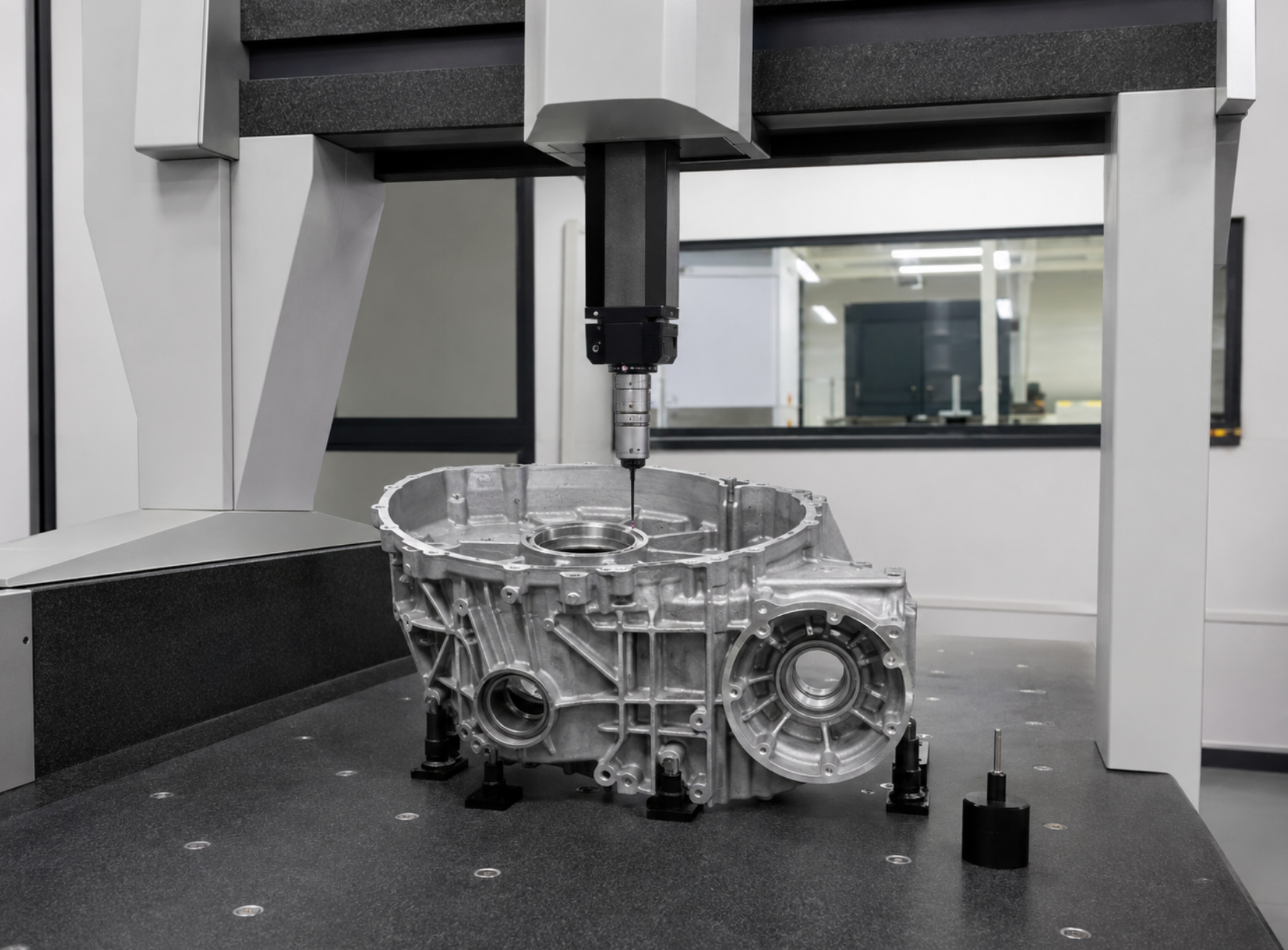
Aluminum gearbox housings are different from simple machined blocks because they often combine casting surfaces, CNC-machined bores, sealing faces, rib structures, thin walls, oil channels, mounting bosses, and multiple datum systems. The part may look acceptable after machining, but small deviations in bore alignment or sealing face flatness can create serious assembly problems.
Aluminum material is also more sensitive to clamping force, temperature change, and thin-wall deformation. If the housing is not supported correctly during inspection, the measured result may not represent the real part condition.
A CMM machine can inspect the full 3D relationship between bores, planes, holes, and datums. It helps manufacturers move from simple size checking to functional quality control.
2. Typical Aluminum Gearbox Housing Features Measured By CMM
A complete inspection plan should focus on features that affect bearing fit, shaft alignment, gear meshing, sealing performance, and assembly with other components.
| Measured Feature | Inspection Purpose | CMM Inspection Focus |
|---|---|---|
| Bearing Seat Bores | Controls bearing fit and shaft support | Diameter, roundness, cylindricity, position, coaxiality |
| Shaft Center Distance | Affects gear meshing and noise control | Axis distance, bore relationship, datum alignment |
| Sealing Faces | Reduces leakage risk and improves cover assembly | Flatness, profile, parallelism, surface relationship |
| Mounting Holes | Ensures correct assembly with covers, motors, brackets, or vehicle structures | Hole position, pitch, diameter, bolt pattern accuracy |
| Datum Planes | Defines inspection reference and assembly reference | Flatness, perpendicularity, datum setup, repeatability |
| Machined Bosses And Pads | Controls component mounting and local interface accuracy | Height, location, profile, parallelism, perpendicularity |
3. Common Quality Risks In Aluminum Gearbox Housings
Aluminum gearbox housings may pass basic visual inspection but still fail during assembly or endurance testing. A CMM helps detect dimensional problems early and provides data for machining process correction.
| Quality Risk | Possible Cause | CMM Control Method |
|---|---|---|
| Bearing Bore Misalignment | Machining datum error, casting deformation, fixture deviation | Measure bore axes, center distance, coaxiality, and position tolerance |
| Sealing Face Leakage Risk | Surface distortion, local machining error, clamping deformation | Check flatness, profile, parallelism, and face-to-datum relationship |
| Mounting Hole Position Error | Tool wear, machining program error, datum shift | Inspect hole pattern, pitch, position tolerance, and bolt interface |
| Thin-Wall Deformation | Casting stress, heat treatment, clamping force, machining stress release | Use proper fixture support and compare critical surfaces after machining |
| Datum Instability | Poor locating surface, burrs, uneven casting reference, fixture issue | Build inspection alignment based on functional datums and repeatable setup |
4. Why Fixture Design Is Critical For Aluminum Housings
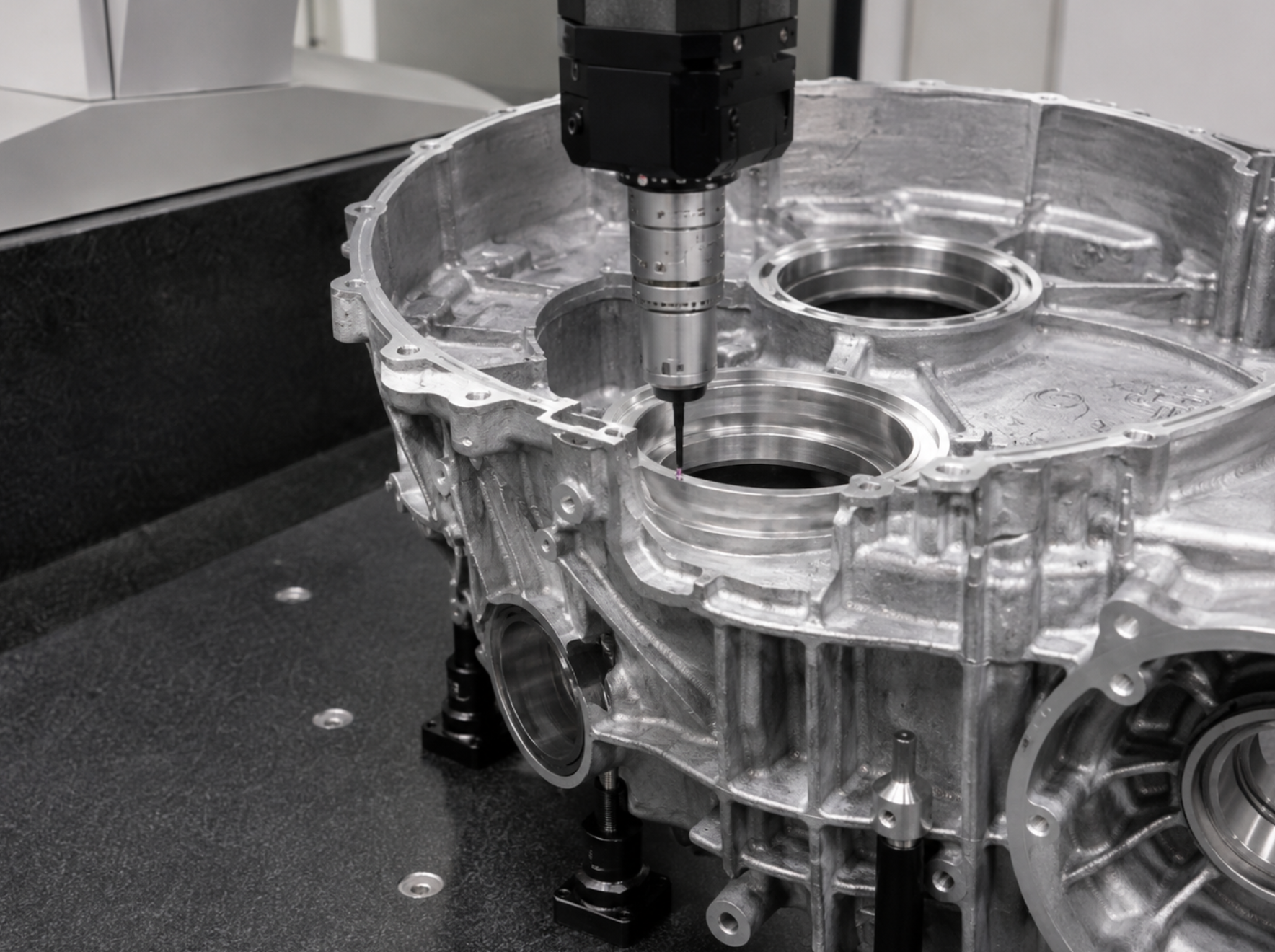
Aluminum gearbox housings often have thin ribs, hollow cavities, large openings, and uneven walls. If the fixture clamps the part too strongly, the housing may deform during inspection. If the support is not stable, the measured bore position or sealing face flatness may change between operators.
A good fixture should locate the housing according to functional datums, support the part without deformation, avoid blocking probe access, and allow repeatable loading. For batch production, fixture repeatability is as important as CMM accuracy.
Fixture Checklist For Aluminum Gearbox Housing
Does the fixture follow the drawing datum structure?
Can the housing be supported without thin-wall deformation?
Does the fixture avoid over-clamping near bearing bores?
Can the probe reach sealing faces, bores, side holes, and mounting pads?
Can different operators load the part repeatedly in the same position?
Is the fixture suitable for FAI, batch inspection, or final inspection?
5. Recommended CMM Configuration For Aluminum Gearbox Housing
The suitable CMM configuration depends on housing size, tolerance, bore depth, part weight, fixture height, report requirements, and inspection frequency. For many aluminum gearbox housing projects, a bridge CMM is a practical solution because it provides stable measurement for medium and large parts in a quality lab environment.
| Configuration Area | Recommended Focus | Buyer Benefit |
|---|---|---|
| Measuring Range | Based on housing size, fixture height, probe clearance, and future part size | Avoids insufficient travel after installation |
| Probe System | Touch-trigger probe for bores, holes, and planes; scanning option for profile needs | Matches real inspection features |
| Stylus Kit | Long styli, extension bars, angled styli, small ball styli, calibration sphere | Improves access to deep bores and side holes |
| Software | CAD import, GD&T, automatic reports, SPC output, custom templates | Supports customer approval and production quality monitoring |
| Fixture Support | Datum-based fixture design for repeatable aluminum housing inspection | Reduces measurement variation caused by loading and clamping |
6. How CMM Supports Batch Quality Control
For aluminum gearbox housing manufacturers, CMM inspection is not only used for first article approval. It can also support process monitoring during batch production. By measuring key dimensions regularly, quality engineers can detect machining drift, tool wear, fixture changes, or casting batch variation before defects become large-scale problems.
Typical Quality Control Workflow
Incoming casting dimensional review before machining if required
First article inspection after CNC machining
Critical bore and sealing face inspection during process validation
Batch sampling inspection for key dimensions and GD&T items
SPC monitoring for bore size, center distance, flatness, and hole position
Final inspection report before shipment or customer approval
7. What Should Be Included In The CMM Inspection Report?
A useful aluminum gearbox housing inspection report should show more than pass or fail. It should help quality teams understand whether the part is dimensionally stable and whether the machining process is under control.
Recommended Report Content
Part name, part number, drawing number, and revision
Material, process stage, inspection date, and operator
Bearing bore diameter, roundness, cylindricity, position, and coaxiality
Shaft center distance and bore axis relationship
Sealing face flatness, profile, and datum relationship
Mounting hole position, pitch, and bolt pattern accuracy
Nominal value, measured value, tolerance, deviation, and pass/fail result
SPC output if batch quality monitoring is required
8. What Buyers Should Provide Before Requesting A Quote
To recommend the right CMM machine for aluminum gearbox housing inspection, the supplier needs real part and process information. A simple request for CMM price is not enough for accurate configuration.
Quotation Information Checklist
Aluminum gearbox housing drawings and CAD files
Maximum part length, width, height, and weight
Material grade, casting process, machining process, and surface condition
Critical bore diameter, bore depth, shaft center distance, and tolerance requirements
GD&T items such as coaxiality, cylindricity, flatness, position, profile, and perpendicularity
Fixture height, clamping method, loading method, and deformation concerns
Inspection purpose: FAI, batch inspection, final inspection, export inspection, or customer approval
Required probe package, software functions, report format, and SPC output
Destination country, installation room condition, and service expectations
9. Common Mistakes To Avoid
Checking only outside dimensions while ignoring bore alignment and shaft center distance.
Using a fixture that deforms thin-wall aluminum housing during inspection.
Ignoring sealing face flatness and profile requirements.
Choosing a CMM size without considering fixture height and probe clearance.
Using a basic stylus setup that cannot reach deep bores or side holes.
Buying software that cannot support required GD&T reports or SPC output.
Not monitoring batch trends after first article inspection.
Requesting a quotation without drawings, CAD files, tolerance data, and inspection workflow.
Conclusion
Aluminum gearbox housing inspection requires accurate control of bearing bores, shaft center distance, coaxiality, sealing faces, mounting holes, datum planes, machined bosses, and GD&T relationships. A suitable CMM machine should combine proper measuring range, stable accuracy, suitable probe package, rigid stylus setup, repeatable fixture support, GD&T software, automatic reporting, SPC capability, calibration certificate, training, and after-sales service.
By providing drawings, CAD files, tolerance data, process information, and inspection workflow before quotation, buyers can receive a more practical CMM solution for aluminum gearbox housing quality control.
FAQ
1. Why is CMM inspection important for aluminum gearbox housing?
Aluminum gearbox housings require accurate control of bearing bores, shaft center distance, sealing faces, mounting holes, and datum relationships. These features affect assembly, gear meshing, vibration, leakage, and service life.
2. Can a CMM check aluminum housing deformation?
A CMM can help detect dimensional deformation by measuring datum planes, sealing faces, bore positions, and profile deviations. Proper fixture support is important to avoid deformation during inspection.
3. What CMM size is suitable for aluminum gearbox housing?
The suitable size depends on housing length, width, height, weight, fixture height, probe clearance, bore depth, and measured features. Buyers should provide drawings and CAD files before selecting the machine range.
4. What should buyers send before requesting a quote?
Buyers should send drawings, CAD files, part size, part weight, bore tolerance, GD&T requirements, fixture method, inspection purpose, report needs, and destination country.
Need A CMM Machine For Aluminum Gearbox Housing Inspection?
Send us your aluminum gearbox housing drawings, CAD files, bore tolerance, sealing face requirements, fixture method, and inspection workflow. We can help evaluate a suitable CMM configuration for your quality control project.
Contact Us Request Quote