


Quick Answer
A CMM machine for pump housing, valve body and flange inspection should be selected according to part size, part weight, bore diameter, flange face size, hole pattern accuracy, sealing surface flatness, port position, datum structure, probe access, report format and inspection frequency. Buyers should confirm not only the machine size, but also the probe package, stylus configuration, fixture method, software capability, calibration certificate and installation environment before quotation.
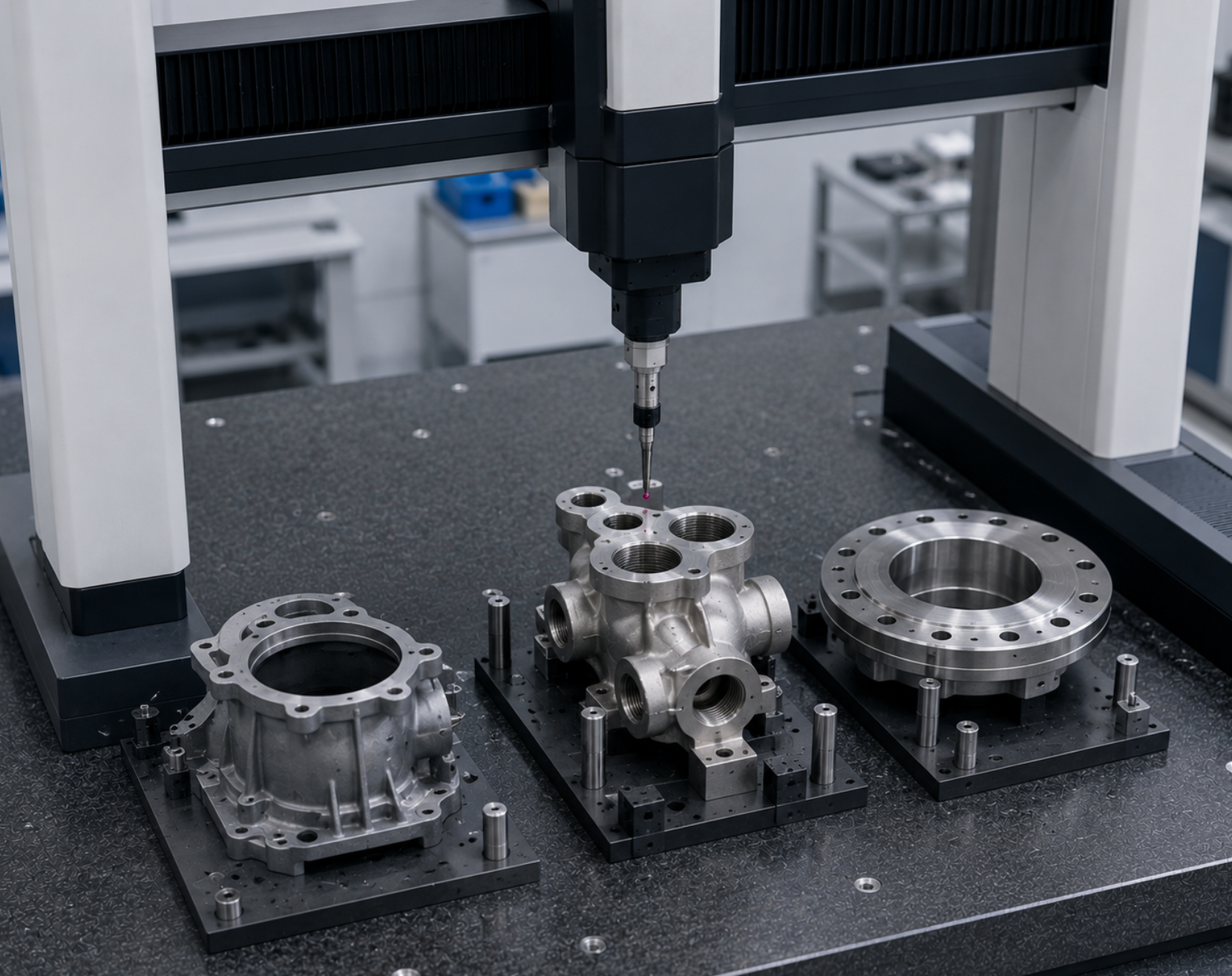
1. Why CMM Inspection Matters For Pump Housings, Valve Bodies And Flanges
Pump housings, valve bodies and flanges are critical components in systems where dimensional accuracy affects sealing, flow performance, alignment, assembly and service life. A small deviation in flange face flatness, port position, bolt hole pattern or bore alignment can create leakage, vibration, assembly mismatch or reduced operating reliability.
These components are often produced by casting and then finished by CNC machining. As a result, they may include both irregular raw surfaces and precision machined features. Visual inspection and manual gauges can check some sizes, but they often cannot verify the full 3D relationship between bores, sealing faces, datum planes, bolt holes and ports.
A CMM machine provides accurate three-dimensional measurement data and helps manufacturers move from simple size checking to functional quality control.
2. Typical Parts Measured In Pump, Valve And Flange Inspection
The CMM selection should reflect the real component types being produced. Different parts require different measuring ranges, stylus access and fixture strategies.
| Part Type | Inspection Focus | CMM Selection Priority |
|---|---|---|
| Pump Housing | Bearing bores, sealing faces, flange faces, mounting holes, port position | Bore access, sealing face flatness, robust fixture support |
| Valve Body | Port position, internal bore alignment, flange faces, seat location, threaded interfaces | Probe reach, stylus extensions, GD&T software |
| Pipe Flange | Bolt hole pattern, face flatness, bore concentricity, outer diameter | Efficient hole pattern measurement and repeatable alignment |
| Pump Cover / End Cap | Flatness, bolt holes, sealing groove, datum relationship | Surface and hole position measurement |
| Valve Cover / Bonnet | Mounting face, hole pattern, bore relationship, mating surface | Automatic reporting and flexible stylus access |
| Machined Cast Components | Multiple datums, sealing interfaces, port geometry, machined pads | Complete 3D inspection and traceable reports |
3. Key Features A CMM Should Measure
Inspection should focus on the features that affect leakage control, mechanical fit and assembly performance.
| Measured Feature | Why It Matters | CMM Inspection Focus |
|---|---|---|
| Flange Face Flatness | Affects gasket compression and sealing reliability | Flatness, profile and local surface deviation |
| Bolt Hole Pattern | Ensures assembly with mating flanges and covers | Hole position, pitch circle diameter, angular distribution and diameter |
| Bore And Center Hole Alignment | Controls shaft fit, flow path alignment or mating component fit | Diameter, coaxiality, concentricity and position |
| Sealing Groove / Mating Face | Affects sealing performance and cover fit | Width, depth, location, profile and datum relationship |
| Port And Nozzle Position | Affects pipe connection and flow assembly accuracy | Center position, angle, orientation and datum reference |
| Datum Planes And Mounting Pads | Defines reference for assembly and measurement alignment | Flatness, perpendicularity, parallelism and repeatability |
4. Common Quality Risks In Pump, Valve And Flange Components
Cast and machined flow-control parts can appear acceptable but still fail during assembly or pressure testing. A CMM helps identify problems early and supports process correction.
| Quality Risk | Possible Cause | CMM Control Method |
|---|---|---|
| Flange Leakage Risk | Poor flatness, local warp, machining error or damaged gasket face | Inspect face flatness, profile and bolt hole alignment |
| Bolt Hole Misalignment | Fixture shift, tool wear, program error or casting datum variation | Measure full hole pattern and position tolerance |
| Bore Misalignment | Datum setup error, casting movement or machining deviation | Check bore axis, diameter, coaxiality and concentricity |
| Port Location Error | Incorrect machining reference or cumulative tolerance build-up | Measure port centers, orientation and datum relationship |
| Mating Surface Distortion | Clamping deformation, casting stress or heat treatment change | Inspect sealing faces and functional surfaces under correct support condition |
5. Recommended CMM Configuration For These Parts
The most suitable CMM depends on the largest pump housing, valve body or flange size, the part weight, the deepest bore or port, and the report requirements. In many cases, a bridge CMM is a practical solution for inspection laboratories handling industrial fluid components.
| Configuration Area | Recommended Focus | Buyer Benefit |
|---|---|---|
| Measuring Range | Based on the largest housing, flange diameter, fixture size and probe clearance | Prevents insufficient travel during inspection |
| Probe System | Touch-trigger probe for holes, bores and faces; scanning option for profile tasks if needed | Matches both routine and advanced inspection needs |
| Stylus Kit | Long styli, angled styli, star styli and extensions for side holes and deep bores | Improves access to complex internal and side features |
| Software | GD&T, CAD import, automatic reports, SPC output and custom templates | Supports customer approval and process quality monitoring |
| Fixture Support | Datum-based support to avoid rocking or distortion of cast parts | Improves repeatability and measurement stability |
6. Fixture Design For Pump Housings, Valve Bodies And Flanges
Cast components often have uneven outside surfaces, large cavities and non-uniform wall thickness. If the part is not supported correctly, it may tilt or deform during measurement. The fixture should locate the part according to functional datums and keep critical features accessible to the probe.
Fixture Checklist
Does the fixture follow the drawing datum structure?
Can the part be supported without rocking or local distortion?
Does the fixture avoid blocking flange faces, holes, ports and sealing surfaces?
Can the probe reach deep bores, side ports and groove areas?
Can different operators load the part repeatedly in the same position?
Is the fixture suitable for first article, batch inspection or final inspection?
7. How CMM Supports Batch Quality Control
Pump and valve manufacturers often need more than first article inspection. During batch production, the CMM can help track critical dimensions, identify machining drift, monitor tool wear and generate traceable reports for customer audits.
Typical Quality Control Workflow
Incoming casting review if the machining allowance or datum condition needs confirmation
First article inspection after CNC machining
Critical bore, flange face and hole pattern inspection during process validation
Batch sampling inspection for key dimensions and GD&T features
SPC monitoring for flange flatness, bore size and hole pattern stability
Final inspection report before assembly or shipment
8. What Should Be Included In The CMM Report?
A useful report should show more than pass or fail. It should help engineers understand whether the part is functionally acceptable and whether the machining process is stable.
Recommended Report Content
Part name, part number, drawing number and revision
Material, process stage, inspection date and operator
Flange face flatness, sealing face profile and local deviation
Bolt hole pattern diameter, position, pitch and pass/fail result
Bore diameter, coaxiality, concentricity and location
Port center position, orientation and datum relationship
Nominal value, measured value, tolerance, deviation and result
SPC output if batch monitoring is required
9. What Buyers Should Provide Before Requesting A Quote
To recommend the right CMM machine, the supplier needs real part and inspection information. A simple request for price does not show the true measurement challenge.
Quotation Information Checklist
Pump housing, valve body or flange drawings and CAD files
Maximum part length, width, height and weight
Material, casting process, machining process and surface condition
Critical dimensions, sealing requirements and GD&T items
Measured features: bores, holes, faces, grooves, ports and datum planes
Fixture method, loading method and any deformation concerns
Inspection purpose: first article, batch inspection, final inspection or export approval
Required probe package, software functions, report format and SPC needs
Destination country, installation room condition and service expectations
10. Common Mistakes To Avoid
Checking only outside dimensions and ignoring sealing faces and bolt hole patterns.
Using unstable support for cast parts with uneven outer surfaces.
Ignoring flange face flatness and only checking hole positions.
Choosing a CMM without enough Z clearance for tall valve bodies or deep bores.
Using a stylus setup that cannot reach side ports or internal features.
Buying software without GD&T or customer report functions.
Skipping process checks and only inspecting at final stage.
Requesting a quotation without drawings, CAD files and feature details.
Conclusion
Pump housings, valve bodies and flanges require accurate inspection of sealing faces, flange flatness, bolt hole patterns, bore alignment, port location, datum planes and functional mating surfaces. A suitable CMM machine should combine proper measuring range, stable accuracy, flexible probe access, repeatable fixture support, GD&T software, automatic reporting, SPC capability, calibration certificate and after-sales service.
By providing drawings, CAD files, tolerance requirements, measured features and inspection workflow before quotation, buyers can receive a more practical CMM recommendation for pump, valve and flange quality control.
FAQ
1. Why is CMM inspection important for flange components?
Flanges require accurate control of face flatness, hole pattern position and bore relationship. These features directly affect sealing and assembly with mating components.
2. Can a CMM inspect valve body ports and internal bores?
Yes. With the correct probe system and stylus configuration, a CMM can inspect port position, internal bores, sealing faces and other functional features on valve bodies.
3. What software functions are useful for pump and valve inspection?
GD&T evaluation, CAD import, automatic report output and SPC data export are especially useful for recurring production and customer approval reports.
4. What should buyers send before requesting a quote?
Buyers should send drawings, CAD files, part size, part weight, tolerance requirements, feature list, fixture method, inspection purpose and destination country.
Need A CMM Machine For Pump Housing, Valve Body And Flange Inspection?
Send us your drawings, CAD files, part size, weight, bore requirements, flange face tolerances, hole pattern details and inspection workflow. We can help evaluate a suitable CMM configuration for your pump and valve component quality control project.
Contact Us Request Quote