


Quick Answer
A bridge CMM for heavy machined parts should be selected according to maximum part size, workpiece weight, fixture weight, table load capacity, X/Y/Z measuring range, probe clearance, crane loading method, floor condition, tolerance level, GD&T report needs, calibration requirements, and installation environment. Buyers should not choose only by nominal measuring range; they should confirm whether the machine can support the full inspection setup safely and accurately.
1. Why Heavy Machined Parts Need Special CMM Planning
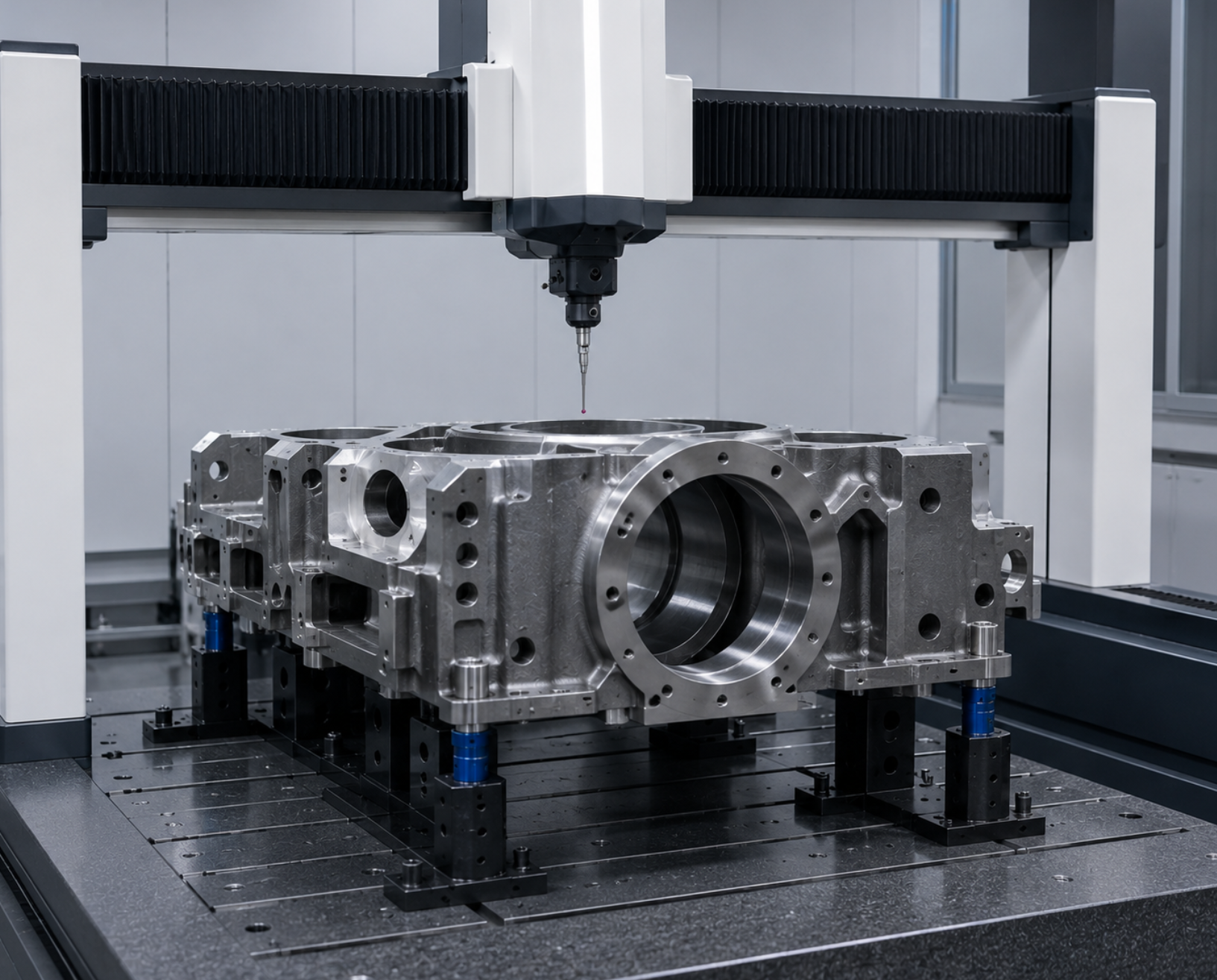
Heavy machined parts are usually large, rigid, expensive, and functionally important. They may include bearing bores, long datum faces, mounting holes, sealing surfaces, flange faces, precision slots, hydraulic ports, guide surfaces, and large machined planes. These features often affect assembly, motion accuracy, sealing performance, machine stability, or load transfer.
Unlike small CNC parts, heavy components can create additional inspection challenges. The part may require crane loading, special support points, heavy fixtures, wide clearance, and stronger table load capacity. If these factors are ignored, the CMM may technically fit the part but still fail to support practical inspection.
A bridge CMM can be suitable for heavy machined parts when the machine size, load capacity, probe package, fixture method, and site conditions are properly matched to the inspection task.
2. Typical Heavy Machined Parts Inspected By Bridge CMM
Heavy machined parts can vary greatly in geometry and weight. A professional CMM recommendation should be based on drawings, CAD files, tolerance requirements, and the real loading method.
| Part Type | Inspection Focus | CMM Selection Priority |
|---|---|---|
| Cast Iron Machine Base | Flatness, guide surfaces, mounting holes, long datum planes | Large measuring range, table load, floor stability |
| Heavy Gearbox Housing | Bearing bores, shaft center distance, sealing faces, coaxiality | Z-axis clearance, bore access, heavy fixture support |
| Hydraulic Manifold Block | Deep holes, port positions, flatness, threaded interfaces | Probe access, stylus extensions, datum alignment |
| Pump Body And Valve Body | Flanges, sealing surfaces, ports, bores, mounting faces | Table load, fixture support, GD&T software |
| Large Steel Frame | Hole position, diagonal relationship, welded distortion, surface alignment | Large X/Y range, custom support fixture, profile inspection |
| Machine Tool Component | Guideway surfaces, parallelism, perpendicularity, locating features | Accuracy level, vibration control, stable inspection room |
3. Size Selection: Measuring Range Is Not The Whole Story
Buyers often start by comparing the part length, width, and height with the CMM measuring range. This is necessary, but not enough. Heavy machined parts also need clearance for lifting tools, fixture plates, support blocks, clamps, probe head movement, stylus extensions, and safe approach paths.
| Size Factor | What To Confirm | Why It Matters |
|---|---|---|
| X/Y Measuring Range | Part length, width, fixture size and probe movement margin | Prevents the part from limiting probe travel |
| Z-Axis Range | Part height, fixture height, probe head size and stylus length | Avoids collision and allows deep feature access |
| Side Clearance | Space around the part for probe approach and loading | Improves safety and inspection efficiency |
| Future Workpieces | Expected larger parts in the next few years | Prevents the machine from becoming too small quickly |
| Room Layout | Door size, crane path, trolley access and maintenance area | Ensures the CMM can be installed and used safely |
4. Table Load Capacity And Fixture Weight
For heavy machined parts, table load capacity is a major selection factor. The total load is not only the workpiece weight. Buyers must also include fixture base plates, support blocks, locating devices, clamps and lifting accessories.
If the load is too high or unevenly distributed, it may affect machine stability, inspection safety, and long-term measurement performance. Heavy parts should be supported carefully to avoid local stress, rocking, or distortion.
Load Calculation Checklist
Maximum workpiece weight
Fixture plate and support block weight
Clamp, locating pin and auxiliary support weight
Load distribution on the granite table
Frequency of heavy part inspection
Whether the part is loaded by crane, trolley or forklift
Safety margin for future heavier components
5. Accuracy Requirements For Heavy Machined Components
Heavy parts do not always require the same tolerance as small precision parts, but their functional dimensions can be very important. Flatness, parallelism, perpendicularity, coaxiality, hole position, bore alignment, guideway relationship, and sealing face accuracy may directly affect assembly performance.
Buyers should choose CMM accuracy based on the tightest functional tolerance, customer requirement, inspection uncertainty, and acceptance standard. The quotation should clearly list machine accuracy, calibration conditions, acceptance method and environmental requirements.
| Accuracy Item | Buyer Should Confirm | Inspection Value |
|---|---|---|
| Machine Accuracy | Stated accuracy specification and acceptance condition | Shows whether the CMM can support part tolerance |
| Repeatability | Repeat measurement stability under real setup | Important for batch inspection and process monitoring |
| Calibration Certificate | Certificate scope, date, standard and measuring condition | Supports traceability and customer confidence |
| Environmental Control | Temperature, vibration, air supply and floor stability | Helps maintain accuracy during daily use |
6. Crane Loading And Inspection Room Planning
Heavy machined parts often require overhead crane loading, jib crane support, trolley loading, or forklift transfer. These loading methods must be planned before the CMM arrives. The CMM room should allow safe part movement without hitting the bridge, probe head, granite table, controller or computer station.
Installation And Loading Checklist
Can the largest part enter the inspection room?
Is there enough crane hook height above the CMM?
Can the part be lowered onto the table without collision?
Is the floor strong enough for the machine and heavy workpieces?
Is vibration from nearby machining equipment controlled?
Is temperature stable enough for the required accuracy?
Is there enough space for operators, maintenance and fixture storage?
7. Fixture Design For Heavy Machined Parts
Fixture design is critical because heavy parts can be difficult to position accurately. The fixture should support the part according to functional datums and avoid unwanted stress or deformation. It should also keep critical features accessible to the probe.
For heavy housings, machine bases, manifolds and frames, the fixture may need robust support blocks, adjustable pads, locating pins, safety stops and lifting clearance. For repeat production, a dedicated fixture can improve loading speed and measurement repeatability.
Heavy Part Fixture Checklist
Does the fixture follow the drawing datum structure?
Can the part be supported without rocking or tilting?
Does the fixture distribute load safely on the table?
Can the probe reach bores, holes, planes, slots and side features?
Can the part be loaded safely by crane or trolley?
Is the fixture repeatable for batch inspection?
8. Recommended Bridge CMM Configuration
A bridge CMM for heavy machined parts should be quoted as a complete inspection system. Machine size and load capacity are only the beginning. Probe system, stylus accessories, software, fixture support and after-sales service are equally important.
| Configuration Area | Recommended Focus | Buyer Benefit |
|---|---|---|
| Large Bridge CMM Body | Measuring range based on the largest part and fixture setup | Provides enough inspection volume for heavy components |
| High Table Load Capacity | Must cover part weight plus fixture weight with safety margin | Supports safe and stable measurement |
| Probe Package | Touch-trigger probe for bores, planes and holes; scanning option if profiles are required | Matches real heavy part inspection features |
| Stylus Kit | Long styli, extensions, angled styli and calibration sphere | Improves access to deep bores and side features |
| Software | CAD import, GD&T, automatic report, SPC output and profile function | Supports customer approval and process control |
| Service Support | Calibration, installation guidance, operator training and after-sales service | Reduces risk after delivery and installation |
9. What Buyers Should Provide Before Requesting A Quote
To recommend a suitable bridge CMM for heavy machined parts, the supplier needs detailed application information. A simple request for price cannot confirm the correct size, load capacity or accuracy level.
Quotation Information Checklist
Heavy machined part drawings and 3D CAD files
Maximum part length, width, height and weight
Fixture size, fixture height and fixture weight
Material: cast iron, steel, aluminum, stainless steel or other alloy
Critical dimensions, tolerance requirements and GD&T items
Measured features: bores, holes, planes, profiles, slots, ports, sealing faces and datum surfaces
Loading method: crane, trolley, forklift or manual assist
Inspection purpose: first article, batch inspection, final inspection or customer approval
Installation room size, floor condition, temperature control and vibration condition
Required report format, software functions, destination country and service expectations
10. Common Mistakes To Avoid
Choosing CMM size only by part outside dimensions.
Ignoring fixture weight when checking table load capacity.
Not planning crane loading, trolley access and room clearance before purchase.
Underestimating Z-axis height for tall parts, fixtures and probe movement.
Using unstable support fixtures that change the part position.
Ignoring vibration, floor stability and temperature control in the inspection room.
Comparing only machine price instead of complete configuration and service support.
Requesting quotation without drawings, CAD files, part weight and loading method.
Conclusion
A bridge CMM for heavy machined parts must be selected carefully around size, load and accuracy. Buyers should consider maximum workpiece size, total fixture weight, table load capacity, X/Y/Z measuring range, crane loading method, probe access, fixture support, floor stability, vibration control, temperature condition, calibration certificate and after-sales service.
By providing drawings, CAD files, part size, part weight, tolerance requirements, measured features, fixture method and installation conditions before quotation, buyers can receive a more practical CMM recommendation for heavy industrial part inspection.
FAQ
1. Why is table load capacity important for heavy machined parts?
The CMM table must support the workpiece plus fixture weight safely. If the load is too high or unevenly distributed, it may affect safety, stability and measurement performance.
2. Is a larger CMM always better for heavy parts?
Not always. A larger CMM provides more measuring volume, but buyers must also consider accuracy, load capacity, room space, installation condition, loading method and budget.
3. What site conditions affect CMM accuracy?
Temperature stability, vibration, floor condition, air supply, machine leveling, room cleanliness and loading method can all affect measurement stability.
4. What should buyers send before requesting a quote?
Buyers should send drawings, CAD files, maximum part size, part weight, fixture weight, tolerance requirements, measured features, loading method, installation room condition and destination country.
Need A Bridge CMM For Heavy Machined Parts?
Send us your heavy part drawings, CAD files, size, weight, fixture plan, tolerance requirements, loading method and installation conditions. We can help evaluate a suitable bridge CMM configuration for your heavy machined part inspection project.
Contact Us Request Quote