


CMM Machine For Bearing Seat Bore And Coaxiality Inspection
2026-06-26 16:34CMM Machine For Bearing Seat Bore And Coaxiality Inspection
Bearing seat bore and coaxiality inspection are critical for many precision components used in automotive parts, gearbox housings, EV motor housings, transmission housings, pump bodies, reducer housings, motor end covers, CNC machined parts, and industrial mechanical assemblies. If the bearing seat bore diameter, roundness, cylindricity, axis position, or coaxiality is not controlled correctly, the final assembly may suffer from vibration, noise, abnormal wear, poor rotation stability, leakage, or shortened service life. A CMM machine helps manufacturers inspect bearing bores and bore axis relationships accurately, generate traceable reports, and reduce quality risk before assembly or shipment.
Quick Answer
A CMM machine for bearing seat bore and coaxiality inspection should be selected according to part size, bore diameter, bore depth, tolerance level, datum structure, probe access, stylus length, fixture repeatability, GD&T software, report format, and calibration requirements. The right CMM solution helps inspect bore diameter, roundness, cylindricity, coaxiality, parallelism, shaft center distance, and datum-based bore position accurately.
1. Why Bearing Seat Bore Inspection Matters
Bearing seat bores are functional features that directly affect bearing fit and shaft support. A bearing seat may look correct visually, but small deviations in bore diameter, roundness, cylindricity, or bore axis position can affect the whole assembly. When the bore is too large, the bearing may become loose. When the bore is too small, assembly may become difficult or cause stress. When bore form or axis alignment is poor, rotation may become unstable.
For gearbox housings, EV motor housings, transmission housings, pump bodies, reducer housings, and precision machined components, bearing seat inspection is not only a dimensional check. It is a functional quality control step that helps prevent vibration, abnormal noise, heat, leakage, bearing wear, shaft misalignment, and assembly failure.
A CMM machine can measure the bore geometry and its relationship with other datums more systematically than simple manual tools. This is especially important when the drawing includes GD&T requirements such as coaxiality, cylindricity, position, perpendicularity, parallelism, or runout.
2. Parts That Often Need Bearing Bore And Coaxiality Inspection
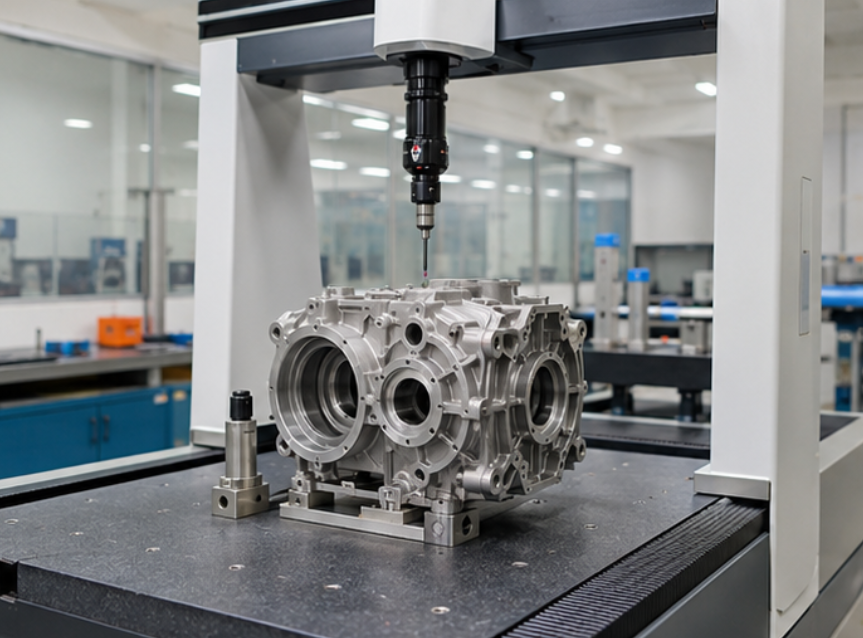
Different industrial parts require different bore inspection strategies. Some parts only need bore diameter and position checks, while others require multiple bore axis relationships, coaxiality, cylindricity, and shaft center distance inspection.
| Part Type | Inspection Focus | CMM Configuration Priority |
|---|---|---|
| EV Motor Housing | Bearing seat bore, coaxiality, end face flatness, mounting hole position | Bore access, GD&T software, fixture repeatability |
| Gearbox Housing | Multiple bores, shaft center distance, bore alignment, sealing face | Larger measuring range, stable fixture, stylus extension |
| Transmission Housing | Bearing bore diameter, coaxiality, datum relationship, hole patterns | Datum-based alignment and automatic report output |
| Pump Body | Shaft bore, sealing surface, flange holes, port alignment | Probe reach, fixture support, flatness and bore inspection |
| Motor End Cover | Bearing seat bore, end face, mounting holes, concentric features | High repeatability and suitable stylus package |
3. What CMM Should Measure On Bearing Seat Bores
Bearing bore inspection should not only check one diameter value. A complete inspection plan should evaluate bore size, bore form, bore axis, relationship to datums, and relationship to other bores or mounting features.
| Inspection Item | Why It Matters | CMM Measurement Focus |
|---|---|---|
| Bore Diameter | Controls bearing fit and assembly force | Multiple section diameter measurement |
| Roundness | Affects bearing contact and rotation stability | Circular measurement at different bore depths |
| Cylindricity | Shows full bore form quality along bore depth | Multi-level bore data and form evaluation |
| Coaxiality | Affects shaft alignment and vibration control | Bore axis relationship based on datum reference |
| Bore Position | Controls assembly with mating components | Datum-based position tolerance evaluation |
| Perpendicularity To End Face | Controls bearing and shaft axis relationship with mounting face | Axis-to-plane GD&T measurement |
4. Why Coaxiality Inspection Is More Than Measuring One Bore
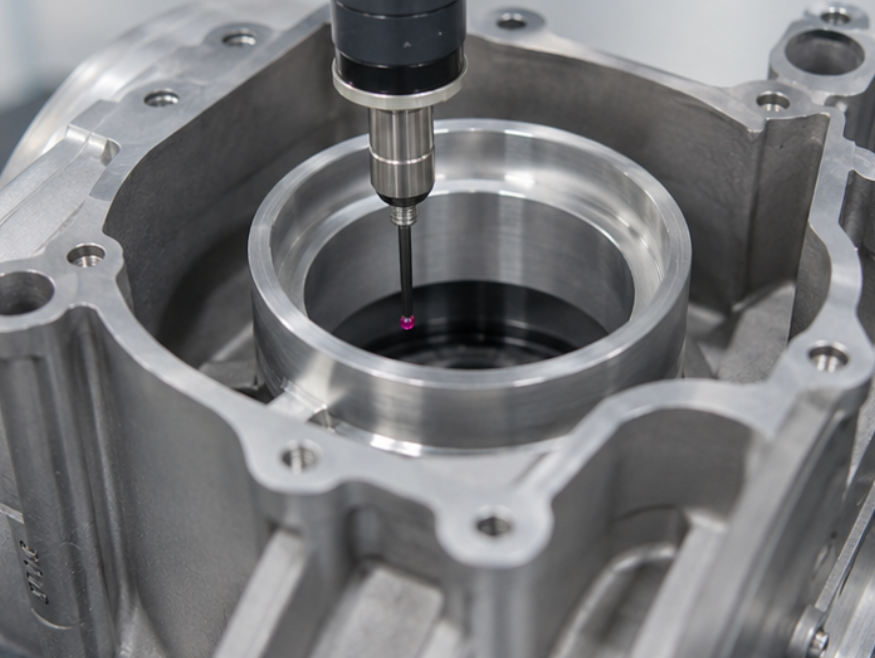
Coaxiality inspection checks whether two or more cylindrical features share the required axis relationship. In bearing seat applications, this is important because the shaft, bearing, cover, and housing must work together. A bore may pass diameter inspection but still fail because the bore axis is shifted, tilted, or not aligned with another functional datum.
A CMM can build the bore axis from measured points and compare that axis with another bore axis or datum reference. This makes it useful for gearbox housings, motor housings, pump bodies, and any component where rotating parts depend on accurate alignment.
Coaxiality Inspection Checklist
Which bore or datum is used as the reference?
Are there multiple bearing seats on the same shaft line?
Does the drawing require coaxiality, concentricity, position, or runout?
Should the bore be measured at multiple depths?
Is the stylus long and stable enough for the bore depth?
Can the fixture hold the part without changing bore alignment?
5. Probe And Stylus Selection For Deep Bore Inspection
Bearing bores may be deep, narrow, or located inside complex housing structures. The probe must reach the required measurement points without collision and without excessive stylus deflection. If the stylus is too long or not rigid enough, measurement repeatability may be affected.
Buyers should confirm probe head type, stylus length, stylus ball diameter, extension bars, star styli, angled styli, and calibration method before purchasing a CMM for bearing bore inspection.
| Probe Item | What Buyers Should Confirm | Inspection Benefit |
|---|---|---|
| Probe Head | Fixed, manual, or motorized probe head | Affects access to different bore directions |
| Stylus Ball Size | Suitable diameter for bore size and feature access | Improves contact accuracy and access to small features |
| Stylus Length | Long enough for bore depth but rigid enough for tolerance | Supports deeper bore inspection with better repeatability |
| Extension Bars | Required for deep or hidden bearing seats | Allows access to internal housing features |
| Calibration Sphere | Included size, base, and qualification procedure | Ensures each stylus setup is properly qualified |
6. Fixture Design For Bearing Bore Measurement
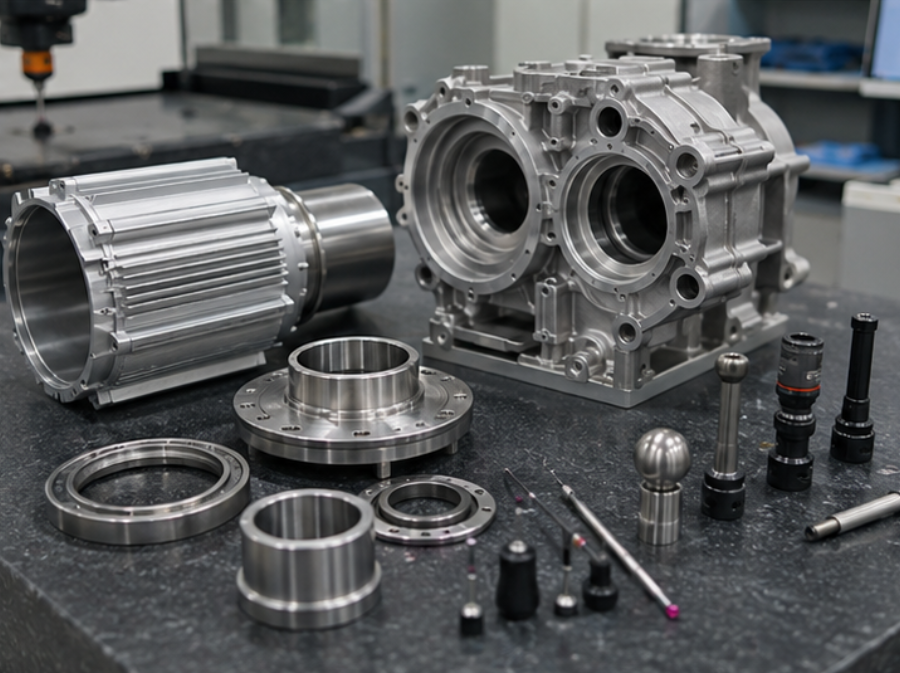
Fixture design is very important for bearing seat bore and coaxiality inspection. If the part is tilted, unstable, or over-clamped, the measured bore axis may not represent the real assembly condition. The fixture should follow the drawing datum structure and support the part without deformation.
For thin-wall aluminum housings, fixture force should be controlled carefully. For heavy gearbox housings or pump bodies, the fixture should provide stable support and enough probe clearance. For batch production, repeatable loading is also important.
Fixture Questions To Confirm
Does the fixture follow the drawing datum structure?
Can the part be loaded repeatedly in the same position?
Does the fixture avoid deformation near the bearing bore?
Can the probe reach the bore at required depths?
Is the part inspected in free state or assembly-like state?
Is the fixture suitable for first article or batch inspection?
7. What Should Be Included In The CMM Report?
A bearing bore and coaxiality inspection report should clearly show whether the part meets the functional requirements of the drawing. The report should not only state pass or fail. It should show enough data for quality engineers to understand bore condition and process stability.
Recommended Report Content
Part name, part number, drawing number, and revision
Bore nominal diameter, measured diameter, tolerance, and deviation
Roundness, cylindricity, and multi-section bore data if required
Coaxiality, position, perpendicularity, or runout result according to drawing
Datum reference and alignment strategy
Probe setup, stylus information, and inspection program information
Pass/fail result, inspection date, operator, and machine information
SPC output if batch production monitoring is required
8. What Buyers Should Provide Before Requesting A Quote
To recommend a suitable CMM machine for bearing seat bore and coaxiality inspection, the supplier needs real part and inspection information. A general request for “CMM price” is not enough to confirm the correct machine, probe package, software, and fixture solution.
Quotation Information Checklist
Part drawings and CAD files
Maximum part length, width, height, and weight
Bearing bore diameter, bore depth, and tolerance requirements
GD&T items such as coaxiality, position, perpendicularity, cylindricity, or runout
Datum reference and assembly function of the bore
Measured features: bearing seats, shaft bores, end faces, mounting holes, and sealing faces
Fixture height, clamping method, and loading method
Inspection purpose: FAI, batch inspection, final inspection, export inspection, or customer approval
Required probe package, software report, SPC output, and destination country
9. Common Mistakes To Avoid
Checking only one bore diameter but ignoring roundness, cylindricity, and axis relationship.
Ignoring coaxiality or datum requirements on the drawing.
Using a stylus that is too long or unstable for deep bore inspection.
Choosing a CMM without considering fixture height and probe clearance.
Over-clamping aluminum housings and changing the bore condition during measurement.
Buying software that cannot support required GD&T reports.
Requesting quotation without bore drawings, CAD files, or tolerance data.
Comparing only machine price instead of the full inspection solution.
Conclusion
Bearing seat bore and coaxiality inspection require more than simple diameter measurement. A suitable CMM machine should help inspect bore diameter, roundness, cylindricity, bore position, coaxiality, perpendicularity, runout, datum relationship, and shaft center alignment according to the drawing. The right solution should include proper measuring range, stable accuracy, suitable probe package, rigid stylus setup, repeatable fixture support, GD&T software, automatic report output, calibration certificate, training, and after-sales service. By providing drawings, CAD files, bore tolerance data, and inspection workflow before quotation, buyers can receive a more practical CMM recommendation for bearing bore quality control.
FAQ
1. Can a CMM measure bearing seat bore diameter?
Yes. A CMM can measure bore diameter at different sections and help evaluate bore position, roundness, cylindricity, and related GD&T requirements when configured correctly.
2. Why is coaxiality inspection important?
Coaxiality affects shaft alignment, bearing performance, vibration, noise, and assembly stability. A bore may pass diameter inspection but still fail if the bore axis is not aligned correctly.
3. What probe setup is needed for deep bore inspection?
Deep bore inspection may require suitable stylus length, rigid extension bars, proper ball size, probe qualification, and enough machine clearance to avoid collision and reduce measurement variation.
4. What should buyers send before requesting a quote?
Buyers should send drawings, CAD files, bore diameter, bore depth, tolerance requirements, GD&T items, part size, fixture method, inspection purpose, report needs, and destination country.
Need A CMM For Bearing Seat Bore And Coaxiality Inspection?
Send us your part drawings, CAD files, bore diameter, bore depth, tolerance requirements, GD&T items, and inspection workflow. We can help evaluate a suitable CMM configuration for your bearing bore quality control project.
Related Innovameld Measurement Pages
For buyers comparing bridge CMM systems, probes, image measuring instruments and factory inspection workflows, these related Innovameld pages help connect the article topic with real product categories and consultation paths on the same website.
- Coordinate Measuring Machine
- Probe
- Measuring Machine
- Products
- Product Page Two
- The CMM Bridge Machine
- Image Measuring Instrument
- Contact Innovameld
Additional Buyer Review Points
Before sending an inquiry, prepare the measuring range, part drawings, tolerance grade, workshop temperature condition, probe requirement, software language, installation space and expected inspection rhythm. This information lets Innovameld recommend a practical coordinate measuring machine configuration instead of a generic quotation.
If the inspected parts include machined housings, molds, precision fixtures, shafts or complex castings, combine machine accuracy, fixture access and operator training in the same review. A clearer inquiry usually leads to a more suitable CMM proposal, faster technical confirmation and better long term inspection stability.