



China CMM Supplier For Overseas Industrial Inspection Projects
2026-06-16 17:32China CMM Supplier For Overseas Industrial Inspection Projects
Overseas industrial buyers need a reliable CMM supplier that can provide more than a standard machine quotation. Coordinate measuring machines are widely used for CNC machined parts, automotive components, aluminum die castings, EV motor housings, aerospace brackets, mold inserts, tooling parts, and precision industrial assemblies. For export projects, buyers must confirm machine accuracy, measuring range, probe package, software functions, fixture support, calibration, export packaging, installation guidance, training, and after-sales service before placing an order. A suitable China CMM supplier should help buyers build a practical inspection solution for real production and quality control needs.
Quick Answer
When choosing a China CMM supplier for overseas industrial inspection projects, buyers should compare machine structure, measuring range, accuracy, probe system, GD&T software, fixture options, calibration documents, export packaging, installation support, training, warranty, and service response. The supplier should review real part drawings, CAD files, tolerances, measured features, and inspection workflow before recommending a machine configuration.
1. Why Overseas Buyers Need A Complete CMM Solution
For overseas industrial inspection projects, buying a CMM is not only about purchasing a machine body. The machine must support real inspection tasks after delivery. If the measuring range is too small, the probe package is incomplete, the software cannot generate required reports, or installation support is unclear, the buyer may face extra cost and delayed production after the machine arrives.
Industrial buyers often inspect complex parts with strict tolerances and GD&T requirements. These parts may include bores, hole patterns, datum planes, sealing faces, curved profiles, slots, side features, and large structural components. A professional CMM supplier should understand these application details before recommending a machine.
A complete CMM solution should include machine configuration, probe selection, software capability, fixture strategy, calibration, training, and service support. This is especially important for overseas buyers who need stable inspection performance without easy access to local technical support.
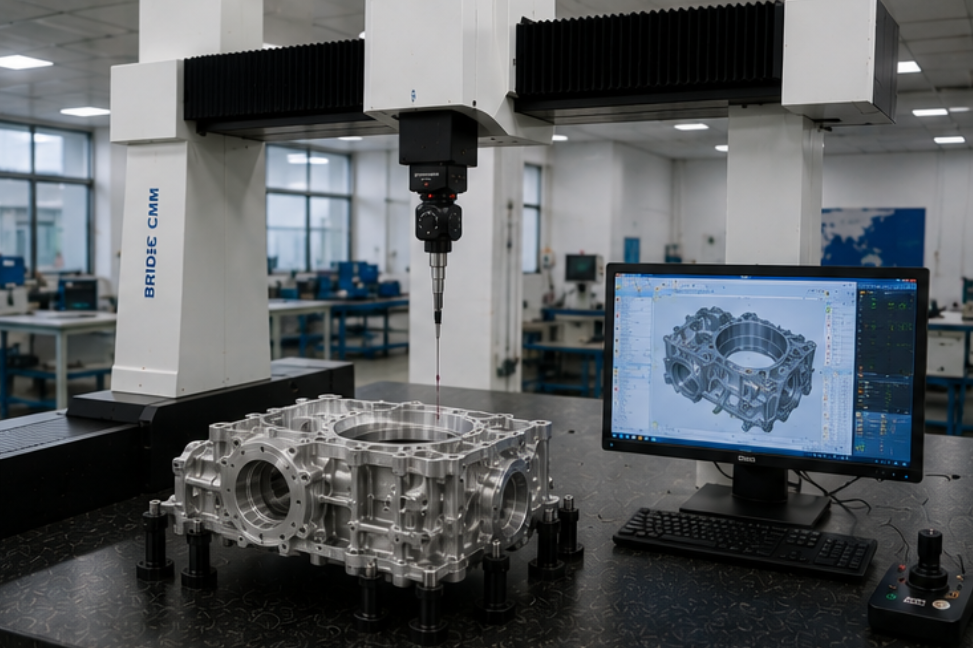
2. Industrial Applications A China CMM Supplier Should Support
Different industries require different CMM configurations. Before quotation, the supplier should confirm the buyer’s part type, tolerance level, inspection purpose, and reporting requirements.
| Application | Inspection Focus | CMM Selection Priority |
|---|---|---|
| CNC Machined Parts | Hole position, bores, flatness, slots, datum surfaces | Probe access, GD&T software, repeatable fixture support |
| Automotive Components | Bore alignment, mounting holes, sealing faces, batch stability | Automatic reports, SPC output, PPAP support |
| Aluminum Die Castings | Casting deformation, machined bores, profiles, datum planes | Fixture design, probe reach, CAD comparison |
| EV Components | Motor housing bores, battery tray flatness, mounting interfaces | Measuring range, GD&T, large-part support |
| Mold Inserts And Tooling | Profiles, steps, slots, small tolerances, form features | Accuracy, stylus selection, scanning option |
3. What Overseas Buyers Should Compare First
Many buyers compare CMM suppliers only by price. This can create risk because two quotations may include very different configurations. One quotation may include only the basic machine and software, while another may include probe accessories, calibration tools, report modules, export packaging, installation support, and training.
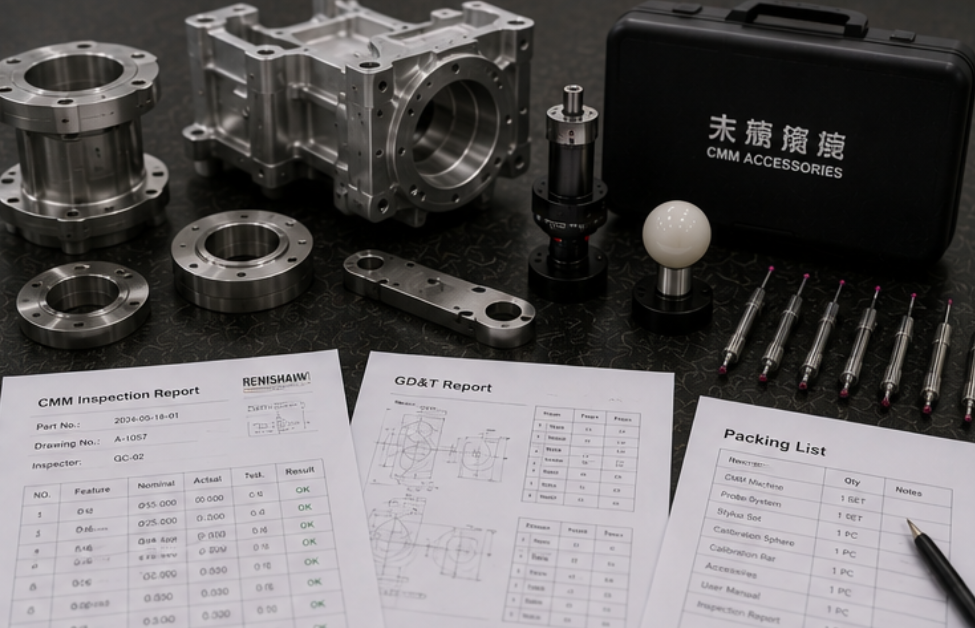
Supplier Comparison Checklist
Does the supplier review drawings and CAD files before quotation?
Is the CMM model, measuring range, and accuracy clearly listed?
Is the probe package complete and suitable for the measured features?
Does the software support CAD import, GD&T, reports, and SPC output?
Are fixture options included, optional, or excluded?
Are calibration certificate and acceptance testing documents provided?
Is export packaging suitable for long-distance transportation?
Are installation guidance, training, warranty, and service response clear?
4. Machine Configuration For Overseas Industrial Projects
A CMM for overseas industrial projects should be configured according to the buyer’s real inspection environment. The supplier should consider part size, fixture height, probe clearance, tolerance level, measured features, operator skill level, and required report format.
| Configuration Area | What Should Be Confirmed | Why It Matters |
|---|---|---|
| Machine Type | Bridge CMM, shop-floor CMM, large-size CMM, or custom solution | Ensures the machine matches the inspection environment |
| Measuring Range | X/Y/Z travel, usable working volume, fixture space | Prevents size limitation after delivery |
| Accuracy | Machine accuracy, repeatability, calibration condition | Determines whether the machine can verify required tolerance |
| Probe System | Touch probe, scanning probe, stylus kit, probe changer | Controls what features can be measured accurately |
| Software | CAD import, GD&T evaluation, automatic report, SPC output | Supports customer approval and quality traceability |
5. Export Packaging And Delivery Support Are Critical
For overseas projects, export packaging is not a small detail. A CMM is precision equipment, so the machine body, granite table, controller, computer, probe system, accessories, calibration tools, and documents must be protected during transportation. Poor packaging may cause damage, accuracy problems, delayed installation, or customer disputes after arrival.
A reliable China CMM supplier should provide export-grade packaging, packing photos, shipping dimensions, gross weight, packing list, commercial invoice, calibration documents, manuals, and installation instructions. Delivery terms such as EXW, FOB, CIF, or DAP should be clearly written in the quotation.
Export Support Checklist
Export-grade wooden case or protective packaging
Moisture protection, shock protection, and accessory protection
Packing list, commercial invoice, and shipping documents
Calibration certificate and factory acceptance report
Pre-shipment photos and video if required
Clear Incoterms and delivery responsibility
Remote installation support documents and videos
6. Installation, Training And After-Sales Service
After the CMM arrives, buyers still need installation, leveling, software setup, probe qualification, calibration verification, operator training, and maintenance guidance. Overseas buyers should confirm whether the supplier provides remote installation support, video guidance, English manuals, software training, and troubleshooting response.
Service support is especially important when the machine is used for customer approval, batch production, or export inspection. If operators do not understand how to build programs, qualify probes, align parts, or generate reports, the machine may not deliver the expected value even if the hardware is correct.
| Service Item | What Buyers Should Confirm |
|---|---|
| Installation Support | Remote video guidance, installation manual, leveling instructions |
| Calibration Verification | Calibration certificate, acceptance test, probe qualification support |
| Operator Training | Machine operation, software, report generation, basic maintenance |
| Software Support | Program setup, GD&T report, CAD import, data output guidance |
| After-Sales Response | Warranty, spare parts, response time, technical communication channel |
7. What Buyers Should Provide Before Requesting A Quote
To receive an accurate CMM recommendation, overseas industrial buyers should provide complete project information. A simple request for “China CMM price” may lead to a basic quotation that does not match real inspection needs.
Quotation Information Checklist
Part drawings and CAD files
Maximum part length, width, height, and weight
Material, production process, and surface condition
Critical dimensions, tolerance requirements, and GD&T items
Measured features: holes, bores, planes, profiles, slots, and side features
Inspection purpose: FAI, batch inspection, final inspection, export inspection, or customer approval
Required probe package, fixture support, software report, and SPC output
Destination country, delivery terms, installation environment, and service expectations
8. Common Mistakes To Avoid
Choosing a China CMM supplier only by the lowest price.
Requesting quotation without sending real drawings and CAD files.
Ignoring probe package, stylus kit, calibration tools, and software modules.
Selecting measuring range without considering fixture height and probe clearance.
Forgetting export packaging, documents, shipping terms, and installation support.
Assuming GD&T reports, SPC output, and CAD import are included by default.
Not confirming training, warranty, spare parts, and after-sales response.
Comparing machine bodies instead of complete inspection solutions.
Conclusion
Choosing a China CMM supplier for overseas industrial inspection projects requires more than comparing machine price. Buyers should evaluate machine configuration, measuring range, accuracy, probe system, software, fixture support, calibration, export packaging, installation guidance, training, warranty, and after-sales service. By providing part drawings, CAD files, tolerance data, measured features, and project requirements before quotation, overseas buyers can receive a more practical CMM solution and build a reliable inspection workflow for long-term quality control.
Need A China CMM Supplier For Your Inspection Project?
Send us your part drawings, CAD files, tolerance requirements, measured features, destination country, and inspection workflow. We can help evaluate a suitable CMM configuration for your overseas industrial inspection project.