


Bridge CMM 1000x1500x800 For Large Aluminum Housing Inspection
2026-06-22 16:11Bridge CMM 1000x1500x800 For Large Aluminum Housing Inspection
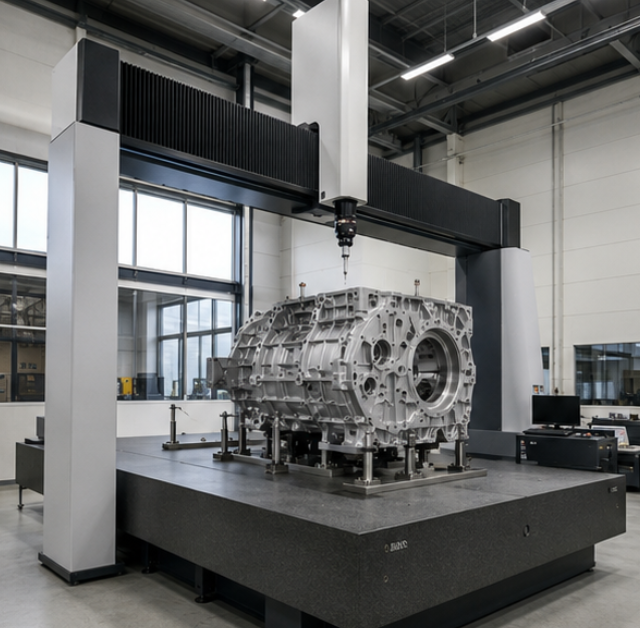
A bridge CMM 1000x1500x800 is suitable for many factories that need to inspect large aluminum housings, die-cast aluminum components, EV motor housings, gearbox housings, pump bodies, transmission housings, industrial equipment housings, and large CNC machined aluminum parts. Compared with smaller CMM models, this measuring range gives buyers more space for large workpieces, higher fixtures, longer probe access, and future part expansion. For industrial buyers, the key is not only whether the housing fits inside the machine, but whether the complete inspection setup can measure bores, sealing faces, mounting holes, datum planes, profiles, and GD&T features accurately and repeatably.
Quick Answer
A bridge CMM 1000x1500x800 is commonly considered when buyers need to inspect large aluminum housings with long length, wide structure, higher fixture setup, deep bores, large sealing faces, multiple datum planes, and complex GD&T requirements. Before quotation, buyers should confirm maximum housing size, weight, fixture height, loading method, tolerance requirements, measured features, probe access, software functions, installation environment, and report needs.
1. Why Large Aluminum Housings Need A Larger Bridge CMM
Large aluminum housings often have wide mounting surfaces, long hole patterns, deep bearing bores, sealing faces, side features, machined datum planes, ribs, thin-wall areas, and cast surfaces. These parts may be used in EV drive systems, automotive powertrain parts, industrial gearboxes, pump assemblies, machinery housings, and precision equipment structures.
Smaller CMM models may be able to measure simple medium-size parts, but large aluminum housings usually need more space. The part itself may be large, and the inspection setup may also require fixture height, locating pins, clamps, side probe access, long styli, and safe travel clearance. A 1000x1500x800 bridge CMM gives more room for this type of workpiece and can reduce the risk of buying a machine that becomes too small after delivery.
For buyers who inspect large housings regularly, choosing the right measuring range at the beginning can save future upgrade cost and reduce inspection limitations.
2. Typical Large Aluminum Housings Inspected By 1000x1500x800 CMM
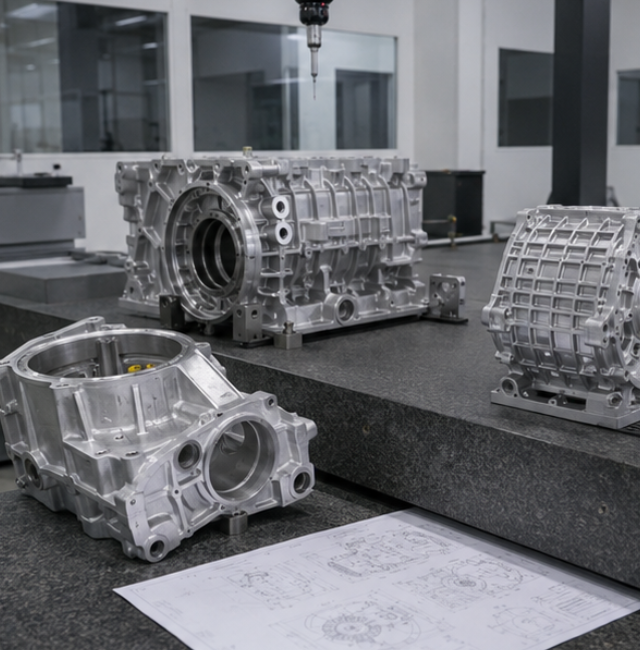
This measuring range is useful for factories that handle larger aluminum castings or CNC machined aluminum structures. The final decision still depends on the real workpiece size, fixture height, tolerance level, and inspection features.
| Housing Type | Inspection Focus | Why 1000x1500x800 May Be Suitable |
|---|---|---|
| EV Motor Housing | Bearing bores, coaxiality, end face flatness, mounting holes | Supports larger housing size, bore access, and fixture height |
| Gearbox Housing | Bore alignment, shaft center distance, sealing faces, bolt patterns | Provides larger X/Y travel for long hole patterns and multiple bores |
| Transmission Housing | Machined faces, internal bores, datum relationships, assembly interfaces | Useful for large cast aluminum parts with complex geometry |
| Pump Body And Valve Housing | Flange faces, ports, sealing surfaces, internal bore positions | Allows measurement of wide housings and multiple functional faces |
| Industrial Equipment Housing | Large datum planes, mounting interfaces, machined slots and profiles | Better for large workpieces and future product expansion |
3. Key Features To Inspect On Large Aluminum Housings
Large aluminum housings usually combine cast geometry and machined precision features. The CMM inspection plan should focus on features that affect assembly, sealing, shaft alignment, bearing fit, mounting stability, and customer approval.
| Measured Feature | Why It Matters | CMM Inspection Focus |
|---|---|---|
| Bearing Bores | Affects shaft support, bearing fit and rotating stability | Diameter, roundness, cylindricity, coaxiality |
| Mounting Hole Patterns | Affects assembly with mating parts or machine frame | Hole position, pitch, diameter and datum relationship |
| Sealing Faces | Affects leakage control and assembly contact | Flatness, profile, parallelism and surface relationship |
| Datum Planes | Controls the inspection reference and assembly reference | Datum setup, alignment strategy and repeatability |
| Cast Profiles | Shows casting deformation, shrinkage and machining allowance | Profile measurement and CAD comparison if required |
4. Why Z-Axis Height And Fixture Space Are Important
For large aluminum housing inspection, Z-axis space is often just as important as X and Y travel. A housing may not be very tall by itself, but after adding fixture base, locating pins, clamps, support blocks, and probe clearance, the actual required height can increase quickly.
The 800 mm Z-axis measuring range gives more flexibility for taller housings, vertical fixture setups, deeper bores, and probe movement above the part. This is especially useful when the part needs to be supported according to the drawing datum instead of simply lying flat on the table.
Z-Axis And Fixture Checklist
What is the maximum housing height?
How tall is the inspection fixture or support tooling?
Does the probe need to enter deep bores or internal features?
Are side holes or vertical faces included in the inspection plan?
Is there enough clearance for probe head movement?
Will the part be inspected in one position or multiple orientations?
5. Large Aluminum Housing Deformation And Fixture Control
Large aluminum housings may have thin walls, ribs, machined datums and cast surfaces. If the fixture clamps the part too tightly or supports it incorrectly, the part may deform during measurement. In this case, the CMM may measure fixture-induced deformation instead of the real free-state or assembly-state condition.
Fixture design should follow the drawing datum structure and support the part without over-clamping. For batch inspection, the fixture should also help operators load parts quickly and repeatably.
Fixture Design Points
Use datum-based location instead of random support points.
Avoid excessive clamping force on thin-wall aluminum areas.
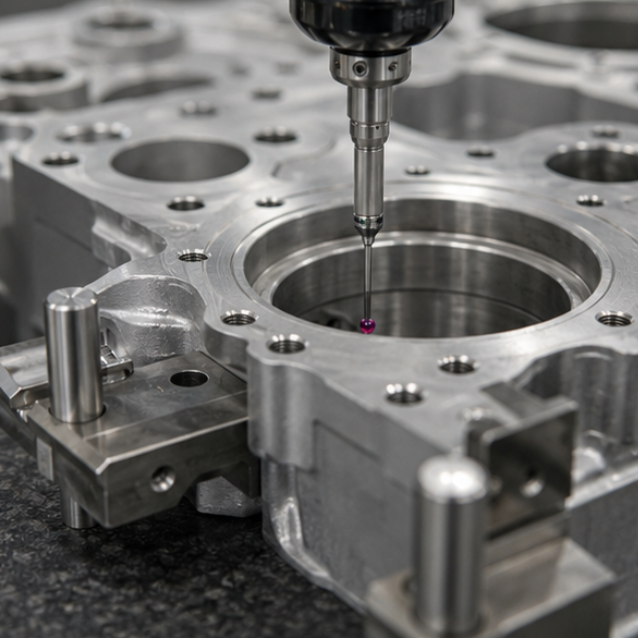
Leave enough probe access for bores, holes and sealing faces.
Use stable support blocks or locating pins for repeatable loading.
Consider part weight and crane loading if the housing is heavy.
Confirm whether a custom fixture is required before quotation.
6. Recommended Configuration For Large Aluminum Housing Inspection
A 1000x1500x800 bridge CMM should be configured according to the actual housing structure and inspection workflow. Machine size is only one part of the decision. Probe system, stylus length, software functions, fixture strategy and service support can strongly affect real usability.
| Configuration Area | Recommended Focus | Buyer Benefit |
|---|---|---|
| Machine Size | 1000x1500x800 measuring range for larger housings | Supports large workpieces, fixture space and future product expansion |
| Probe Package | Touch-trigger probe for holes, bores and planes; scanning option if profiles are required | Matches real housing inspection features |
| Stylus Accessories | Longer styli, extensions or angled styli for deep bores and side features | Improves feature access and reduces repositioning |
| Fixture | Custom or modular fixture based on datum structure | Improves repeatability and reduces deformation risk |
| Software | CAD import, GD&T, automatic report and SPC output | Supports customer approval and production quality control |
7. Installation And Loading Requirements
Larger bridge CMM models need careful installation planning. Buyers should confirm floor space, room access, temperature stability, vibration condition, compressed air, power supply, grounding and workpiece loading method before delivery.
Large aluminum housings may require trolley loading, crane loading or special handling. The loading method should be planned together with the CMM layout to prevent machine damage and improve inspection efficiency.
Installation Preparation Checklist
Inspection room size and available machine space
Loading route from workshop to CMM room
Crane, trolley or manual loading requirement
Temperature control and vibration condition
Compressed air, power supply and grounding
Operator area, computer desk and maintenance space
Calibration, installation guidance and training support
8. What Buyers Should Provide Before Requesting A Quote
To confirm whether a 1000x1500x800 bridge CMM is suitable, the supplier needs detailed information about the large aluminum housing and inspection workflow. A simple request for machine price may lead to an incomplete configuration.
Quotation Information Checklist
Large aluminum housing drawings and CAD files
Maximum part length, width, height and weight
Fixture height, clamping method and loading method
Material, casting process, machining process and surface condition
Critical dimensions, tolerance requirements and GD&T items
Measured features: bores, sealing faces, mounting holes, profiles and datum planes
Inspection purpose: sample approval, FAI, batch inspection, final inspection or export inspection
Required probe package, software functions, fixture support and report format
Destination country, installation environment and service expectations
9. Common Mistakes To Avoid
Choosing a CMM by part length only and ignoring Z-axis fixture height.
Forgetting probe clearance for deep bores and side features.
Ignoring large aluminum housing deformation during clamping.
Not planning crane or trolley loading before installation.
Buying basic software when GD&T and CAD reports are required.
Skipping fixture design for repeatable batch inspection.
Requesting a quotation without drawings, CAD files or tolerance data.
Comparing only machine price instead of the complete inspection solution.
Conclusion
A bridge CMM 1000x1500x800 is a practical choice for large aluminum housing inspection when buyers need more measuring space, higher fixture clearance, deeper feature access and future part capacity. It can support inspection of EV motor housings, gearbox housings, transmission housings, pump bodies, valve housings and large industrial aluminum structures. To choose the right solution, buyers should confirm part size, weight, fixture height, probe access, tolerance requirements, software functions, installation conditions and service support before requesting a quotation.
FAQ
1. What does 1000x1500x800 mean for a bridge CMM?
It usually refers to the nominal X/Y/Z measuring range. Buyers should still confirm usable measuring volume after considering fixture height, probe head size, stylus length and safe movement clearance.
2. Is this size suitable for all large aluminum housings?
Not always. It depends on housing length, width, height, weight, fixture method, probe access, measured features and future part plans.
3. Why is fixture design important for aluminum housing inspection?
Large aluminum housings may deform if they are clamped incorrectly. A proper fixture supports the part according to datum structure and improves repeatable inspection.
4. What information should buyers send before requesting a quote?
Buyers should send drawings, CAD files, maximum housing size, weight, tolerance requirements, measured features, fixture method, loading method, software needs and destination country.
Need A Bridge CMM 1000x1500x800 For Large Aluminum Housing Inspection?
Send us your large aluminum housing drawings, CAD files, part size, weight, tolerance requirements and inspection workflow. We can help evaluate whether a 1000x1500x800 bridge CMM is suitable for your project.
Related Innovameld Measurement Pages
For buyers comparing bridge CMM systems, probes, image measuring instruments and factory inspection workflows, these related Innovameld pages help connect the article topic with real product categories and consultation paths on the same website.
- Coordinate Measuring Machine
- Probe
- Measuring Machine
- Products
- Product Page Two
- The CMM Bridge Machine
- Image Measuring Instrument
- Contact Innovameld
Additional Buyer Review Points
Before sending an inquiry, prepare the measuring range, part drawings, tolerance grade, workshop temperature condition, probe requirement, software language, installation space and expected inspection rhythm. This information lets Innovameld recommend a practical coordinate measuring machine configuration instead of a generic quotation.
If the inspected parts include machined housings, molds, precision fixtures, shafts or complex castings, combine machine accuracy, fixture access and operator training in the same review. A clearer inquiry usually leads to a more suitable CMM proposal, faster technical confirmation and better long term inspection stability.