



Clay Modeling Milling Machines
2025-12-06 01:18Clay Modeling Milling Machines: Bridging Digital Design and Physical Prototyping
In the ever-evolving landscape of design and manufacturing, where digital tools have become predominant, one traditional practice persists and thrives thanks to technological innovation: clay modeling. The clay modeling milling machine stands as a remarkable synthesis of age-old craftsmanship and cutting-edge computer-controlled precision, serving as a critical bridge between virtual concepts and tangible reality. This technology has revolutionized how designers and engineers develop and refine complex products, particularly in industries where three-dimensional form and aesthetic appeal are paramount.
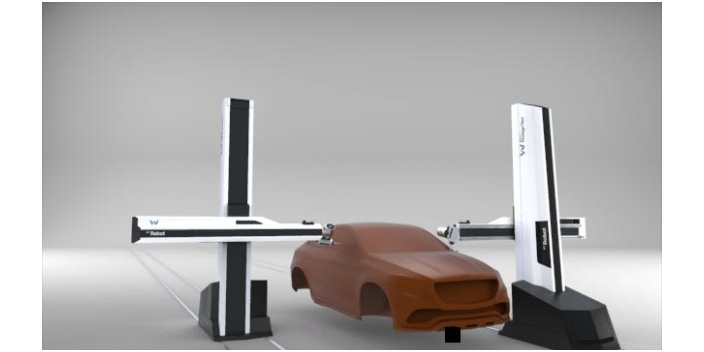
Understanding Clay Modeling Milling Machines
A clay modeling milling machine is a specialized computer numerical control (CNC) system designed to transform digital designs into physical clay prototypes with exceptional accuracy. These machines typically employ multi-axis (often five-axis) systems that can maneuver cutting tools with precision greater than 0.001 inches (0.025 mm), faithfully reproducing even the most complex contours from CAD data onto a clay surface.
The process begins with the creation of a digital model using CAD (Computer-Aided Design) software. This virtual blueprint is then converted into a set of instructions (G-code) that guides the milling machine's movements. The machine sculpts the design from a block of industrial plasticine—a specialized, oil-based modeling material that remains malleable—mounted on a stable armature or frame. What distinguishes this process is its hybrid nature: the machine handles the bulk of the rough shaping with speed and precision that would be impossible to achieve manually, after which master modelers step in to refine the surfaces by hand, infusing the model with a sense of life and fluidity that machines alone cannot achieve .
Primary Application: Automotive Design and Development
The most prominent and extensive application of clay modeling milling machines is unquestionably in the automotive industry. For nearly a century, car manufacturers have relied on full-scale clay models to evaluate and refine vehicle designs, a practice that continues in nearly every major automotive design studio today.
The value of a physical, full-size model is irreplaceable. It allows designers and engineers to assess the interplay of light and shadow across the vehicle's surfaces, study the flow of lines from every angle, and grasp proportions in a way that even the most advanced virtual reality systems cannot replicate. Designers can physically walk around the model, viewing it under different lighting conditions to evaluate how each line flows into the next, making adjustments that are perceptible only in three dimensions .
The process is both efficient and iterative. While creating a full-size model manually could take up to three months, a five-axis milling machine can produce the initial form in a fraction of the time. This acceleration allows design teams to explore more iterations. Typically, several scale models are created and evaluated before 2-3 selected designs are developed into full-size clay models for final assessment, wind tunnel testing, and modification
. Despite the significant investment—with a single full-size model costing hundreds of thousands of dollars—the industry considers it essential for achieving the high-quality aesthetics required in the competitive automotive market .
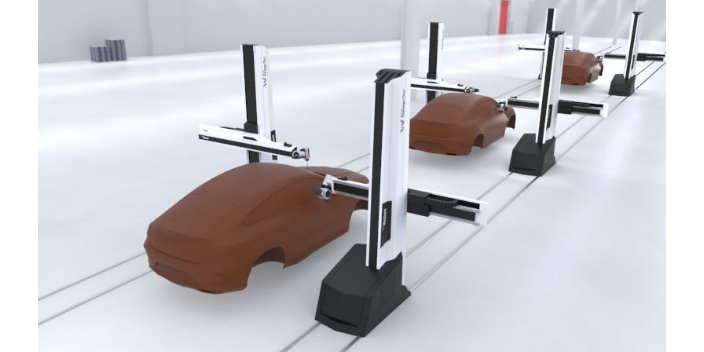
Expanding Applications in Other Industries
While automotive design remains the core application, the unique benefits of this technology are being adopted in other fields that require the development of complex, ergonomic, or artistically sensitive forms.
Aerospace and Transportation
The aerospace industry utilizes similar prototyping techniques for designing both interior and exterior components. The ability to create large-scale, high-precision models is invaluable for evaluating the ergonomics of cabin layouts, the aerodynamic properties of surfaces, and the integration of complex systems within confined spaces.
Consumer Product Design
For high-end consumer goods—from electronics to sporting goods—where ergonomics and aesthetic appeal are key differentiators, clay milling allows designers to hold and feel a product prototype long before expensive production molds are made. This tactile feedback is crucial for refining products that interact directly with the human body.
Architecture and Sculpture
The technology has found a niche in architectural modeling and large-scale art installations. Milling machines can create highly detailed scale models of buildings or monumental sculptures, allowing architects and artists to visualize and adjust their creations in three dimensions before committing to final construction or fabrication. Some advanced applications even involve using robotic arms to mill large-scale facade elements or sculptures directly .
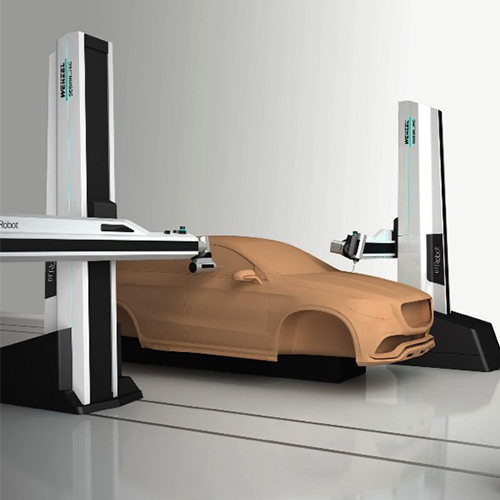
Technological Evolution and Future Trends
Clay milling technology continues to evolve, with recent advancements focusing on increasing efficiency, sustainability, and integration with other digital processes.
One significant innovation is 3D clay printing. Companies like Kolb have developed technology that 3D-prints clay onto an armature before the milling stage. This approach applies clay more efficiently, reduces material waste (saving both clay and milling time), and creates a fully recyclable model without the need for a traditional foam core, making the process more sustainable.
Furthermore, the pursuit of speed remains a focus. Newer generation milling robots and machines boast significantly faster operating speeds, with some capable of movements up to 40 meters per minute. This acceleration compresses the design loop, allowing designers to move more quickly from a digital idea to a physical prototype and back to digital refinement.
In conclusion, the clay modeling milling machine is a pivotal technology that masterfully connects the digital and physical worlds of design. By providing an unparalleled capacity to visualize, evaluate, and refine complex forms in real space, it has secured an indispensable role in automotive design and is increasingly valuable across diverse industries. As the technology evolves to become faster, more efficient, and more integrated with additive processes, its power to shape the objects of our world—from the cars we drive to the spaces we inhabit—will only grow more profound.
Related product and article resources
For procurement comparison and technical evaluation, readers can continue with these related product pages and supporting articles.
- Products
- Product catalog
- Contact the sales team
- Contact us
- 100% Inline Automatic Inspection for Automotive Body-in-White: Technology Breakdown
- 5-Axis Machining Centers: Capabilities for Complex Geometry Manufacturing
- 5 Key Features of High-End CMMs
- A Look Inside a Fully Automated Chassis Arc Welding Production Line