



Bridge CMM For Mold Inserts And Tooling Inspection
2026-06-18 17:40Bridge CMM For Mold Inserts And Tooling Inspection
Mold inserts and tooling parts require accurate dimensional inspection because small deviations can affect mold assembly, product forming accuracy, parting line fit, cavity geometry, insert replacement, and long-term production stability. These parts often include tight tolerances, complex profiles, slots, steps, datum planes, guide holes, locating features, cooling channels, sealing surfaces, and precision-machined contours. A bridge coordinate measuring machine helps mold manufacturers and tooling factories verify critical dimensions, inspect GD&T requirements, compare parts with CAD models, and generate reliable inspection reports before assembly, repair, or shipment.
Quick Answer
For mold inserts and tooling inspection, buyers should choose a bridge CMM according to part size, tolerance level, profile inspection needs, datum structure, probe access, stylus configuration, fixture repeatability, CAD comparison software, GD&T reporting, and calibration support. The right CMM solution should help inspect cavities, inserts, tooling plates, guide holes, slots, steps, and precision-machined surfaces accurately before mold assembly or delivery.
1. Why Mold Inserts And Tooling Parts Need CMM Inspection
Mold inserts and tooling components are often used as functional parts inside injection molds, die casting molds, stamping dies, forming tools, fixtures, and precision production equipment. If an insert has incorrect profile, poor flatness, wrong locating hole position, or unstable datum relationship, the final molded or formed product may show flash, mismatch, deformation, assembly problems, or dimensional instability.
Manual gauges can check simple dimensions, but mold inserts usually contain complex 3D surfaces, pockets, deep slots, small steps, guide holes, and high-precision reference features. A bridge CMM can measure these features in a more structured way and help engineers confirm whether the insert matches the drawing and CAD model.
For tooling factories, CMM inspection is useful during new mold development, first article approval, mold repair, insert replacement, pre-assembly inspection, and final quality confirmation before shipment.
2. Typical Mold And Tooling Parts Measured By Bridge CMM
Different mold and tooling parts require different probe strategies and software functions. Before choosing a CMM, buyers should define the main part family, maximum size, smallest tolerance, and inspection purpose.
| Part Type | Inspection Focus | CMM Selection Priority |
|---|---|---|
| Mold Inserts | Profile, cavity geometry, steps, slots, datum planes | Accuracy, CAD comparison, stylus access |
| Tooling Plates | Flatness, hole position, parallelism, perpendicularity | Measuring range, fixture support, GD&T software |
| Core And Cavity Blocks | Form surfaces, parting line, locating features, sealing faces | Profile inspection and CAD model comparison |
| Guide Components | Guide holes, bushings, pin positions, coaxiality | Bore measurement and datum alignment |
| Custom Fixtures And Jigs | Locating pins, support points, mounting planes, repeatability | GD&T evaluation and repeatable measurement setup |
3. Critical Features To Check On Mold Inserts And Tooling Parts
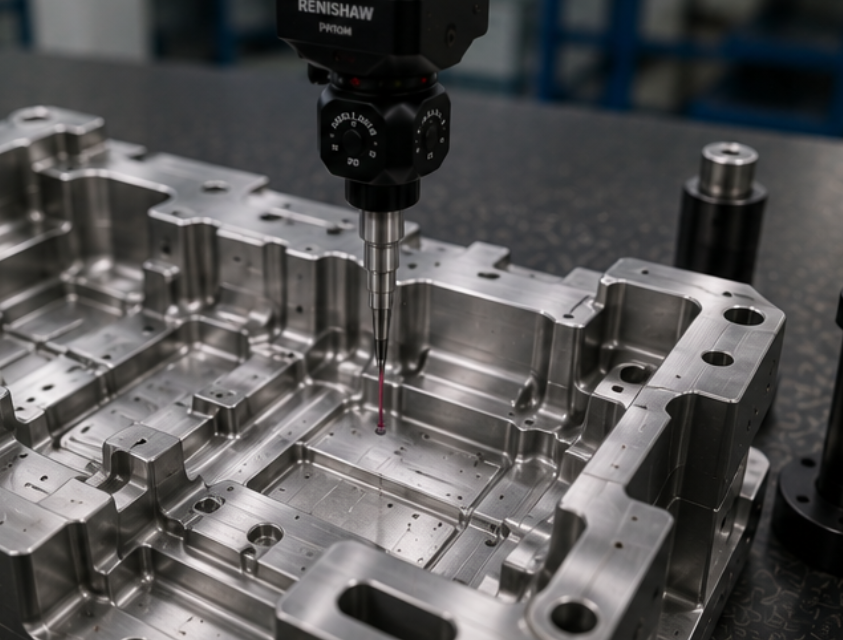
Mold and tooling inspection should focus on features that affect assembly, molding accuracy, insert replacement, and production repeatability. The inspection plan should follow the datum structure on the drawing instead of only measuring visible outside dimensions.
| Inspection Feature | Why It Matters | CMM Inspection Focus |
|---|---|---|
| Cavity Profile | Affects molded part shape and dimensional accuracy | Profile measurement, CAD comparison, scanning if required |
| Locating Holes | Controls insert position and replacement repeatability | Hole diameter, position tolerance, datum relationship |
| Parting Line Area | Influences flash, mismatch and mold closing accuracy | Flatness, profile, step height and surface relationship |
| Slots And Steps | Affects insert assembly, sliding fit and tooling function | Width, depth, position, perpendicularity and parallelism |
| Datum Planes | Controls measurement reference and mold assembly reference | Flatness, perpendicularity, datum alignment and repeatability |
| Cooling Channel Interface | Affects mold cooling connection and production stability | Hole position, sealing face, port alignment and depth |
4. Why Probe Access Is Important For Tooling Inspection
Mold inserts and tooling parts often include narrow slots, deep pockets, small holes, stepped surfaces, vertical walls, and hidden features. Even if the machine has enough accuracy, the inspection will fail if the probe cannot reach the required area safely and repeatably.
Buyers should confirm the stylus length, ball diameter, extension bars, angled styli, star styli, and probe head type before purchase. For simple tooling plates, a basic touch-trigger probe may be enough. For complex mold inserts, the factory may need special styli or scanning capability to inspect profiles and surfaces.
Probe Access Checklist
Can the probe reach deep pockets, narrow slots and internal walls?
Is the stylus ball small enough for fine features?
Is the stylus length stable enough for tight tolerances?
Are angled styli or star styli required for side features?
Is a motorized probe head needed for multi-face measurement?
Is a scanning probe required for profile or freeform surface inspection?
5. Recommended Bridge CMM Configuration For Mold And Tooling Inspection
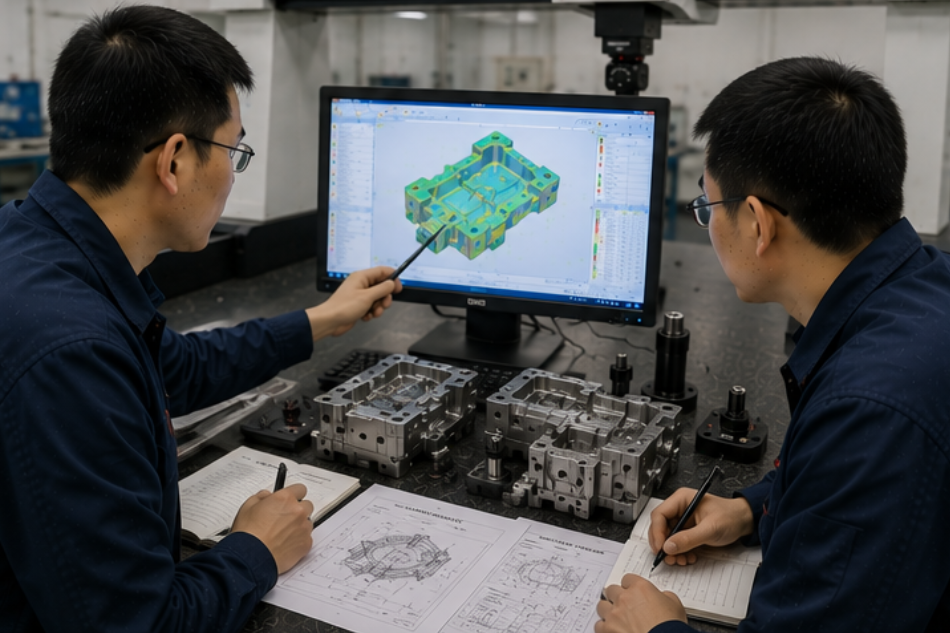
The best CMM configuration depends on mold insert size, tolerance requirements, feature depth, profile complexity and reporting needs. For many mold shops and tooling factories, a bridge CMM is suitable because it provides stable accuracy, repeatable movement and professional report capability in a quality lab.
Recommended Configuration
Machine Type: Bridge CMM for stable high-precision inspection of mold inserts and tooling parts.
Measuring Range: Selected by maximum tooling size, fixture height, probe clearance and future part families.
Probe System: Touch-trigger probe for holes, planes and standard geometry; scanning probe if profile data is required.
Stylus Package: Small ball styli, extension bars, angled styli and star styli for detailed feature access.
Fixture: Modular fixture or custom support based on datum structure and part stability.
Software: CAD import, GD&T evaluation, profile comparison, automatic reports and SPC output if required.
Service: Calibration, installation guidance, training and after-sales technical support.
6. CAD Comparison And GD&T Reports For Tooling Approval
Mold inserts and tooling parts often need more than simple dimension reports. The inspection software should support CAD import, profile comparison, datum alignment, GD&T evaluation and automatic report generation. For complex cavity geometry, CAD comparison can help engineers quickly see whether the actual part matches the design intent.
A useful report should include nominal values, measured values, deviation, tolerance, pass/fail result, datum reference, part ID, drawing number, inspection date and operator information. For mold repair or insert replacement, the report can also help compare old and new tooling components.
| Software Function | Value For Mold And Tooling Inspection |
|---|---|
| CAD Import | Supports measurement programming from 3D models |
| Profile Comparison | Checks cavity surfaces, contours and freeform geometry |
| GD&T Evaluation | Verifies position, flatness, perpendicularity, profile and datum relationships |
| Automatic Report | Reduces manual reporting and improves inspection traceability |
| Deviation Output | Helps tooling engineers identify machining or polishing correction areas |
7. What Buyers Should Provide Before Requesting A Quote
To recommend the right bridge CMM for mold inserts and tooling inspection, the supplier needs complete application information. A general request for machine price may lead to an incomplete configuration, especially when profile inspection, small feature access or CAD comparison is required.
Quotation Information Checklist
Mold insert or tooling drawings and CAD files
Maximum part length, width, height and weight
Material, machining process, heat treatment and surface condition
Critical dimensions, tolerance requirements and GD&T items
Measured features: cavities, profiles, slots, steps, holes, datum planes and side features
Need for CAD comparison, profile measurement or scanning inspection
Required stylus size, probe access and fixture method
Inspection purpose: new mold approval, insert replacement, mold repair, final inspection or export shipment
Required report format, software function, calibration and training expectations
8. Common Mistakes To Avoid
Choosing a CMM only by machine price without checking mold insert inspection needs.
Ignoring probe access for deep pockets, narrow slots and small features.
Using basic software when CAD comparison or profile inspection is required.
Selecting measuring range without considering fixture height and probe clearance.
Not confirming whether scanning probe or special styli are needed.
Measuring outside dimensions but missing cavity profile and datum relationship.
Requesting a quotation without drawings, CAD files or tolerance data.
Skipping CMM inspection before mold assembly, insert replacement or export shipment.
Conclusion
Bridge CMM inspection helps mold manufacturers and tooling factories verify mold inserts, tooling plates, cavity blocks, guide components and custom fixtures before assembly or delivery. The right solution should combine suitable measuring range, stable accuracy, proper probe access, stylus configuration, fixture support, CAD comparison software, GD&T reporting and calibration service. By providing drawings, CAD files, tolerance data, measured features and inspection workflow before quotation, buyers can receive a more practical bridge CMM recommendation for mold inserts and tooling inspection.
Need A Bridge CMM For Mold Inserts And Tooling Inspection?
Send us your mold insert drawings, CAD files, tolerance requirements, measured features and inspection workflow. We can help evaluate a suitable bridge CMM configuration for your mold and tooling quality control needs.